

The right stone supplier for builders in Ontario helps professionals match slab material, colour and dimensions to the project’s design and practical requirements. Start by defining where the material will be used, then compare options against the intended look, layout and build schedule. This gives builders and landscaping professionals a clearer basis for choosing materials for each project.
Material selection shapes both the finished appearance and the project plan. This guide explains how to assess stone options, colours and dimensions for Ontario projects, and what to prepare before selecting materials. You’ll also learn how Infinity Stone Inc.’s slab range can fit into a project’s material selection.
Key Takeaways
- Match the stone type to the project’s intended use and design before narrowing down colour and finish.
- Compare slab dimensions and specifications with the project plans to support accurate material selection.
- Plan stone requirements early, with the intended layout and schedule in mind.
- Understand how product supply differs from fabrication and on-site installation when coordinating project work.
- Explore quartz, granite, marble and porcelain slabs from Infinity Stone Inc. for projects that call for these surface materials.
Natural stone products for landscape and building professionals
Residential and commercial projects use stone in different ways. A home entry may call for a coordinated look between the threshold and garden path, while a commercial courtyard may need a consistent layout across a larger area. Start with the application, then consider exposure, foot traffic, drainage and how the stone relates to surrounding materials. Define the product format and finish before narrowing the colour choices.
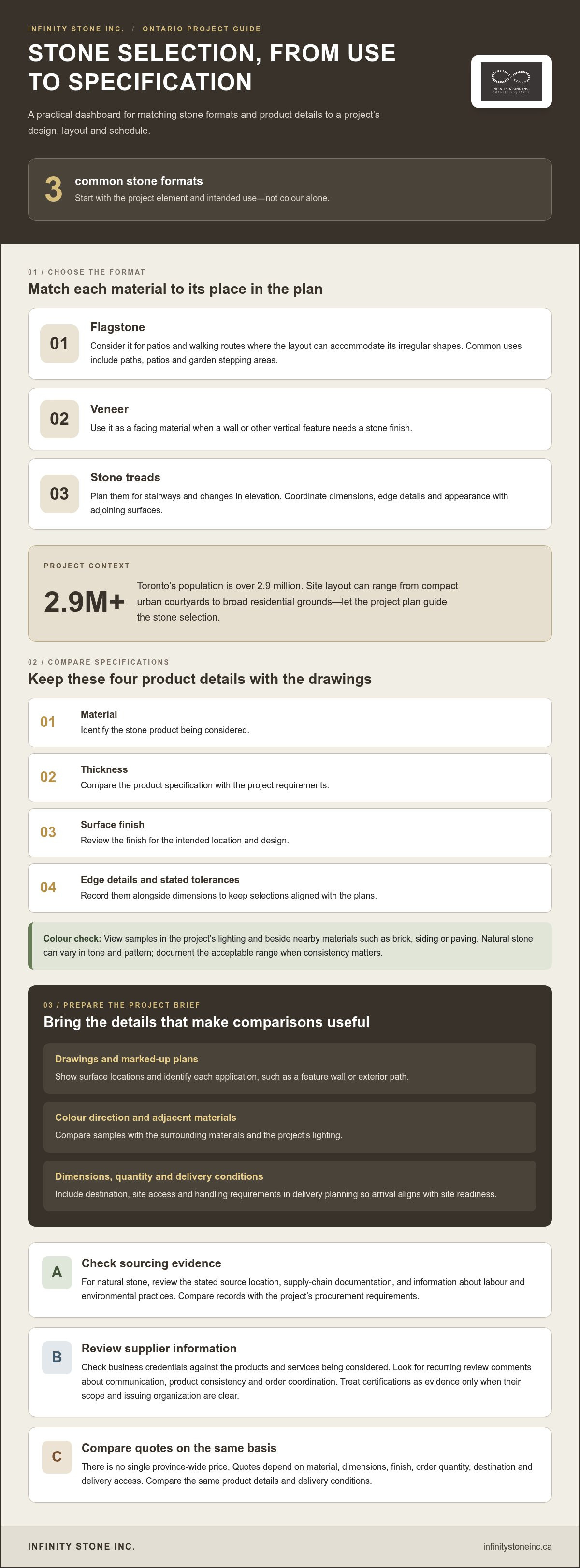
Common formats include flagstone, veneer and stone treads. Flagstone is often used for paths, patios and garden stepping areas, with irregular shapes creating a natural pattern. Stone veneer adds a stone surface to walls and other vertical features. Treads create a defined surface for steps, where dimensions and edge details affect the finished look. Identify each format’s placement and function in the plans before selecting materials.
For a practical selection process, match each stone type to a specific project element:
- Flagstone: consider it for patios and walking routes where the layout can accommodate its shape.
- Veneer: use it as a facing material when a wall or structure needs a stone finish.
- Stone treads: plan them for stairways and changes in elevation, coordinating their appearance with adjoining surfaces.
Toronto landscaping projects can range from compact urban courtyards to broad residential grounds. Toronto has a population of over 2.9 million people, making it a substantial urban setting for varied building and landscape work. For a downtown courtyard, a coordinated path and wall treatment can help define the space. In a larger property, stone choices can connect an entrance, terrace, and garden route. Site layout should guide the selection, rather than choosing a material by colour alone.
Indian natural stone may suit projects seeking distinctive geological character, but responsible sourcing decisions require attention to provenance. Review the stated source location, supply-chain documentation, and information about labour and environmental practices. Compare these records with the project’s procurement requirements. Clear documentation gives builders a sounder basis for assessing origin and sourcing standards than broad claims about a material’s ethics.
How can builders assess an Ontario stone supplier’s reputation, certifications and customer reviews? Check business credentials against the products and services being considered, then look for recurring review comments about communication, product consistency and order coordination. Treat certifications as relevant evidence only when the scope and issuing organization are clear.
A stone supplier should communicate the product format, intended application and information needed for project planning. Prepare a brief with drawings, surface locations, preferred colour direction and schedule considerations. Identifying a feature wall separately from an exterior path, for example, helps match materials to their intended uses. This structured brief supports clearer decisions for residential and commercial projects across Ontario.
Product specifications, colours, and sizes
Compare stone by intended use, dimensions, finish and colour variation. Product specifications should identify the material, thickness, surface finish, edge details and any stated tolerances. A paver layout depends on consistent dimensions, while a feature wall may prioritize colour movement and texture. Record these details alongside the project drawings to keep selections aligned with the design.
Colour can look different across a full surface than on a small sample. View samples in the project’s lighting and beside nearby materials such as brick, siding or paving. Natural stone can vary in tone and pattern, so review multiple pieces when consistency matters. Document the acceptable range of variation before ordering.
Stone inventory changes with sourcing and demand. Request product identification and written specifications for the material under consideration, and distinguish stocked items from products sourced for a specific project. Delivery planning also depends on order quantity, destination, site access and handling requirements. Include these details in the schedule so material arrival aligns with site readiness.
A showroom visit can help you compare colour, veining and finish across larger pieces than a small sample allows. Bring drawings or a marked-up plan, and note the intended application for each selection. A useful review process is to:
- Match the product type and finish to its intended location.
- Compare available samples with adjacent materials and project lighting.
- Record dimensions, colour expectations, and delivery requirements in the project documents.
Which Ontario stone suppliers provide samples, technical specifications and installation guidance? Look for stone distributors that make samples available and provide product-specific specifications and guidance for the intended application. Compare that guidance with the project’s installation requirements.
What are current wholesale and delivered prices for building stone in Ontario? There is no single province-wide price. Quotes depend on material, dimensions, finish, order quantity, destination and delivery access. Wholesale terms and freight can affect the delivered total, so compare quotes using the same product details and delivery conditions.
Do Ontario stone suppliers offer contractor or builder pricing, trade accounts or volume discounts? These are supplier-specific commercial terms, not uniform Ontario pricing rules. Order size, account arrangements and product selection can affect the terms offered.
Assess a limited lifetime product warranty by its written terms, not its headline. Review which product it covers, what conditions apply and whether installation or maintenance affects coverage. Keep the warranty document with the product specifications and project records so the scope of protection for the selected material is clear.
Service to Ontario landscapers and builders
Project support starts with clear communication about the site, materials and delivery planning. For construction and landscaping teams, sharing the site context early helps align stone selection with project stages.
Ontario and Canadian Service Areas
Service areas describe where orders can be supplied and how delivery is coordinated. Ontario projects in Toronto, Ottawa, Hamilton, or London can involve different site access, travel routes, and unloading plans. A broader Canadian service area may also involve longer-distance transport and additional coordination. Before scheduling, map the site address, access restrictions, receiving hours, and required delivery stage.
Geography affects more than the distance between a supplier and a job site. Urban sites may have limited staging space, while rural projects can require careful timing around access roads and equipment. For a Toronto renovation, confirm where stone can be received and stored. For a landscaping project outside a major centre, include site directions and unloading arrangements in the purchase plan.
Plan each order around the project sequence. Identify the delivery point, who will receive the materials and where the stone will be protected before installation. If a project has separate phases, such as an entrance followed by a terrace, coordinate order details with those milestones. This helps keep the delivery team and site staff aligned.
Sales for Builders and Contractors
Builders and contractors can make purchasing clearer with a concise project brief. Include the project location, material requirements, intended applications, drawings and delivery constraints. A residential entrance and a commercial landscape feature may require different quantities and handling plans. Clear details help suppliers respond to the actual scope rather than an incomplete product description.
For repeat work, keep consistent records across projects. Store product descriptions, approved samples, order quantities and delivery notes together. When a design changes, document the revision before ordering more material. This gives the project team a shared reference and distinguishes new requirements from the original scope.
Landscaping professionals also benefit from coordinating stone with adjacent work. A path, retaining feature and stair area may involve different trades. Share relevant drawings and sequencing information with the purchasing contact, then align material arrival with site readiness. Across Ontario’s varied project types, precise communication helps coordinate the work.
For every order, use a simple handoff checklist:
- Record the full site address and delivery access details.
- Name the receiving contact and identify the designated staging area.
- Match the order documents to the latest project drawings and schedule.
These steps give Ontario builders and landscapers a practical framework for coordinating stone supply. A Toronto commercial project, an Ottawa residential build and a rural landscaping job each have distinct access and sequencing needs. Clear scope, location and receiving instructions connect purchasing with the work on site.
Consultation and stone cut to specification
A useful stone consultation begins with the project drawings, intended application and selection priorities. For coping around a pool or garden wall, identify exposed edges, adjoining surfaces and the desired profile. These details help define the material and dimensions before procurement. They also distinguish selecting stone from the separate work of cutting or fabricating it.
Prepare a concise project brief before discussing material options. Include marked-up plans, the location of each stone element, preferred colour direction and dimensional requirements. Note whether a piece is a step, sill, wall cap or coping. Each application can affect thickness, edge treatment and how the stone meets adjacent construction.
Show dimensions clearly in drawings, using consistent units throughout. A plan might show the finished length and width of a coping piece, while an elevation clarifies its position against a wall. Include joints, overhangs and corners wherever they affect the finished layout. Clear references reduce ambiguity between the design intent and the material ordered.
Before finalizing a specification, review these project details:
- Application: identify whether the stone is for a wall, step, sill, or coping.
- Geometry: record dimensions, corners, curves, and exposed edges on the drawings.
- Appearance: note the desired colour range, texture, and relationship to nearby finishes.
- Sequence: coordinate measurements with the stage when surrounding construction is ready.
Cut-to-specification requirements need precise communication. A straight coping run differs from a corner return or curved wall, so drawings should show each condition rather than relying on a general description. For repeating pieces, label each location and distinguish standard dimensions from unique cuts. This gives the project team a clear reference for review and material planning.
Finding the right stone means comparing its character with both the design and the intended use. A restrained façade may call for a consistent visual range, while a garden wall might benefit from more visible variation. Bring reference images or samples of adjacent finishes to the discussion. Record the approved direction in the project documents to keep later decisions aligned.
Confirm what the material order covers before coordinating the work sequence. Product selection, dimensional drawings, cutting, fabrication and installation are separate project activities. Identify which documents govern each activity and share relevant updates with the responsible team. If site measurements change, revise the drawings and specifications before relying on earlier dimensions.
A well-prepared consultation defines the stone application, documents dimensions, establishes a visual direction and clarifies scope. For coping, that might mean identifying the wall location, exposed edges, corner treatment and relationship to adjoining finishes. These details make material planning more precise and help the finished stone element follow the design intent.
Which stone suppliers in Ontario sell to builders and contractors?
Ontario builders typically source stone through wholesalers, stone yards, slab distributors and landscape-supply businesses. Each serves a different purchasing need. A landscape contractor planning a garden path may need outdoor stone products, while a builder specifying an interior surface may need slabs. Start by matching the supplier’s product category to the project scope.
Then determine whether the supplier serves trade buyers and supports project-based orders. A contractor purchasing for a residential build may need product documentation, coordinated ordering and clear delivery terms. A commercial project may require consistent selections across several spaces. Review the purchasing process, order requirements and relevant product specifications before choosing.
Compare suppliers by the practical details that shape procurement, not by a broad claim of serving Ontario. Review the material categories, product formats, specifications and delivery arrangements relevant to the project. A supplier focused on landscaping materials may suit a patio plan, while a slab distributor may better fit a building surface.
A useful comparison checklist includes:
- Product fit: match the supplier’s materials and formats to the project drawings.
- Trade purchasing: understand ordering requirements for builders and contractors.
- Project coordination: align delivery arrangements with site access and construction stages.
- Documentation: keep specifications, selections, and order details with project records.
When choosing a stone supplier for builders in Ontario, consider regional service alongside product fit. A Toronto renovation, an Ottawa landscaping project and a rural build can involve different receiving arrangements. Share the project location, site access details and required delivery stage when comparing suppliers. This helps determine whether the purchasing and delivery process suits the job.
Separate product supply from related work in the project scope. A supplier may sell materials without offering cutting, fabrication or installation. For a stone feature, identify who is responsible for each step and which drawings set the dimensions. Clear scope boundaries help prevent ordering assumptions from becoming scheduling problems.
Use a short procurement brief to compare suitable suppliers consistently. Include the project type, intended application, selected material category, drawings and delivery constraints. Keep written responses with the project documents, then compare how each supplier addresses the same requirements. This gives builders and contractors a focused way to assess options across Ontario.
Explore stone selection options as you define the material scope for your next project.
Infinity Stone: Quartz Slabs
Infinity Stone Inc. supplies quartz slabs for builders and designers choosing surface materials. Its range also includes quartzite, granite, marble and porcelain slabs, giving professionals several material categories to consider. Compare each option with the intended application, design palette and project specifications. A clear selection brief can note preferred colours, dimensions and planned locations, keeping material decisions aligned with the drawings and project requirements.
Turn to Infinity Stone Inc. when your project calls for these slab materials and you’re ready to explore suitable options. Compare the available categories with your design priorities and material schedule. Visit infinitystoneinc.ca to explore the slab range.
Shape your next stone selection
Start your next project with a focused material brief: note the intended application, the look you want to achieve and the details that matter most to the design. This gives your team a clear basis for comparing options and coordinating decisions with the project plan. Choosing a stone supplier for builders in Ontario is part of connecting the selected material with the needs of the build.
Infinity Stone Inc.’s range includes quartzite, quartz and granite slabs. Consider which material best suits your project, then bring that preference into the selection process. A deliberate choice can give a room or architectural feature a distinctive foundation without complicating the design.
Contact Infinity Stone Inc. about your project to explore slab options for your plans. Your next material decision can be a confident step towards a considered, enduring design.
Frequently Asked Questions
Where are Ontario stone suppliers located, and which regions do they serve?
Ontario suppliers are based in different locations and serve different areas. Infinity Stone Inc. is based in Mississauga and focuses on Ontario. For a project elsewhere in the province, consider how the supplier’s location fits the job-site address and receiving arrangements. A stone supplier for builders in Ontario should suit the project’s delivery needs as well as its material requirements.
What types of building stone do Ontario suppliers offer, including natural stone, manufactured stone, and masonry products?
Ontario suppliers may specialize in natural stone, manufactured stone, masonry products or slabs, and their catalogues differ. Infinity Stone Inc. supplies quartzite, quartz, granite, marble and porcelain slabs. These are slab offerings, not a general masonry catalogue. A project specifying brick or manufactured veneer, for example, needs a supplier that carries that format. Match the product category to the construction detail before comparing finishes or colours.
What are minimum order quantities, delivery fees, and lead times for stone orders in Ontario?
Minimum quantities, delivery fees and lead times depend on the supplier, product, order size, destination and delivery arrangements. There is no single Ontario-wide schedule or fee for every stone order. Selected slabs may have different handling and transport needs from a larger multi-material order. Compare written order details using the same product, quantity, destination and receiving conditions.
What should builders check about stone grading, durability, freeze-thaw performance, and warranties?
Builders should review the product’s grading description, stated durability information, freeze-thaw performance documentation and written warranty terms. Check that each document applies to the specific stone and intended application rather than relying on a general product description. Outdoor paving, for example, has different exposure considerations from an interior feature. Warranty terms should identify covered products, conditions, exclusions and care requirements so the project team understands the applicable scope.


