

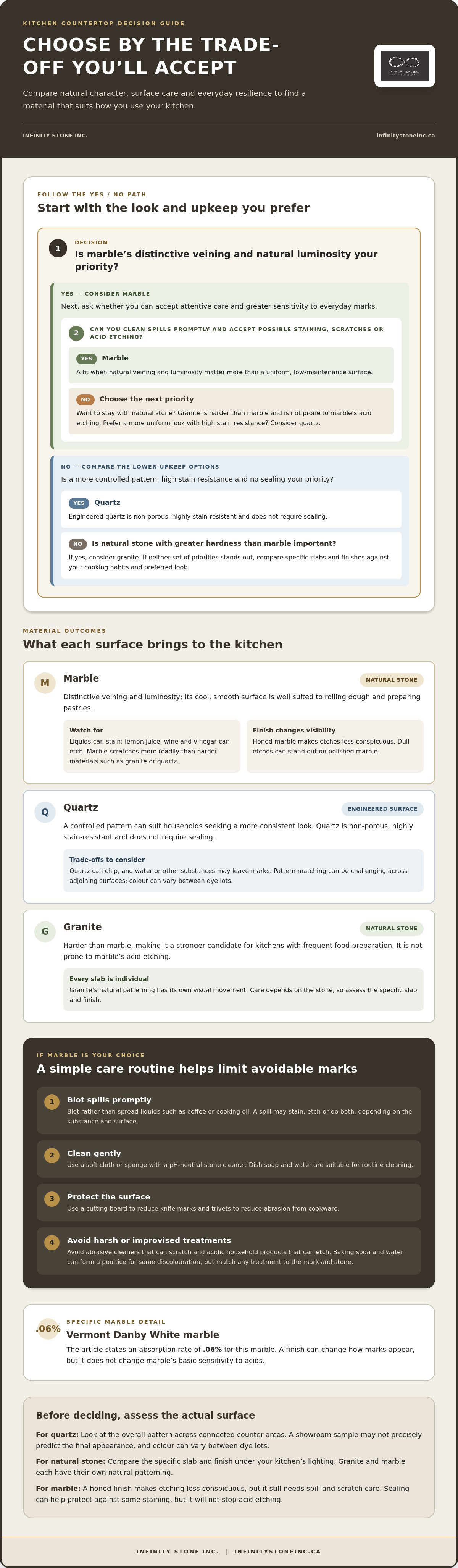
Marble isn’t automatically a bad choice for a kitchen. It’s a beautiful natural stone, but its surface is more delicate than quartz or granite. Whether marble is a bad choice for a kitchen depends on your tolerance for staining and etching: acidic spills can dull the finish, while marble’s cool, smooth surface is well suited to rolling dough and preparing pastries.
That trade-off is central to the decision. Marble’s veining and natural luminosity have distinctive appeal, but everyday cooking can leave marks that become part of the surface’s character. If you prefer a more uniform look with less upkeep, quartz or granite may better suit your routine.
This comparison explains how marble, quartz, and granite differ in staining, baking, and heat resistance, and where each material may fit best. You’ll also find practical ways to care for marble and a guide to choosing a surface that suits both your kitchen’s style and how you use it.
Key Takeaways
- Choose marble for its distinctive natural character and pastry-friendly surface, while weighing its greater sensitivity to everyday marks.
- Compare marble, quartz and granite by how each fits your cooking habits, care preferences and desired look.
- Learn why natural heat resistance doesn’t remove the need to protect a countertop from sudden temperature changes.
- Understand what sealing can help protect against, and why it won’t stop acid etching.
- See which factors shape marble maintenance and repair costs in Canada, so you can plan without relying on a one-size-fits-all estimate.
Marble staining and acid etching
Marble’s appearance comes with a surface that needs attentive care. Its pores can absorb liquids such as coffee or cooking oil, leaving stains. Acids create a different mark: lemon juice, wine, and vinegar can dull the finish through etching. Depending on the substance and the surface, a spill may cause a stain, an etch, or both.
Are some marble types or finishes more suitable for kitchens than others? Yes. A honed finish hides etches better than polished marble, while Vermont Danby White marble has a stated absorption rate of .06 %.
The finish changes how marks appear, not the stone’s basic sensitivity to acids. Polished marble reflects light, so a dull etch can stand out against its sheen. Honed marble has a softer, matte appearance that can make etching less conspicuous. Marble also scratches more readily than harder materials such as granite or quartz. Use a cutting board to protect it from knife marks and trivets to reduce abrasion from cookware.
Respond promptly to spills. Blot liquids rather than spreading them, then clean the area with a soft cloth or sponge and a pH-neutral stone cleaner. Avoid abrasive cleaners, which can scratch the finish, and acidic household products, which can etch it. Dish soap and water are suitable for routine cleaning. Persistent marks may need targeted stone care; baking soda and water can form a poultice for some discolouration. Don’t apply an improvised treatment without matching it to the mark and stone.
Is marble safe for food preparation, and are there Canadian food-safety considerations? Marble can serve as a food-preparation surface when kept clean, but use a cutting board for raw ingredients and wipe the counter after spills. Clean utensils and hands, and keep the surface free of food residue between tasks.
What should homeowners know about marble warranties and resale value in Canada? Warranty coverage depends on the written terms, so distinguish product defects from stains, scratches, and etching caused by use. For resale, visible condition and a buyer’s preference for natural patina or a more uniform surface can affect appeal; no countertop material guarantees a higher sale price.
| Option | Etch visibility | Scratch and stain considerations |
|---|---|---|
| Polished marble | Dull etches can stand out | Protect from acids and sharp tools |
| Honed marble | Etches are less conspicuous | Still needs spill and scratch care |
| Granite | Not prone to marble’s acid etching | Harder surface; care depends on stone |
| Quartz | Not natural marble | High stain resistance; no sealing required |
Choose honed marble if its softer finish suits your kitchen and you can clean spills promptly. Choose quartz or granite if lower sensitivity to stains and scratches matters more.
Comparisons with quartz and granite
Marble, quartz, and granite balance natural character, care, and everyday resilience differently. Compare each surface with your cooking habits, not just its appearance.
Marble and Quartz
Marble is natural stone, valued for its distinctive veining and luminosity. Engineered quartz offers a more controlled pattern, though it may not reproduce marble’s natural depth. Quartz is non-porous, highly stain-resistant, and doesn’t require sealing. These qualities suit households seeking a more consistent surface with less routine maintenance.
Quartz still has trade-offs. It can chip, and water or other substances may leave marks. Matching patterns can also be challenging, especially across adjoining surfaces. Colour may vary between dye lots, so a showroom sample may not precisely predict the final appearance. For a large island or connected counter run, assess the overall pattern rather than judging a small sample alone.
Choose marble when individual veining and natural luminosity matter more than uniformity. Choose quartz when a controlled look and high stain resistance carry greater weight. Neither choice eliminates the need for practical kitchen care.
Marble and Granite
Marble and granite are both natural stones, but they differ in hardness and surface behaviour. Marble is softer and more susceptible to scratches, stains, and etching. Metal tools can scratch marble, while acidic ingredients can dull its finish. Granite’s greater hardness makes it a stronger candidate for kitchens where counters see frequent food preparation.
Granite’s natural patterning differs from marble’s characteristic veining. Every slab has its own visual movement, so the look across a kitchen depends on the stone selected. Marble offers a refined, luminous appearance; granite can provide a more resilient natural-stone surface. The best fit depends on the balance you want between visual character and tolerance for surface marks.
Neither natural stone is indestructible. Use a cutting board to limit direct contact with knives, and clean spills promptly. Compare the specific slab’s appearance and finish under your kitchen’s lighting. A dramatic marble pattern may become the defining design feature, while granite can suit a busier work area.
- Prioritize natural luminosity: marble offers a distinctive look, with greater sensitivity to etching.
- Prioritize stain resistance: quartz is non-porous and does not require sealing.
- Prefer natural stone with greater hardness: granite is harder than marble.
- Plan for a coordinated surface: inspect pattern continuity, especially for quartz across connected counter areas.
For a closer look at how different stone surfaces compare, explore countertop material options with your design priorities in mind.
Heat resistance and thermal shock
Marble is naturally heat-resistant, so hot pots and baking dishes can be placed directly on its countertop without causing damage. That makes marble practical beside an oven or baking area. Heat resistance, however, describes its response to heat; it doesn’t make the surface immune to impact, sudden temperature changes, or every kitchen mishap.
Thermal shock is stress caused by a rapid temperature change. For example, placing a very hot dish on a cold, wet section creates a sharper temperature contrast than setting cookware on a dry surface. Marble’s natural heat resistance helps with ordinary hot cookware, but using a trivet is a sensible way to reduce abrupt changes and protect the finish.
Impact is a separate concern. A heavy cast-iron pan dropped or struck against an edge can chip stone, even when heat isn’t the issue. Keep cookware steady as you move it from the stove, and avoid sliding heavy pots across the counter. A trivet also prevents rough pan bases from rubbing against the marble.
For baking, marble’s cool, smooth surface is useful for rolling dough and handling delicate pastries. You can work chilled pastry or dough directly on the counter, while an oven dish needs stable support after baking. Use a board or mat for tasks involving metal tools, and lift baking dishes instead of dragging them across the surface.
- Hot pot: Marble’s natural heat resistance allows direct placement, but a trivet limits contact and surface wear.
- Freshly baked dish: Set it down carefully, especially near an edge or seam.
- Cast-iron cookware: Avoid impacts that could chip the stone.
- Pastry preparation: Use marble’s cool surface for rolling dough, then clean away food residue.
Daily habits matter most around the stove and oven. Set cookware down gently, keep heavy pans away from exposed edges, and use trivets when moving dishes from a hot oven to a cooler counter. These precautions address impact and sudden temperature changes without treating marble as unable to tolerate heat.
Marble suits kitchens where baking and natural stone character are priorities. In a household that often moves heavy cookware, careful handling and strategic use of trivets help protect the surface. The distinction is simple: heat resistance supports ordinary cooking routines, while avoiding hard impacts and sharp temperature contrasts helps protect the countertop from other kinds of stress.
How often should kitchen marble be sealed, and does sealing prevent stains or etching?
Sealing marble helps limit moisture absorption, but it doesn’t make the stone stain-proof or acid-proof. Guidance on resealing frequency varies: one recommendation is every six to twelve months, while another gives every 3-5 years, depending on use and UV exposure. These ranges differ, so use the interval suited to the stone and its kitchen conditions rather than treating one schedule as universal.
A sealer addresses liquid penetration, not every kind of surface mark. If coffee or oil reaches unsealed marble, it may penetrate and leave a stain. Sealer can reduce moisture absorption, giving you more time to wipe up a spill. Lemon juice, vinegar, and wine behave differently: their acidity can etch marble by dulling its surface, and sealing doesn’t prevent that reaction.
Sealing doesn’t replace daily care. Wipe spills promptly, especially around the sink, where water can collect near slab seams. Use a pH-neutral stone cleaner and a soft cloth for routine cleaning. Avoid abrasive cleaners, which can scratch the finish, and acidic products, which can etch it. A clean surface makes spills and marks easier to see.
Before resealing, clean the countertop and follow the sealer’s product directions. Applying sealer over residue can trap grime or create an uneven appearance. The stone’s use and exposure affect how often it needs attention: a heavily used food-preparation area may need a different schedule from a lightly used section. Sunlight exposure is also a factor in the longer 3-5-year guidance.
- For liquid protection: Sealing reduces moisture absorption, but wipe coffee, oil, and water promptly.
- For acid protection: Remove lemon juice, vinegar, and wine quickly; sealer won’t stop etching.
- For cleaning: Choose a pH-neutral cleaner and soft cloth instead of abrasive or acidic products.
- For timing: Compare the six-to-twelve-month and 3-5-year guidance against use and UV exposure.
Think of sealing as one part of marble care, not a finish that prevents every mark. A water ring or seam discolouration still calls for prompt drying and attention to its source. Acid etching needs a different response because it changes the surface rather than simply allowing liquid to penetrate. Follow the resealing guidance for your stone, and keep a pH-neutral cleaner near the kitchen sink for everyday spills.
How much does marble countertop maintenance and repair cost in Canada?
Marble upkeep and repair are different tasks, so the work involved depends on the issue. Routine cleaning uses a soft cloth and pH-neutral cleaner, while a damaged surface may need targeted restoration. In Ontario, the scope depends on the counter’s size, finish, condition, and type of mark. A small etch near a sink differs from a chip along an exposed edge.
Plan maintenance around how the stone will be used each day. A busy cooking area collects more spills and sees more contact with cookware than a decorative baking station. Prompt cleanup can limit staining, while trivets and cutting boards reduce wear. These habits help prevent avoidable damage, but marks that have already formed still need assessment.
Repair work depends on what happened to the marble. Acid etching dulls the finish; a penetrating liquid can leave a stain; an impact can chip an edge. These are different problems, so the treatment and work involved differ. Location matters, too: a mark across a visible work area may need a different approach from one in a less prominent corner.
Seams and surface area also affect the work involved. A long countertop with several joined slabs presents different restoration needs from a compact island. A repair that blends with the surrounding veining requires attention to the stone’s appearance, not just the damaged spot. Keep a record of the slab’s finish and document damage with clear photos to describe the issue accurately.
- Routine care: Include suitable cleaner and soft cloths in the household maintenance plan.
- Stain: Identify the substance, such as coffee or oil, and where it reached the stone.
- Etching: Note whether the dull area followed contact with lemon juice or vinegar.
- Chip: Record the edge or surface location and whether cookware caused the impact.
- Scope: Describe the affected area, countertop layout, finish, and visible seams.
For an Ontario kitchen, compare the repair scope with the surface’s condition and your design priorities. A localized mark and widespread damage call for different decisions. Replacing a countertop also involves a new slab and separate project work, so don’t treat replacement as equivalent to cleaning or restoring a small area.
Planning a new kitchen? Explore marble slab options and consider how the stone’s finish and natural pattern will suit your intended use.
Infinity Stone Inc.: Quartz Slabs
Infinity Stone Inc. offers Quartz Slabs for homeowners comparing marble’s natural character with an engineered surface. If you value marble’s distinctive veining but are considering alternatives, compare quartz with Granite Slabs, Marble Slabs, Porcelain Slabs, and Quartzite Slabs. Each material has a different visual character and care profile, helping you choose according to your design priorities and kitchen routine.
Explore the slab options to narrow your shortlist by material and appearance. Marble remains a considered choice for kitchens where natural variation and a baking-friendly surface matter; quartz offers an alternative for those prioritizing stain resistance.
Visit infinitystoneinc.ca to explore the available stone options.
Choose the surface that suits your kitchen
Whether marble is a bad choice for a kitchen depends on the everyday experience you want from the room. Before deciding, picture your regular cooking routine: where you prepare ingredients, how you use the island, and which surfaces remain visible from nearby living spaces. This practical view can clarify whether marble’s natural variation is worth its care requirements.
As you refine your shortlist, compare how different slabs support the same design direction. Infinity Stone Inc. offers Quartzite Slabs, Quartz Slabs, and Granite Slabs alongside marble, giving you distinct material options to consider for your kitchen. Think about how each surface will complement your cabinetry, lighting, and the overall character you want to create.
A considered choice starts with the balance that feels right for your home, not a universal rule about which stone belongs in a kitchen. Contact Infinity Stone Inc. for countertop advice as you shape your material shortlist and move your design forward with confidence.
Frequently Asked Questions
Conclusion: Is Marble Right for You?
Marble is right for a kitchen if you value natural variation and accept visible signs of use. Whether marble is a bad choice for a kitchen depends on how you want the surface to look over time. A household that treats the counter as a hardworking prep area may prefer a more uniform material. For a baking zone or design focal point, marble’s distinctive character can be a deliberate choice.
Marble vs Quartz: Which is Better For Kitchens?
Quartz is a strong fit if stain resistance and avoiding sealing matter most. Marble suits homeowners who prioritize natural veining and accept patina as part of its appearance. For example, a family that often prepares acidic foods may favour quartz for the main work area, while marble can create a dedicated baking surface. Compare actual slab patterns with your cabinetry and lighting before making the final design decision.
What are the negatives of marble countertops?
Marble is softer and more vulnerable to scratches, stains, and acid etching than harder countertop materials. A knife dragged across the surface can leave a scratch, while lemon juice can dull the finish. Sealing reduces moisture absorption but doesn’t prevent etching. These trade-offs matter most on a heavily used counter, where frequent food preparation and spills call for attentive care.
What are the pros and cons of marble countertops in a kitchen?
Marble offers natural veining, a distinctive luminous appearance, and a cool surface suited to rolling pastry. Its disadvantages include greater sensitivity to scratches, staining, and acid etching. It also needs more attentive cleaning than a surface chosen for lower upkeep. A practical compromise is to use marble for an island or baking station, then select another material for other work areas.
How easily does marble stain, etch, scratch, and chip in everyday kitchen use?
Marble can stain when it absorbs penetrating liquids, and acidic foods can etch its surface. Metal tools may scratch the softer stone, while a heavy pan striking an edge can cause a chip. The result depends on the substance, contact, and impact. For instance, a lemon left on polished marble can create a dull mark that differs from a liquid stain.
How should marble kitchen countertops be cleaned and maintained?
Clean marble with a soft cloth or sponge and a pH-neutral stone cleaner. Dish soap and water are also options for routine residue. Blot spills rather than spreading them, and dry water around the sink and slab seams. Use a cutting board for chopping, and lift heavy cookware instead of dragging it. Avoid abrasive cleaners and acidic household products, which can damage the surface.
How does marble compare with quartz, granite, and porcelain for kitchen countertops?
Marble stands out for its natural veining, but it is softer and more susceptible to surface marks. Quartz is non-porous, highly stain-resistant, and doesn’t require sealing. Granite is harder than marble. For porcelain, compare the individual slab’s appearance and care information rather than assuming it behaves like natural stone. Review samples beside your cabinetry to judge colour, pattern, and overall design fit.


