

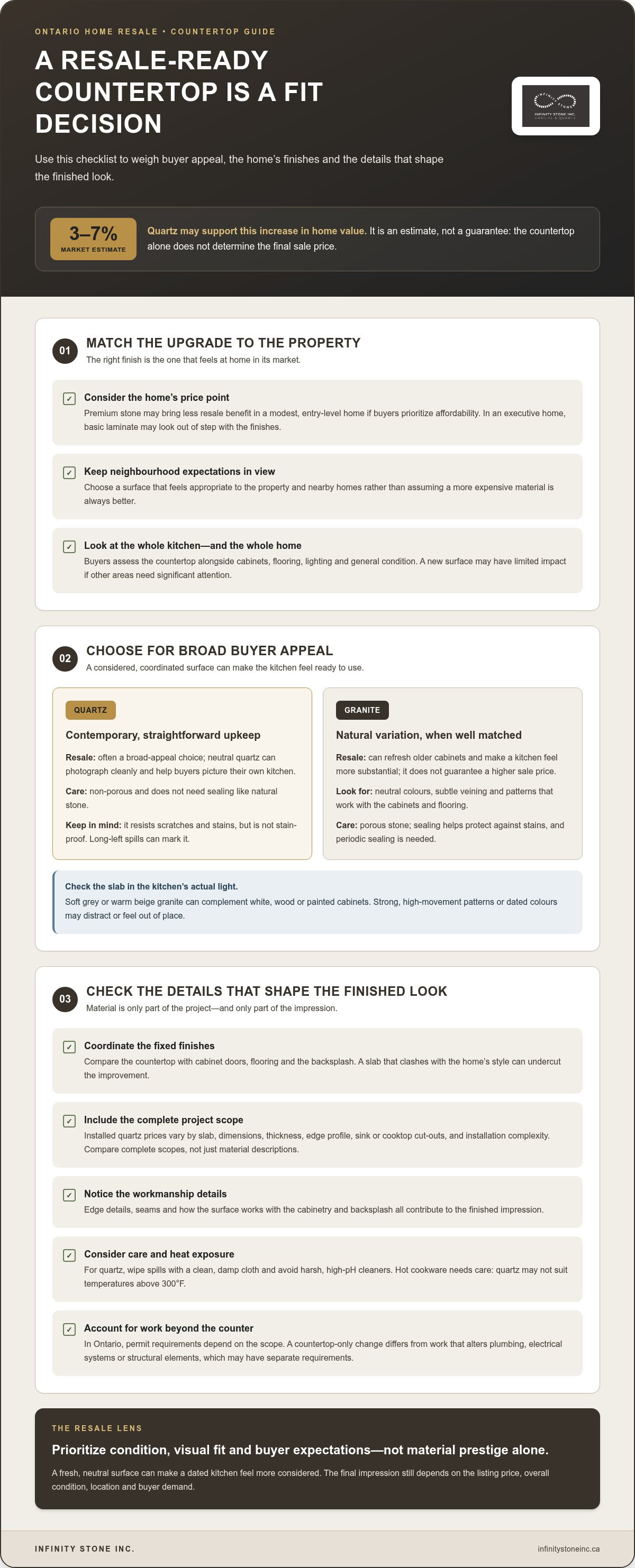
The most expensive countertop isn’t automatically the one that adds the strongest resale appeal. If you’re weighing what countertop increases home value most in Ontario, quartz is often the broad-appeal choice; market estimates suggest it may support a 3–7% increase in a home’s value. Granite can also strengthen a kitchen’s impression when its colour and pattern suit the home.
Buyers notice how a kitchen feels as a whole, not just the countertop material. A fresh, neutral surface can make a dated kitchen feel more considered, while a finish that clashes with the home or neighbourhood may have less appeal. The home’s price point matters, too: the countertop should suit buyers’ expectations for the property.
This guide compares quartz and granite for resale, explores how neutral colours and local expectations shape buyer appeal, and explains when a countertop upgrade may not add value. It also covers why the condition of the rest of the home and the finished details matter alongside the slab you choose.
Key Takeaways
- Quartz is often a broad-appeal resale choice, while granite can also suit buyers when its pattern and finish fit the home.
- Choose a countertop that feels appropriate to the property’s price point and neighbourhood, rather than assuming a more premium surface is always better.
- Neutral colours and restrained patterns can make it easier for a range of buyers to picture the kitchen as their own.
- Consider the whole home before renovating: a new counter may have limited impact if other areas need significant attention.
- Pay attention to the finished look, including edge details, seams and how the surface works with the cabinetry and backsplash.
1. Is quartz or granite better for resale?
For many Ontario kitchens, quartz offers a balance of contemporary appeal and straightforward upkeep. Market estimates suggest quartz countertops may increase a home’s value by 3–7%, although a surface alone doesn’t determine the final sale price. Neutral quartz can photograph cleanly and help buyers picture their own kitchen in the space. Selling speed still depends on the listing price, overall condition, location and buyer demand, not the countertop alone.
Compared with dated laminate, quartz can make a kitchen feel more considered and ready to use. Replacing worn surfaces is especially relevant when stains, visible damage or an old-fashioned finish dominate the room. Tile can also look dated, and its grout lines may suggest more upkeep. Granite can deliver a comparable visual upgrade, but its natural pattern varies. Choose a slab that works with the cabinets and the home’s overall style.
Installed quartz prices in Canada vary by project, so a single figure can mislead. Cost depends on the slab, countertop dimensions, thickness, edge profile, sink or cooktop cut-outs, and installation complexity. A large island or several cut-outs involves different work from a straightforward counter run. Compare complete project scopes, not just material descriptions, and keep the finish consistent with the kitchen’s quality and the home’s price point.
Quartz is non-porous, so it doesn’t need sealing like natural stone. Its surface resists scratches and stains, but it isn’t stain-proof: spills left for a long time can mark it. Wipe spills with a clean, damp cloth, and avoid harsh, high-pH cleaners that can damage resin binders. Quartz also isn’t suited to every heat exposure; hot cookware needs care because the surface may not suit temperatures above 300°F.
For countertop replacement in Ontario, permit requirements depend on the scope of work. A countertop-only change differs from work that alters plumbing, electrical systems or structural elements, which may have separate requirements. Consider the whole project, not just the surface, when assessing whether approvals apply.
Lower-cost choices can make sense when they suit the home, but a dated finish may weaken the kitchen’s presentation. Worn laminate or tile with conspicuous grout lines can leave buyers anticipating an update. Marble offers a distinctive natural-stone appearance, yet a highly individual pattern may appeal to fewer buyers than a neutral design. The key risk is a mismatch: a surface that clashes with the cabinets or the home’s expected finish can undercut the improvement. Choose based on condition, visual fit and buyer expectations, not material prestige alone.
2. How granite affects buyer perception and resale
Granite can make a kitchen feel more substantial than worn laminate or dated tile. Its natural variation adds visual depth, and a well-matched slab can refresh older cabinets without changing the entire room. Buyers assess the kitchen alongside its cabinetry, flooring, lighting and general condition. Granite doesn’t guarantee a higher sale price, but a well-kept surface can make the space feel more complete.
For broad buyer appeal, look for neutral granite colours, subtle veining and classic patterns. Soft grey or warm beige granite can complement white, wood or painted cabinets without dominating them. A high-movement pattern, with strong veins and contrasting colour shifts, may feel out of place in a minimalist kitchen. A dated colour can also distract from the room’s other finishes. Before choosing, compare the slab with cabinet doors and flooring in the kitchen’s actual light.
Granite’s upfront cost depends on the stone and project, not the material name alone. Granite may cost less than quartz in many cases, while higher-end natural stone selections can require a larger investment than simpler surfaces. Marble is another natural stone, with its own pattern and price variations. Compare actual slabs and the full project scope, including dimensions and cut-outs, instead of assuming granite, quartz or marble always follows one fixed cost order.
Compared with laminate, granite creates a more substantial natural-stone appearance, which can help when a tired counter makes the kitchen seem overdue for a remodel. Tile offers a distinct look, but grout lines can seem high-maintenance or old-fashioned to buyers. Neither comparison makes granite right for every home: the surface should match the cabinets, backsplash and expected finish level of the property.
Granite is porous, so sealing helps protect it from stains. Quality granite also needs periodic sealing, making care part of ownership. Keep the surface clean and attend to spills; a neglected counter can undermine the polished impression the stone was meant to create. This maintenance distinction matters to buyers comparing natural granite with non-porous quartz, which doesn’t require sealing.
For resale-focused choices, prioritize fit over visual drama: select a neutral slab, coordinate it with the kitchen’s fixed finishes, and consider whether the rest of the room needs attention first. A countertop can be less costly to replace than cabinets, and granite may refresh existing cabinetry when those cabinets remain in good condition. Explore granite slab options alongside marble to compare natural patterns with the character of the kitchen.
3. Matching upgrades to a home's price point and neighbourhood
A countertop upgrade should suit the home’s price point and nearby properties. In a modest, entry-level house, premium stone may bring less resale benefit if buyers prioritize affordability. In an executive home, a basic laminate counter may look out of step with the property’s finishes. The goal is to meet buyer expectations, not simply choose the most expensive surface.
Neighbourhood context helps guide the decision. Compare the kitchen’s finish with the home’s overall condition and the quality buyers expect in the area. A restrained granite pattern may suit a traditional house, while a clean quartz surface may align with a contemporary condo. An elaborate pattern or waterfall island can work in a luxury property but feel overdone in a home where other rooms need attention.
Before selling, assess the kitchen first, then replace a dated or worn counter if it undermines the room. Choose a neutral finish that complements the cabinets, backsplash and flooring. If the counter is already clean and presentable, prioritize visible issues elsewhere, such as damaged flooring or a bathroom needing renovation. This approach focuses spending on features buyers see as part of the home’s overall condition.
Match the material to the intended buyer and the home’s style. Granite can create a natural focal point, but high-movement patterns may compete with minimalist cabinets. Quartzite may suit luxury or executive homes where buyers want the look of marble in genuine stone. A waterfall island is a premium design feature that can raise perceived value, but it works best when the kitchen and the rest of the home support that level of finish.
Consider return on investment as a whole-project decision, not a promise tied to one slab. Kitchen renovations typically return 75–100 per cent on investment. According to REMAX, kitchen renovations ranked among the top three renovations for return on investment in 27 of 31 housing markets studied. Those figures concern renovations overall, not countertops alone. A counter upgrade is more likely to contribute meaningfully when it addresses a visible mismatch or worn surface.
Use a simple comparison before committing: note the home’s price bracket, inspect nearby listings for kitchen finishes, and identify the room’s most visible problem. Then choose a surface that suits both the cabinets and buyer expectations. For example, a neutral counter can unify dated cabinetry without adding competing patterns. If a scratch or worn edge is the main drawback, weigh replacing the counter against broader kitchen needs. The most suitable upgrade improves the room’s presentation without making it feel over-renovated for its setting.
4. Neutral colours and buyer appeal
Neutral countertop colours, including white, soft grey and warm beige, appeal to a broad range of buyers. Their advantage is flexibility: a restrained surface can work with different cabinet colours and let buyers imagine their own furnishings. When preparing an Ontario home for sale, start with the kitchen’s fixed finishes rather than choosing a colour in isolation. A white counter beside cool-grey cabinets creates a different effect from warm beige beside natural wood.
Undertones matter. A white surface can read cool beside a blue-grey backsplash, yet look warmer beside cream cabinets. Soft grey may connect stainless-steel appliances with painted cabinetry, while beige can complement wood flooring. Bring cabinet, flooring and backsplash samples together before selecting the counter. This simple comparison can reveal clashing undertones that are less obvious when viewing each finish separately.
Colour and pattern should work together. A white quartz surface with subtle veining can add detail without competing with patterned backsplash tile. If the cabinets already have a strong grain, a quieter counter can balance the kitchen visually. Conversely, plain cabinetry can accommodate more visible movement in the stone. Buyers see the whole composition, so consider how the surface relates to the room rather than treating it as a standalone feature.
Assess samples in the kitchen’s actual light. Place them beside the sink, near the backsplash and against the cabinet doors, then view them at different times of day. A counter that looks neutral under showroom lighting may appear cooler or warmer at home. For example, compare a soft-grey sample with both the existing flooring and wall colour before settling on the palette.
Premium appeal comes from coherence, not simply a dramatic colour or expensive-looking pattern. A restrained surface, clean edge and coordinated backsplash can make the kitchen feel intentional. Elaborate veining may suit a statement island, but repeating it across every surface can overwhelm a compact room. Consider where the eye lands first, and keep the counter’s visual weight in proportion to the cabinets and island.
Neutral doesn’t mean choosing an average-looking option without thought. Select a shade that suits the home’s architecture and finish level, then check it beside the elements that will remain. For selling, a cohesive palette can make listing photographs feel orderly and help buyers focus on the kitchen’s layout and condition. It won’t repair worn cabinets or damaged flooring, so address those visible issues as part of the same preparation plan. The best colour complements the room while remaining easy for different buyers to picture in their own home.
5. When a countertop upgrade may not improve resale value
A beautiful new surface can still miss the mark if the kitchen isn’t the home’s main concern. Buyers notice chipped edges, poor seams and mismatched veining, but they also notice worn cabinets, damaged flooring and unfinished rooms. If several areas need attention, spending the renovation budget on one premium counter may leave the overall property feeling incomplete. The slab’s durability won’t compensate for visible work elsewhere.
Use a condition-first test before choosing an upgrade. If the existing counter is sound and the issue is a dated colour, cleaning and coordinating nearby finishes may improve its presentation. If laminate is peeling, tile grout is damaged or the surface has deep chips, replacement can address defects that refinishing won’t resolve. Refinishing suits a surface that can be improved without hiding structural damage; replacement makes more sense when the material is worn or the kitchen needs a cohesive reset.
Countertop-specific resale recovery depends on how much buyers value the change, the home’s price point, the kitchen’s existing condition and the total renovation spend. Kitchen renovations typically return 75–100 per cent on investment, but that figure applies to kitchen renovations overall, not countertops alone. Don’t use it as a guaranteed estimate for a new surface. A measured upgrade that solves a visible problem is easier to justify than an expensive remodel that outpaces the rest of the home.
Material choice also affects whether an upgrade fits buyer expectations. Porous natural stone such as granite needs periodic sealing; engineered quartz doesn’t require sealing. Both can be durable choices, but neither adds value simply by being premium. A dramatic stone pattern may compete with quiet cabinetry, while a restrained colour may look underwhelming in a luxury kitchen designed around a statement island. Match the surface to the room, not just the material category.
Before committing, assess the kitchen and the rest of the property together. Note the counter’s visible defects, compare its colour with the cabinets and backsplash, then list other repairs buyers will see. If the counter is clean and intact, focus first on a more noticeable issue. If it is worn or clashes with the kitchen, choose an upgrade proportionate to the home’s finish level. This sequence keeps resale decisions grounded in presentation rather than prestige.
For a material comparison that considers the room’s finish and resale goals, explore stone slab options before settling on a surface.
Infinity Stone: Quartz Slabs
Infinity Stone Inc. offers quartz slabs for homeowners comparing surfaces for an Ontario kitchen renovation. If resale appeal is the priority, consider how the slab’s colour and pattern work with the cabinetry, flooring and home’s price point. A neutral quartz surface can complement a range of finishes, while a pronounced pattern can become a defining feature.
Granite, marble, porcelain and quartzite slabs offer distinct material choices for different design goals. Compare them in the context of the room and the buyers you hope to attract, rather than choosing by appearance alone. A considered selection starts with the kitchen’s existing finishes and the level of upgrade that suits the property.
Contact Infinity Stone Inc. to discuss slab options for your project.
Choose a surface with the whole room in mind
Your next step can be a focused material decision, not a full kitchen redesign. Look at the cabinets, backsplash, flooring and natural light together, then consider which surface will create a coherent finish for the home. A countertop should feel intentional in its setting, not selected in isolation.
If you’re deciding which countertop increases home value most in Ontario, compare materials against your home’s style and the buyers you hope to attract. Quartz slabs, granite slabs and quartzite slabs each offer a distinct visual character. Consider how the pattern, colour and overall feel work with the elements that are staying, and choose a direction that supports the room’s design.
Infinity Stone can help you explore slab options for your project. Contact Infinity Stone about countertops to take the next step with a considered material choice. A thoughtful selection can bring clarity to your renovation plans and help you move forward with confidence.
Frequently Asked Questions
And granite countertops?
Granite can support resale appeal when its character suits the kitchen and the home’s finish level. Before choosing a slab, view its pattern beside the cabinet doors, backsplash and flooring, rather than judging it alone. A lively stone may become the room’s focal point, while a quieter selection can sit comfortably within a more restrained design. Consider the care involved, too, so the material suits how the next owner may use the kitchen.
Is quartz or granite better for resale?
Neither material is automatically better for every Ontario home. Quartz can suit buyers who favour a consistent appearance and straightforward care, while granite offers natural variation that may complement traditional or distinctive interiors. For example, compare a quartz sample and granite slab against the same cabinet and backsplash choices. The stronger resale option is the one that makes the complete kitchen feel cohesive for the property’s likely buyers.
What is the best countertop for kitchens?
The best kitchen countertop suits the room’s use, design and maintenance needs. For a busy family kitchen, consider how the surface will handle daily spills and cleaning. For a kitchen designed around natural character, compare granite, marble or quartzite patterns with the cabinetry. Also assess the island and perimeter counters together, since a surface that looks compelling on a small sample may feel different across a larger area.
Which countertop adds the most resale value?
If you’re asking what countertop increases home value most in Ontario, quartz is often considered for its broad buyer appeal, while granite can suit homes where its natural pattern complements the design. Neither material guarantees a resale gain. View the kitchen from its main entrance and consider whether the counter improves the first impression or competes with other finishes. A well-matched surface matters more than choosing a material solely for prestige.
Which countertop materials add the most resale value to an Ontario home?
For homeowners wondering what countertop increases home value most in Ontario, quartz and granite are common resale-focused choices, while quartzite can suit a higher-end home seeking natural-stone character. The right selection depends on the home’s existing finishes and likely buyers. For example, a contemporary condominium may call for a simpler visual treatment, while a traditional detached home may accommodate more distinctive stone. Compare samples with the kitchen’s fixed finishes before deciding.
Do quartz countertops increase Ontario home resale value more than granite?
Quartz may have an edge with buyers who value a uniform look and less sealing-related upkeep, while granite can appeal through its natural variation. Neither material has a guaranteed advantage across Ontario properties. Consider the specific kitchen: a calm quartz pattern may suit sleek cabinetry, while granite may bring character to simpler cabinets. The comparison is most useful when both materials are judged against the same room finishes and home price point.
Does countertop material affect home value differently in Toronto, Ottawa, and smaller Ontario markets?
The city alone doesn’t determine which countertop will appeal to buyers. Toronto, Ottawa and smaller Ontario markets contain homes at different price points and with varied architectural styles. Compare finishes in nearby properties that resemble yours in size, condition and buyer bracket. A premium surface may suit one home but feel out of proportion in another. Local context helps you judge whether the upgrade complements the property rather than simply following a city-wide assumption.
What countertop styles and colours appeal most to Ontario homebuyers?
Styles that coordinate with the kitchen’s existing finishes can suit a wider range of tastes. For instance, pair a softly patterned surface with detailed cabinet fronts, or use a simpler pattern where the cabinetry already has strong visual character. Check colour samples beside the backsplash and flooring under the room’s own lighting. This practical comparison helps avoid a mismatch that might be hidden by showroom lighting or by viewing a sample without the surrounding finishes.


