

The most striking slab isn’t always the right choice for a new Ontario home. When selecting stone for a new build home in Ontario, look beyond colour and pattern: the room, the home’s design direction and how the material will relate to cabinetry and other finishes all matter.
A dramatic natural stone or a refined, consistent engineered surface may catch your eye, but the best fit depends on the space and the look you want. This guide compares stone categories for interior applications and explains how to match their visual character to your plans. You’ll also find practical steps for preparing to view slabs, assessing colour and veining in person, and coordinating your selection with cabinetry and finishes. Considering these decisions together helps create a surface that feels intentional in the room and cohesive throughout your new home.
Key Takeaways
- Understand how interior stone slabs differ from exterior stone veneer and which material categories to compare for your new build.
- When selecting stone for a new build home in Ontario, weigh each slab’s colour, veining and pattern against the room’s design intent.
- Use a room-by-room approach to coordinate stone with cabinetry and nearby finishes rather than seeking one material for every space.
- Prepare for slab viewing by defining your surfaces, gathering finish references and noting the visual qualities you prefer.
- Explore quartzite, quartz, granite, marble, porcelain and sintered stone at Infinity Stone’s Mississauga showroom, where imported selections are professionally hand-picked.
Selecting Stone for a New Build Home in Ontario: Start with Interior Surfaces
Exterior stone veneer and interior stone slabs serve different design purposes. Veneer is an exterior cladding choice; this guide focuses on large-format slabs selected for surfaces and design features inside a home. The distinction matters because selecting stone for a new build home in Ontario starts with identifying the interior spaces you want the material to shape, not comparing exterior cladding systems.
A stone slab is a broad piece of natural or engineered material chosen for an interior surface or design application. Its colour, veining, movement and overall pattern can make it a focal point or a quiet backdrop. Understanding the difference between natural stone and engineered stone helps frame the choice, but the room and its intended character should guide the comparison.
Which parts of a new build can use interior stone slabs?
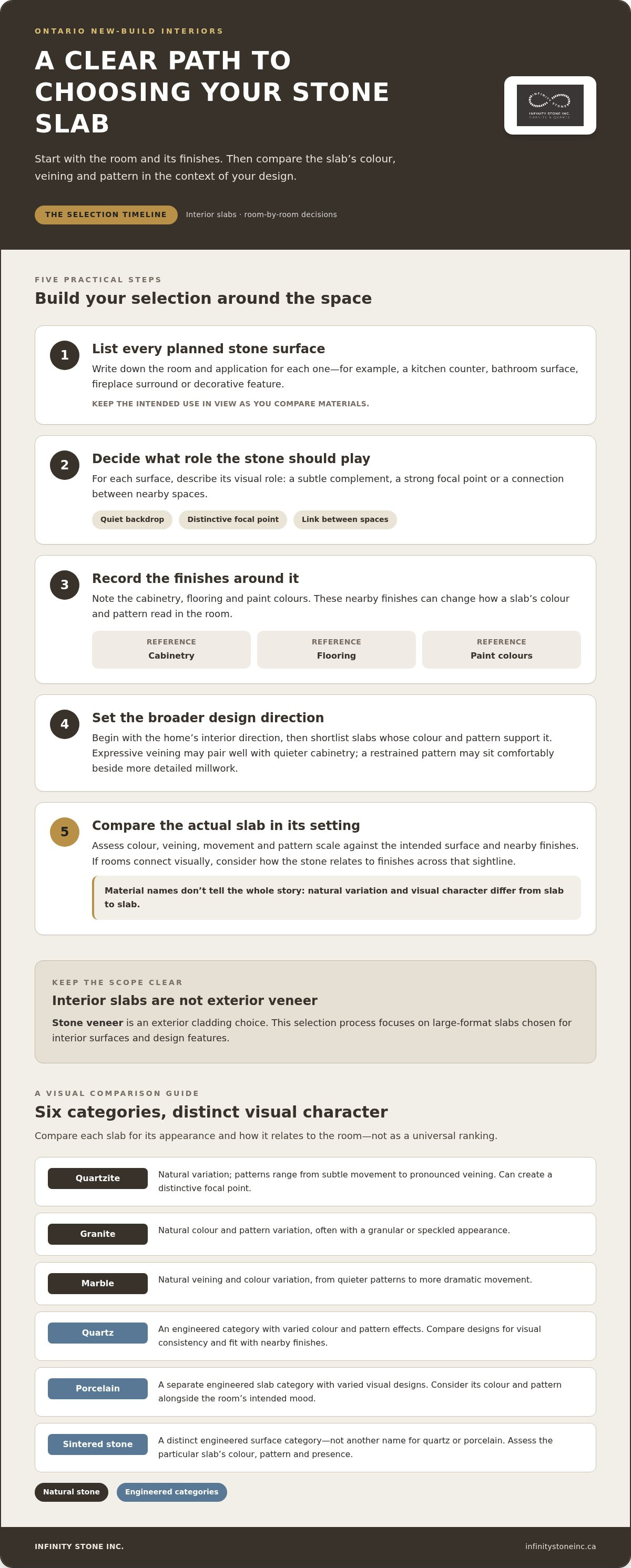
Kitchen countertops are a familiar example, but they’re not the only possible interior application. Depending on the design, slabs may also be considered for bathroom surfaces, fireplace surrounds or other decorative features. Start by listing every planned stone surface and the room it belongs to. This inventory keeps the intended application in view as you compare materials.
- Note the surface and room, such as a kitchen counter or bathroom vanity top.
- Describe its visual role: a subtle complement, a strong focal point or a connection between nearby spaces.
- Record the finishes around it, including cabinetry, flooring and paint colours.
Why should stone selection begin early in the design process?
Stone can influence the palette around it. A slab with expressive veining may pair well with quieter cabinetry and simpler surrounding finishes, while a restrained pattern may sit comfortably alongside more detailed millwork. Colour matters too: a surface that looks cool or bright on its own may read differently beside warm wood, coloured cabinetry or flooring. Considering these relationships early helps the room feel composed rather than assembled from separate decisions.
Begin with the broader interior direction, then shortlist slabs whose colour and pattern support it. If the kitchen connects visually to a dining or living area, consider how the surface will relate to finishes across that sightline. You don’t need to settle every detail at once. The aim is to include stone in the design conversation while there’s still room to coordinate choices, rather than treating it as an isolated final accent.
This guide compares interior material categories by appearance, room and design intent. It doesn’t assess exterior veneer, cladding systems or stone used as a structural building material. With the intended surfaces identified and the home’s visual direction in mind, you’ll have a clearer basis for comparing slabs in the sections ahead.
How Natural and Engineered Stone Slabs Differ in Look and Character
Natural stone is quarried and cut into slabs, while engineered stone categories are manufactured from selected materials. That distinction helps frame a comparison, but it doesn’t determine which surface suits a room. Colour, pattern, visual consistency and the overall design direction matter too. When selecting stone for a new build home in Ontario, compare each material in the context of its intended surface, not as a universal ranking.
Material | Visual character and design possibilities
Quartzite | Natural variation, with patterns that can range from subtle movement to pronounced veining. It can bring a distinctive focal point to an interior.
Granite | Natural colour and pattern variation, often with a granular or speckled appearance. The individual slab’s character can shape the room’s palette.
Marble | Natural veining and colour variation, from quieter patterns to more dramatic movement. It’s often considered when the stone itself is intended to draw the eye.
Quartz | An engineered category with a range of colour and pattern effects. Compare individual designs for visual consistency and how they relate to nearby finishes.
Porcelain | A separate engineered slab category with varied visual designs. Consider how its colour and pattern work with cabinetry, flooring and the room’s intended mood.
Sintered stone | A distinct category of engineered surface, not another name for quartz or porcelain. Assess the particular slab’s colour, pattern and overall presence in the proposed setting.
What design qualities can natural stone bring to a new build?
Quartzite, granite and marble each offer natural variation, so a material name alone can’t tell you exactly how a slab will look. Veining, colour shifts and pattern scale differ from slab to slab. That individuality can make a surface feel singular, especially when its markings become a deliberate feature. Explore quartzite slabs in Ontario to consider the material’s design possibilities.
How should engineered stone categories enter the comparison?
Quartz, porcelain and sintered stone are separate material categories, each with its own visual possibilities. Don’t use their names interchangeably. Compare the actual colour, pattern and degree of visual movement in each slab against your design priorities. Leya Quartz and Leya Sintered Stone are category-specific names; the names alone don’t describe their appearance. For another perspective, explore this Ontario porcelain countertop guide.
For a more considered comparison, view interior stone slab selections alongside your cabinetry and finish references. Next, narrow the options by room and design intent.
Compare Stone Slabs for Ontario New Builds by Room and Design Intent
There’s no single stone category that is automatically right for every room. Start by deciding on the effect you want: a dramatic focal surface, a restrained backdrop or visual continuity between connected spaces. The same category can create very different impressions depending on a slab’s colour, veining and pattern scale. When selecting stone for a new build home in Ontario, compare the slab with the room’s finishes and purpose rather than choosing by material name alone.
Room-and-design-intent matrix
- Kitchen, statement surface: Consider a slab with pronounced veining or a distinctive pattern as a focal point. Compare its dominant colours with cabinetry and flooring so nearby finishes support rather than compete with it.
- Kitchen, quieter scheme: Look at more restrained colour and pattern, especially if cabinetry, flooring or other finishes already have strong visual detail. A subtle surface can let those elements remain prominent.
- Bathroom vanity: Decide whether the surface should echo the kitchen palette or introduce a different mood. Compare light and dark tones, and consider whether veining should be a quiet detail or a defining feature.
- Fireplace surround or decorative feature: Assess pattern scale and visual movement from the viewing distance and in relation to nearby wall colours and furnishings. A bold pattern can draw attention; a quieter one may blend into the room’s composition.
How can a kitchen’s stone selection support the full design scheme?
A kitchen slab can set the visual rhythm for the room. For a focal-point direction, choose a pattern whose movement is easy to appreciate, then keep surrounding colours and finishes in conversation with its most prominent tones. For a more composed look, a quieter slab can balance detailed cabinetry or flooring. Compare actual options against your selected finishes; photographs and sample colours alone may not show the pattern across a full slab. A marble slab reference for Ontario can help you explore how marble’s distinct veining may contribute to a design scheme.
How can stone create continuity across several interior spaces?
Map each planned stone surface and note what it will be seen beside. Repeating one material can create a clear visual connection, while choosing complementary colours or patterns can distinguish rooms without making the home feel disjointed. For example, a kitchen and nearby bathroom could share a related neutral tone while using different pattern character. These are design approaches, not rules: the specific slab and intended application should guide the comparison.
As you narrow your choices, record the room, desired visual effect and neighbouring finishes for each surface. Then compare slabs against those notes. Explore interior stone slab selections with your room-by-room design plan in mind.
A Practical Ontario Checklist for Viewing and Selecting Stone Slabs
A showroom visit is more useful when you arrive with a clear design brief, but not a fixed answer. Use this sequence to organize your priorities, compare material categories and assess slabs in relation to their intended rooms. It’s a practical approach to selecting stone for a new build home in Ontario, whether you’re choosing one focal surface or coordinating several.
What should homeowners prepare before comparing slabs?
Before viewing, list each planned room and surface, such as a kitchen countertop or bathroom vanity. Note the home’s overall design direction and the visual qualities you’re drawn to, including preferred colours, veining and pattern scale. Bring available references for cabinetry, flooring and adjacent finishes. These details give you a useful basis for comparison without requiring you to commit to a particular stone category in advance.
- Define the surfaces. Write down every interior area where stone is being considered and identify the room for each one. A separate note for each surface helps keep the intended use clear as you compare options.
- Establish design intent. Decide whether each surface should make a statement, provide a quiet backdrop or help connect nearby spaces. Record the atmosphere you want, such as soft and understated or rich in colour and pattern.
- Compare categories. Look at quartzite, granite, marble, quartz and porcelain as distinct choices, and include sintered stone in your comparison where relevant. Focus on how each category’s visual character relates to your design goal, rather than choosing by name alone.
- View the slabs. Assess the actual slab instead of relying only on a small image. Step back to take in its overall colour and pattern distribution, then look closely at distinctive areas. A photograph or small sample can’t show the full composition in context.
- Record your preferences. Note the material, colour, pattern and details that stood out, along with the room and finish references you compared them against. Write down any reservations too, so your shortlist reflects considered choices rather than a quick first impression.
What should readers observe when viewing a slab?
Look across the full surface. Notice where colour shifts, veining or other pattern details are concentrated, and whether the visual movement feels balanced for the planned space. Compare those qualities with your cabinetry, flooring and adjacent finish references. This makes the assessment more specific than asking whether a slab is attractive on its own. Seeing the material in person gives you context that a small image cannot convey.
Bring your checklist to Infinity Stone’s Mississauga showroom to view its professionally hand-picked imported selections in person. Keep your room notes and finish references close as you compare. A focused visit can help you create a shortlist that reflects both your design direction and the character of the slabs themselves.
Explore Interior Stone Slabs for Your Ontario New Build with Infinity Stone
A considered material choice starts with seeing how a slab’s colour and pattern work together in person. Infinity Stone Inc. supplies natural and engineered stone slabs for interior applications, giving homeowners and design professionals a range of categories to compare as they plan a new build. Its selection includes quartzite, quartz, granite, marble, porcelain and sintered stone.
What can homeowners explore at Infinity Stone’s Mississauga showroom?
The Mississauga showroom offers a local setting to explore imported stone selections that are professionally hand-picked. Viewing slabs in person lets you consider their overall colour, pattern distribution and distinctive areas alongside the finishes planned for your home. Natural-stone selections include exotic-colour options such as Patagonia, Vitra and Taj Mahal, each with its own visual character.
Bring your room-by-room notes and references for cabinetry, flooring or other finishes. These give you a practical framework for comparing a slab’s appearance with your design direction. Infinity Stone supplies stone materials for interior projects, including countertop and other home design applications.
Infinity Stone reports 2,100 satisfied customers. For homeowners selecting stone for a new build home in Ontario, the showroom is a place to explore material categories and consider how individual slabs might relate to the rooms they’re planned for.
How can readers take the next step with a slab supplier?
Come prepared with the surfaces you’re considering, your preferred visual qualities and the finish references you’ve gathered. A shortlist of colours, patterns or design goals can make it easier to compare slabs and note which options best align with your plans. Homeowners and design professionals can explore materials with their project requirements in mind.
Infinity Stone’s showroom is at 6915 Davand Dr., Mississauga, ON L5T 1L5. Hours are weekdays 9 am to 5 pm and Saturday 10 am to 2 pm. A visit lets you view the stone selections and assess their colour and character directly, rather than relying only on small images.
Use the framework from this guide to compare materials by room, design intent and visual relationship to nearby finishes. When you’re ready to explore, visit Infinity Stone’s stone selection and consider which slabs belong in your new home.
Let Your Stone Choice Shape a Home That Feels Like Yours
A new build is an opportunity to make deliberate choices that give each space its own character. The right slab doesn’t need to follow a trend or match every surface in the home. It should feel at ease with the architecture and finishes you’ve chosen, while reflecting the atmosphere you want to live with. That personal point of view is a useful guide as you continue selecting stone for a new build home in Ontario.
As your plans take shape, stay open to a slab that brings an unexpected colour or pattern into the scheme. Seeing stone in person can help you notice details that suit your vision and refine how you want the finished rooms to feel. Visit Infinity Stone’s Mississauga showroom to explore its selections alongside your design priorities.
Explore premium stone slabs at Infinity Stone and find a surface that feels at home in your plans. The next choice can be the beginning of a distinctly personal interior.
Frequently Asked Questions
What does bookmatching mean when selecting stone slabs?
Bookmatching is a way of arranging two adjacent slabs so their patterns mirror one another, like facing pages in an open book. The effect can create a symmetrical feature across a large surface, especially where veining or other markings are prominent. The visual result depends on the particular slabs and how their patterns align, so assess the pair together rather than choosing each slab independently.
Can the same stone slab selection be carried through multiple rooms?
Yes, a consistent material or related slab selection can visually connect rooms, but the exact slab and the selected stone category aren’t interchangeable ideas. One slab may not provide material for every planned surface; dimensions and project layout matter. For a cohesive look, compare the slabs intended for each space and consider whether their colours and patterns relate well, even if the markings aren’t identical.
Should stone selection happen before cabinetry and flooring are finalized?
Stone selection can begin before cabinetry and flooring are finalized, but it should be coordinated with those decisions. A slab can influence the colours and finishes that feel harmonious around it. As you narrow options, compare stone against cabinetry and flooring references, then review the relationship again as selections become more definite. This helps prevent a preferred slab from being considered in isolation from the room.
Why can two slabs of the same stone look different?
Natural stone forms with individual variations, so slabs from the same material category can differ in colour, veining and pattern distribution. Even slabs that share a general appearance may have distinctive areas in different places. This is why a name or small image can’t represent every slab. When selecting stone for a new build home in Ontario, focus on the specific slab’s character and how it fits the intended design.
What should I compare when viewing a full stone slab in person?
Compare the overall colour, the scale and direction of the pattern, and where the most distinctive areas appear. Then consider how those details relate to the cabinetry, flooring and other finishes planned for the room. Step back to take in the whole slab before focusing on individual markings. If you’re considering more than one slab, compare them side by side where possible to understand their differences.
Can a stone slab be used for a full-height backsplash?
A full-height backsplash is one possible interior design application for slab material. The intended area, the slab dimensions and the overall design plan all shape whether that approach fits a particular project. Consider how the surface will relate to the countertop and surrounding cabinetry, including where its pattern will sit. A slab can create a continuous visual field, while tile creates a different layout of smaller pieces and joints.
How is a stone slab different from stone tile?
A slab is a large-format piece of material, while tile is supplied in smaller individual units arranged across a surface. That difference affects the visual composition: a slab can show broad, uninterrupted pattern movement, while tile creates a repeated layout with visible divisions. For a design with strong veining, consider how a large-format surface presents the pattern compared with smaller sections.


