

Engineered quartz can echo natural stone, but its consistency can also make the resemblance feel too uniform. Understanding how to make engineered quartz look natural starts with choosing a convincing pattern, nuanced colour and surface texture, then considering how seams affect the finished look. Some engineered quartz countertops are made with up to 90% pure quartz aggregates mixed with resins and pigments.
That polished, stone-inspired appearance comes with practical design trade-offs. Repeated veining or an even pattern can feel less organic than natural stone, and visible seams may interrupt the effect across a larger surface. These details matter when you want a cohesive kitchen, bathroom or other interior.
This guide explains how pattern scale, colour variation, texture, pigments and resins shape quartz’s resemblance to stone, and where that resemblance can fall short. You’ll also learn how seam placement affects the overall impression, so you can assess the full surface rather than judging a sample alone.
Key Takeaways
- Compare veining scale and pattern movement with the room’s overall design to choose a quartz surface that feels more stone-like.
- Look for subtle colour and texture variation, while remembering that engineered quartz can offer greater consistency than natural cut stone.
- Understand how crushed quartz, resin and pigments work together to create the surface’s appearance.
- Consider how seam placement and pattern alignment affect the impression of a continuous stone surface.
- Explore natural quartzite slabs if authentic mineral variation is a priority in your material selection.
Design options and pattern consistency
Choosing how to make engineered quartz look natural means considering the whole surface, not just its colour. Pattern, finish and slab layout all influence whether a countertop feels convincingly stone-inspired or noticeably uniform.
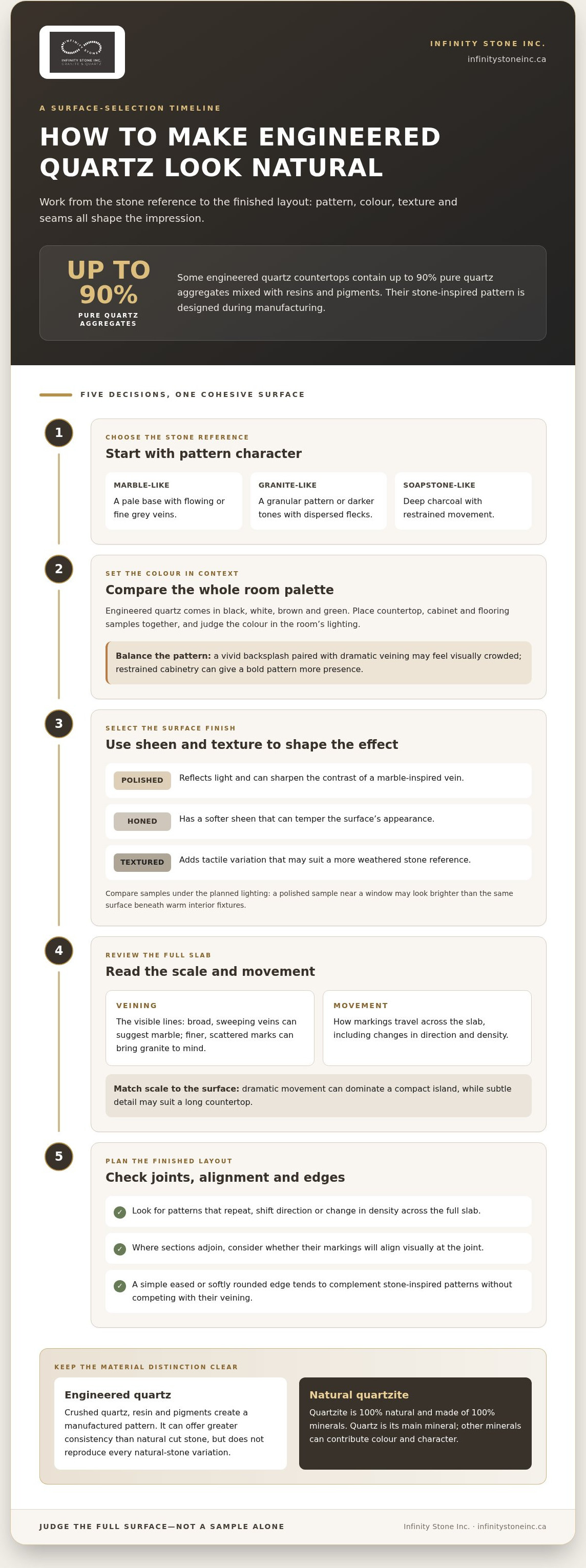
Which engineered quartz colours and patterns most closely resemble granite, marble, or soapstone? A pale base with flowing grey veins can suggest marble, while a granular pattern recalls granite. Deep charcoal with restrained movement can evoke soapstone.
Which finishes make engineered quartz look more natural: polished, honed, or textured? Honed and textured finishes can soften a manufactured appearance. Polished surfaces can also look natural when their pattern suits the stone they reference.
How do veining, movement, and slab selection affect a natural-stone look in quartz? Vein scale and direction shape the visual flow. Reviewing the full slab helps reveal repeating patterns and how markings may meet across countertop sections.
Choosing Colours and Patterns
Colour and pattern determine which natural stone a quartz surface recalls. Engineered stone comes in black, white, brown and green, offering a broad palette for kitchens and bathrooms. A white ground with fine grey lines may bring marble to mind; darker tones with dispersed flecks can resemble granite.
To decide how to make engineered quartz look natural, compare its pattern with the room’s other finishes. Place cabinet, flooring and countertop samples together. A vivid backsplash paired with dramatic veining may feel visually crowded, while restrained cabinetry can give a bold pattern more presence. Judge the colour in the room’s lighting, too.
Finishes and Surface Texture
A finish changes how light interacts with the surface and its markings. Polished quartz reflects light, which can sharpen the contrast of a marble-inspired vein. Honed quartz has a softer sheen, while a textured finish adds tactile variation that may suit a more weathered stone reference.
Compare samples under the lighting planned for the space. A polished sample near a window may look brighter than the same surface beneath warm interior fixtures. Consider the complete palette: a honed finish can temper high-contrast cabinetry, while polished quartz may complement a brighter, more formal kitchen.
Veining, Movement, and Slab Selection
Veining describes visible lines; movement describes how those markings travel across a slab. Broad, sweeping veins can suggest marble, while finer, scattered marks may bring granite to mind. Scale matters: dramatic movement can dominate a compact island, while subtle detail may suit a long countertop.
Inspect the full slab to see where patterns repeat, shift direction or change in density. If sections will adjoin, consider whether their markings will align visually at the joint. Natural granite and marble vary, while engineered quartz can offer greater consistency. Choose the degree of pattern continuity that suits the room.
How engineered quartz resembles natural stone
Engineered quartz borrows visual cues from natural stone, including marble-like veining and granite-inspired colour variation. Crushed quartz, resin and pigments are combined during manufacturing, allowing the surface pattern to be designed rather than formed as one continuous geological feature.
Some engineered quartz countertops can contain up to 90% pure quartz aggregates mixed with resins and pigments. A pale background with grey veins can evoke marble in a kitchen, while darker tones and dispersed flecks can suggest granite in bathrooms. The resemblance is visual: quartz and quartzite are different materials, and engineered quartz does not reproduce every variation found in natural stone.
Which countertop edge profiles look most natural with engineered quartz? A simple eased or softly rounded edge tends to complement stone-inspired patterns without competing with their veining. A more elaborate profile can suit a formal design, but its effect depends on the pattern and surrounding cabinetry.
How much does natural-looking engineered quartz cost per square foot in Canada, including installation? The installed total depends on the selected slab, countertop area, cutouts, edge details, fabrication and installation. These project components determine the overall cost, so a single per-square-foot figure would not accurately describe every kitchen or bathroom.
Can engineered quartz be altered, stained or refinished to look more natural? Its colour and pattern come from a manufactured mix of quartz, resin and pigments, so surface staining won’t create authentic mineral veining. Abrasive cleaners and scouring pads can damage engineered quartz, making them unsuitable for changing its appearance.
For a genuinely natural alternative, quartzite offers a different material character. Natural quartzite is 100% natural and made of 100% minerals; quartz is its main mineral, while other minerals can contribute colour and character. Marble is also natural stone, but it has a distinct appearance and material identity. Comparing full slabs helps distinguish engineered patterning from natural mineral variation.
Sustainability comparisons involve more than a stone-like appearance. Consider the material’s composition, where it was produced, how far it travelled and how it will be used in the kitchen or bathroom. These factors describe different parts of a surface’s environmental footprint; visual similarity alone doesn’t establish which material has the lower impact.
To compare engineered patterns with natural-stone character, review stone surfaces for interior projects alongside the room’s cabinetry, lighting and intended use.
For homeowners seeking a natural stone appearance, quartzite is an alternative to consider, offering a distinct choice beyond engineered quartz’s designed patterns.
Consistency of colour and texture
Engineered stone can provide more consistent countertop colour and texture than natural cut stone. That predictability helps coordinate connected surfaces, such as an island and perimeter counters. It also shapes the design: a steady pattern can feel composed, while limited variation may seem less organic beside the mineral shifts in natural granite or marble.
Natural stone varies from piece to piece. On a long island, adjacent sections may differ in veining, mineral flecks or background colour, making a unified composition harder to achieve. Engineered quartz gives designers a more controlled visual rhythm. This can suit rooms where cabinetry, flooring and countertops need to relate closely without competing patterns.
Consistency doesn’t mean every quartz surface looks identical. Black, white, brown and green options offer distinct palettes, and the amount of visible movement changes each design’s character. A white surface with restrained grey markings, for example, creates a quieter impression than a dark surface with more pronounced contrast.
Assess the surface up close and from across the room. Look for shifts in texture and colour nearby; from a distance, notice whether the pattern feels calm or repetitive. In a kitchen, compare an island with the perimeter counters. Matching surfaces can create continuity, while a contrasting island can define a separate focal point.
Lighting also affects how colours and texture appear. View a sample near a window and under the room’s planned interior lighting, then compare it with cabinet and flooring finishes. In a bathroom, a consistent vanity surface can coordinate with surrounding materials without introducing another competing pattern.
A useful way to think about how to make engineered quartz look natural is to consider the room’s existing visual activity. A patterned floor, detailed backsplash and strongly grained cabinetry may call for a quieter counter. Simpler surroundings can accommodate a surface with more movement. The key is balance, not maximum variation.
- For continuity: Choose related colour and texture across an island and adjoining counters.
- For contrast: Pair a quieter perimeter surface with a more expressive island, considering nearby patterns.
- For a natural impression: Evaluate the surface in the room, rather than judging colour alone.
When considering how to make engineered quartz look natural, distinguish its visual consistency from natural stone’s individual variation. Engineered quartz is described as resistant to hard stains and scratches, but it is not immune to damage. Performance and appearance are separate considerations: consistency can unify a design, while natural stone’s variation gives each piece distinct character.
Resins and pigments in engineered quartz
Engineered quartz countertops combine crushed quartz crystals with resin, while pigments help create the finished colour and pattern. The quartz contributes mineral content; resin binds the material, and pigments influence its visual character. Some engineered quartz contains up to 90% pure quartz aggregates mixed with resins and pigments. That composition helps explain why a slab can resemble stone without being a natural granite or marble formation.
Pigments shape the base colour, from white and brown to black and green, and can contribute to the contrast between the background and visible markings. A pale ground with grey lines can suggest marble, while a dark colour with dispersed lighter flecks can evoke granite. These are designed visual references, not proof that the slab contains those natural formations.
Pattern depends on how colour and quartz aggregates appear together across the surface. A restrained pattern may read as quiet stone, while pronounced contrast can make veining the dominant feature. Compare a small sample with the full slab: the sample may show the grey-on-white palette, but the full slab reveals how markings repeat or travel.
Resin also affects the finished material, so engineered quartz remains distinct from natural stone. The two materials can share a visual language, but their composition differs: quartz countertops contain resin, while natural granite forms through geological processes. That distinction matters when choosing a kitchen or bathroom surface, especially if natural mineral variation is central to the design.
Finish changes how pigments and markings appear. A polished surface reflects more light, which can make contrast look sharper; a honed finish has a softer sheen that can quiet the same pattern. Compare both finishes under the room’s planned lighting. A grey-veined white design, for instance, may feel more dramatic when light reflects across its polished surface.
To judge whether a resin-and-pigment design feels convincing, assess three elements together: the base colour, the scale of the markings and their contrast. A marble-inspired design with broad grey veins creates a different impression from granite-like fine flecks. Match that visual rhythm to cabinetry, flooring and other patterns rather than judging colour alone.
Resin has a practical limitation in sunlight: it can yellow, so engineered quartz is generally suited to indoor use. For an indoor kitchen, compare the slab’s colour in natural daylight and under the room’s artificial lighting. This helps reveal whether the selected finish and pigments work with the surrounding materials as intended.
Resins and pigments make a broad range of stone-inspired appearances possible, but they don’t turn engineered quartz into natural stone. Choose a design by considering its composition, full-slab pattern and finish together. A granite reference can guide colour and movement, while the engineered surface retains its own consistent, manufactured character.
Visible seams and uniform appearance
A seam is the joint where separate countertop sections meet, and its visibility can influence the surface’s overall appearance. Some people find engineered stone seams more noticeable, particularly when a strong vein or contrasting colour stops abruptly. A consistent pattern may also seem too uniform beside the irregular movement associated with natural stone.
Pattern direction matters at each joint. If grey veining runs diagonally across one section, a different direction on the adjoining piece can interrupt the visual flow. A quieter pattern, such as fine flecks on a dark background, may make the transition less prominent because it has fewer bold lines to align.
Consider the countertop layout before selecting a pattern. An island, a long perimeter run and a corner turn create different visual relationships between sections. A dramatic marble-inspired vein, for example, draws attention to where it ends, while a subtler pattern can keep a joint from becoming the room’s focal point.
Assess the full slab and planned layout together. Look for prominent markings that may meet at joints, changes in background colour and repeated motifs. This helps you understand whether the pattern reads as a continuous composition or as separate pieces. A small sample alone won’t show how these details interact across an island and adjoining counters.
- Strong veining: Notice where prominent lines approach a joint and whether their direction appears interrupted.
- Subtle movement: Assess whether fine markings maintain a coherent look across connected sections.
- Uniform colour: Decide whether a steady appearance suits the room or feels less organic than natural stone.
Seams and uniformity affect aesthetics, not the material’s durability by themselves. Engineered quartz is resistant to hard stains and scratches, but it isn’t immune to damage. A beautiful, stone-like appearance still depends on how the selected pattern relates to the countertop layout, lighting and surrounding finishes.
For a natural impression, decide which visual quality matters most: pronounced movement, subtle variation or a calm, consistent field. A quartz design with a bold vein may create an expressive focal point, while a quieter pattern can support detailed cabinetry. Either approach can feel deliberate when the surface works with the room.
Review quartz slab patterns with the intended layout in mind, especially where sections meet. Explore quartz slab patterns to compare how different surface designs could shape a coordinated interior.
Infinity Stone: Quartzite Slabs
Infinity Stone Inc. offers quartzite slabs for projects where authentic natural-stone character matters more than engineered pattern consistency. Natural quartzite is 100% natural and made of 100% minerals, with its mineral composition contributing to its colour and character. Its appearance differs from engineered quartz, making it a useful comparison for kitchen and bathroom designs seeking genuine geological variation.
Compare quartzite, quartz and granite slabs to see how each material’s character relates to your room’s finishes and design direction. Reviewing these options can help clarify whether you prefer a more consistent engineered surface or the individual variation of natural stone.
Contact Infinity Stone Inc. to discuss stone slab options for your project.
Choose a Surface That Feels Right for Your Space
The next decision is whether you want a stone-inspired design or the character of natural stone itself. Knowing how to make engineered quartz look natural can guide your selection, but the final choice should suit the atmosphere you want to create. A refined, coordinated room may call for a different material expression than a space built around distinctive natural variation.
Consider your priorities before narrowing the selection: visual consistency, authentic mineral character or a balance between the two. Infinity Stone Inc. offers quartz, quartzite and granite slabs, giving you distinct material directions to consider for your project. Compare these options with your intended design to turn inspiration into a more confident material choice.
Discuss your project with Infinity Stone Inc. and explore the surface that best supports your vision. A considered choice can give your space a lasting sense of character.
Frequently Asked Questions
Are There Any Downsides?
Yes. A natural-stone-inspired surface can still feel manufactured if its finish or pattern seems too regular across a large island. Honed quartz may also show water marks, making frequent wiping part of its upkeep. In a bright Ontario kitchen, direct sunlight is another consideration because resin can yellow. Weigh these trade-offs against the surface’s consistent appearance and straightforward spill cleanup.
How can engineered quartz countertops be styled to look more like natural stone?
Build a balanced material palette around the countertop rather than treating it as an isolated feature. For example, pair a stone-inspired surface with simple cabinet fronts, natural wood accents and understated hardware. In a kitchen with detailed cabinetry, keep nearby finishes visually quiet so the countertop doesn’t compete. In a more restrained room, a distinctive stone pattern can become the central design feature.
How should quartz backsplash, seams, and sink details be designed for a natural look?
Plan the backsplash and sink as part of one continuous composition. A matching backsplash can connect the counter to the wall, while a contrasting backsplash creates a clear transition. Where the layout allows, keep joints away from prominent focal areas and consider how the pattern meets at corners. A simple undermount sink and discreet faucet help keep attention on the stone-inspired surface.
How does engineered quartz compare with natural stone in appearance, durability, and maintenance?
Engineered quartz offers a more controlled appearance, while natural granite and marble can show individual variations. Quartz is nonporous, so spills are easy to wipe away; natural stone can absorb spills and may need regular sealing. Neither option is immune to damage. Consider the room’s use: a busy kitchen may favour straightforward surface care, while a design focused on unique mineral character may favour natural stone.
What risks or care requirements matter when trying to make engineered quartz resemble natural stone?
Protect the resin and finish as carefully as the appearance. Use a trivet for hot cookware, a cutting board for food preparation and a soft cloth instead of abrasive pads. Wipe harsh solvents away promptly, since they can damage resin. In a sunlit room, consider how exposure may affect the colour over time; engineered quartz is generally intended for indoor use.


