

The slab that looks perfect beside an indoor kitchen may not be the right outdoor bbq countertop material. Sun, moisture and Ontario’s freeze-thaw cycles can affect surfaces differently, so appearance alone is not a reliable guide.
An outdoor BBQ area deserves a considered finish, but the material also needs to suit its exposure and care requirements. This guide compares countertop options by performance, appearance and project priorities, so you can narrow the choices before selecting a slab.
You’ll see why granite and quartzite are often considered for outdoor use, where porcelain and sintered stone may suit projects seeking weather resistance and lower maintenance, and why standard engineered quartz is generally not recommended for exposed outdoor settings. We’ll also cover practical questions for an Ontario project, from site conditions to the balance between natural character and ongoing care. The goal is a surface that complements your design and is chosen with its outdoor setting in mind.
Key Takeaways
- Choose an outdoor bbq countertop material for its actual exposure and everyday use, not appearance alone.
- Compare granite, quartzite, porcelain and sintered stone by their outdoor performance and care requirements.
- Standard engineered quartz is generally not recommended for exposed outdoor settings, so product-specific suitability matters.
- Assess sun, moisture and seasonal exposure at your Ontario site before narrowing your slab choices.
- Explore granite, quartzite, quartz, porcelain and sintered stone slabs at Infinity Stone in Mississauga.
What Makes an Outdoor BBQ Countertop Material Different?
An outdoor BBQ countertop material is chosen to suit exterior exposure as well as regular use in a cooking and entertaining area. The material might be granite, quartzite, porcelain or another category; the individual slab is the specific piece selected for the project. That distinction matters: category-level guidance can help narrow the options, but it doesn’t establish the performance of every slab or product.
Indoors, a countertop is generally sheltered from direct weather. Outdoors, conditions vary with the site. Sunlight, precipitation and temperature changes can influence which surfaces are appropriate, while the counter’s position beside a grill or prep area shapes how it will be used. For a general overview of countertop materials, consider how each category’s properties relate to its intended setting.
How Is an Outdoor Countertop Different from an Indoor Surface?
Exterior exposure adds variables an indoor selection may not face in the same way. Direct sun can affect materials differently from shaded conditions, and moisture and temperature variation make product-specific suitability important. These conditions aren’t identical in every backyard. A counter beneath a roof or within a covered structure may experience different exposure from one fully open to the elements. Its orientation and placement matter too.
Look beyond the broad material label. A category is a starting point, not a blanket performance promise. The chosen product’s specifications and care guidance should match the conditions it will encounter. This is especially useful when comparing an indoor favourite with a surface intended for an exterior application.
Which Project Details Matter Before Comparing Materials?
Start by describing the counter’s location and role. Note how much shelter it has, how you’ll use it for cooking or serving, and which finishes will sit beside it. These details help frame the selection before you focus on colour, veining, texture or overall visual character.
- Exposure: Is the counter fully exposed, partly sheltered or covered? Consider sun, precipitation and seasonal temperature changes at the site.
- Use: Will it serve mainly as a prep surface, a place to set items, or a combination of everyday tasks? Its role helps define your practical priorities.
- Design: Look at nearby cabinetry, flooring and exterior finishes. The slab should contribute to a cohesive composition, not just look appealing on its own.
- Product details: Use general material advice to filter your options. The exact slab or product’s outdoor guidance and maintenance needs should suit the project.
With these details established, you can compare material categories against relevant criteria rather than relying on an indoor display or appearance alone. This site-first approach makes slab selection more deliberate.
Which Qualities Should You Compare in Outdoor Countertop Materials?
A useful comparison weighs more than a material’s reputation or showroom appearance. For an outdoor BBQ countertop material, assess site conditions, the care you’re prepared to provide, the look you want and the needs of the overall project. These criteria help narrow the field before you settle on a particular slab.
Keep the categories distinct. Granite and quartzite are natural stones; engineered quartz is a separate category, as are porcelain and sintered stone. Their compositions and product guidance differ, so a performance claim for one shouldn’t be applied to another. Standard engineered quartz is generally not recommended for exposed outdoor settings because its resin binders may be affected by UV exposure. The guidance for the exact product still matters.
How Should Sun, Moisture, and Temperature Affect Your Choice?
Assess exposure for your specific project rather than assuming every Ontario outdoor kitchen faces the same conditions. A counter beneath a roof may experience different sun and precipitation from one that’s fully open. Placement and orientation also affect exposure. Include seasonal temperature variation in your assessment.
Look for guidance tied to the exact material and product. Statements about UV stability, stain resistance or temperature performance should be supported by material-specific information, not a broad category label or an indoor-use reputation. Compare that guidance with the intended installation context, including how exposed the counter will be.
A material’s general reputation can guide your shortlist, but only verified specifications can inform a decision about the exact product and its intended setting.
How Much Maintenance Are You Comfortable With?
Care expectations can shape a decision as much as appearance. Granite and quartzite may require sealing, while guidance for porcelain or sintered stone can differ. Don’t assume every natural stone needs the same treatment or that every product in a category has identical care instructions. Review the specific product’s maintenance guidance, including any recommended sealer and upkeep routine, before choosing.
Infinity Stone also offers Dry Treat Sealers. Treat sealer selection as part of the material’s care plan, and follow guidance suited to the specific stone rather than assuming one product or schedule fits every slab.
- Exposure suitability: Match product-specific guidance to the counter’s sun, moisture and seasonal conditions.
- Maintenance: Compare care instructions and sealing expectations for the exact material.
- Visual character: Consider colour, pattern and finish alongside the surrounding outdoor elements.
- Project needs: Account for the counter’s intended use and the requirements of the wider design.
With these criteria in view, compare documented performance first, then refine your choices by appearance and care preferences. To explore stone options as you build a project shortlist, browse Infinity Stone’s slab selection.
Granite, Quartzite, Porcelain, or Quartz: How Do They Compare Outdoors?
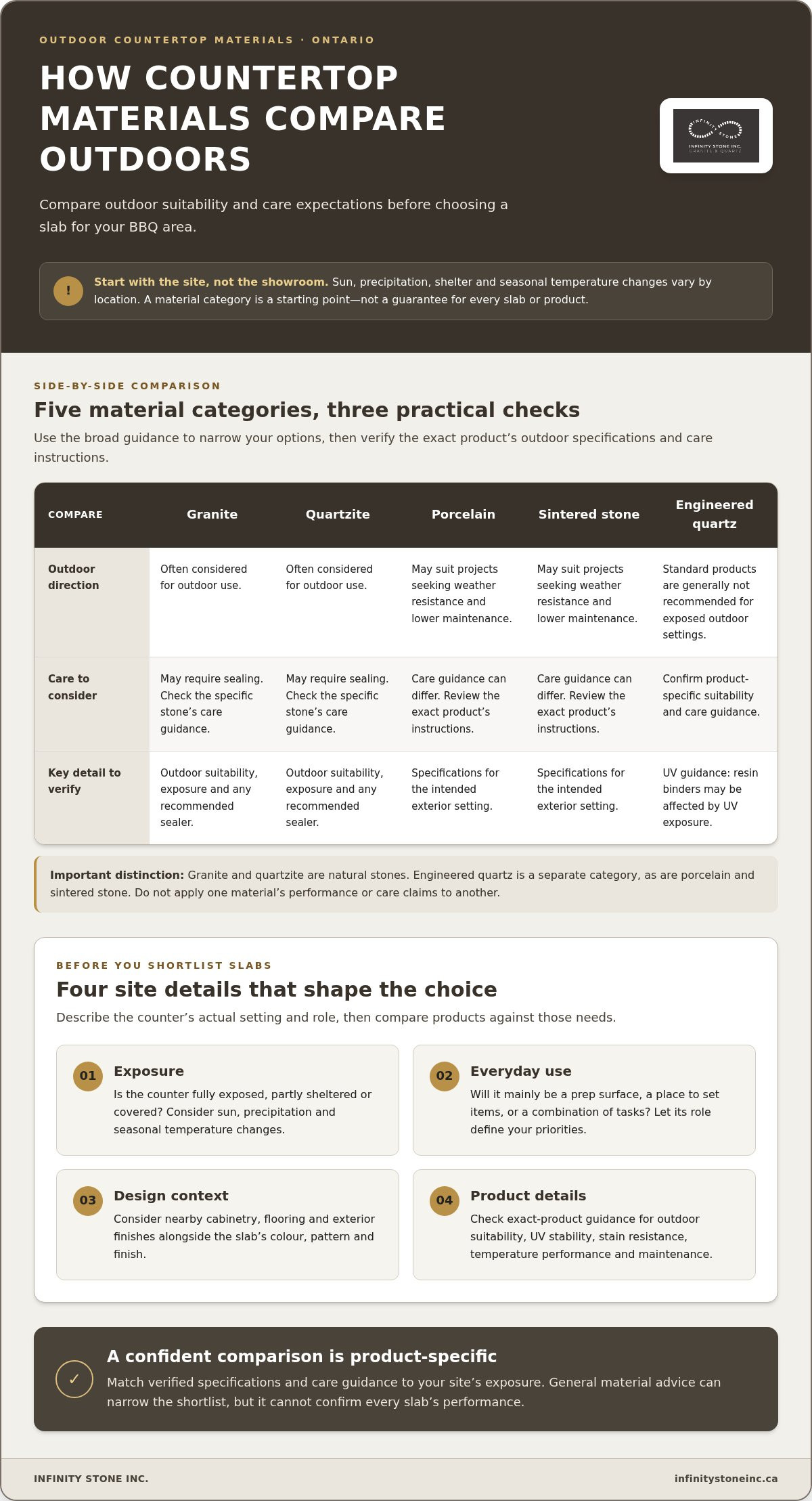
No single material suits every outdoor BBQ area. Compare visual character, site exposure and care requirements, then use the exact product’s documentation to assess performance. The table is a starting point, not a substitute for specifications. Guidance for an individual slab or product may affect its suitability for your project.
| Material | Visual character | Exposure questions | Maintenance guidance |
|---|---|---|---|
| Granite | Natural pattern and colour variation from slab to slab. | Is the specific granite suitable for the site’s sun, moisture and seasonal temperature changes? | Granite used outdoors generally needs regular sealing. Research guidance for Canada commonly specifies at least annual sealing; follow instructions for the exact stone. |
| Quartzite | Natural veining and variation give each slab its own character. | Review product-specific outdoor guidance for the intended exposure and application. | Sealing may be required. Use care instructions for the specific slab rather than assuming they match another natural stone. |
| Porcelain | Available in varied visual styles, including designs that reference natural stone. | Check the exact product’s outdoor, UV and temperature guidance. | Research guidance describes porcelain as not requiring sealing, but confirm care instructions for the product selected. |
| Sintered stone | Offers a manufactured surface aesthetic, with appearance varying by product. | Review documented suitability for the site’s exposure and intended installation. | Research guidance describes sintered stone as not requiring sealing; consult product-specific care details. |
| Engineered quartz | Manufactured patterns and colours can provide a consistent design direction. | Most standard engineered quartz is not recommended for exposed outdoor use because resin binders can be affected by UV exposure. Check the manufacturer’s guidance for the exact product. | Follow the product’s care instructions, and don’t assume indoor guidance establishes outdoor suitability. |
When Might Natural Stone Suit the Design?
Granite and quartzite are natural-stone options, with individual slabs offering distinct patterning and colour variation. That character can help connect a BBQ counter with stone features elsewhere in the landscape. Variation is an aesthetic quality, not evidence of outdoor performance. Review the particular slab’s guidance for exposure and maintenance before treating either material as suitable for the project.
How Should You Assess Porcelain, Sintered Stone, and Quartz?
Porcelain and sintered stone are separate material categories, not interchangeable names. Leya Sintered Stone is described as having the hardness of an igneous rock; that description alone doesn’t establish suitability for every outdoor application. Standard engineered quartz warrants particular care: its resin content can make it vulnerable to UV-related colour change or degradation. Manufacturer documentation for the exact product should guide the decision.
Use this comparison to refine your shortlist, not to declare a universal winner. A well-matched outdoor bbq countertop material is one whose documented guidance aligns with the site, care expectations and design intent. Consider the slab itself as well as its category: natural variation, colour and pattern can influence how the finished counter relates to surrounding materials.
How Should Ontario Homeowners Evaluate an Outdoor BBQ Countertop?
A practical selection begins with the setting, not the slab. In Ontario, outdoor surfaces may experience changing seasonal conditions, but the degree of exposure depends on the site. Record the details first, then compare material guidance and visual options against the project rather than relying on a general recommendation.
Use this checklist in order. It moves from what the site demands to how the finished counter should look.
- Map the exposure. Note whether the counter will be fully open, partly sheltered or covered. Record when direct sun reaches it, where precipitation may land, and whether nearby structures or overhangs provide protection. Consider seasonal temperature variation without assuming every Ontario backyard has identical conditions.
- Describe the surroundings. Identify the exterior finishes the counter will sit alongside, such as the home’s cladding, deck or patio surface, cabinetry and nearby stonework. Include their colours and textures. This context makes it easier to judge whether a slab will complement the overall outdoor palette.
- Set out how you’ll use the counter. Decide whether it will primarily support food preparation, serving, or a mix of activities. Its everyday role helps define what matters in the selection and gives you a useful basis for comparing products and their care guidance.
- Compare material-specific documentation. Use your site notes to assess guidance for the exact product or slab, including statements about outdoor suitability, sun exposure, moisture, temperature changes and maintenance. Broad material descriptions can help build a shortlist, but shouldn’t replace product documentation relevant to the intended setting.
- Refine by slab appearance. Compare colour, pattern and visual movement with the finishes you recorded. A slab with pronounced veining can become a focal point; a more restrained pattern may sit quietly beside distinctive exterior materials. Natural stone varies from slab to slab, so assess the individual piece rather than relying on a category name alone.
This sequence keeps the decision grounded in the actual project. For example, a covered counter and a fully exposed one may call for different product guidance, even if you prefer the same colour family. Align the shortlist with the site first, then assess which individual slabs deliver the desired character.
For broader selection context, consider how the slab will relate to the home’s exterior and other outdoor finishes as a complete design composition. Infinity Stone supplies premium natural and engineered stone slabs from its Mississauga showroom, including granite, quartzite, quartz and porcelain. Exploring slabs in person lets you compare pattern and colour variation directly.
Once you’ve recorded the site conditions and design direction, explore premium stone slabs for your project.
Where Can You Explore Outdoor Countertop Slabs in Mississauga?
Once you’ve identified the exposure and design direction for your BBQ area, compare actual slabs. Infinity Stone Inc. supplies premium natural and engineered stone slabs from Mississauga, with selections for homeowners and design professionals considering an outdoor bbq countertop material. Its range includes granite, quartzite, quartz, porcelain and sintered stone. Each category offers a distinct visual character, and the right shortlist depends on your project’s conditions and priorities.
What Can You Explore at Infinity Stone?
Infinity Stone’s slabs are hand-picked and imported from around the world. Viewing the selection in person lets you consider each slab’s colour and pattern, details that can be difficult to judge from a material name alone. The company states that it has 2,100 satisfied customers, reflecting its work supplying stone materials to homeowners and design professionals.
The showroom brings natural and engineered categories together, making it possible to compare different visual directions as you refine a project palette. Natural-stone slabs have their own pattern variation, while manufactured materials offer distinct design options. These visual qualities are separate from technical suitability: use relevant product documentation to assess performance for the intended outdoor setting.
It’s also useful to understand the scope of the supply relationship. Infinity Stone supplies slabs; it doesn’t fabricate countertops or provide on-site installation. The slab selection is one part of a wider project, alongside separate fabrication and installation arrangements.
What Is the Next Step in Your Material Selection?
Bring your site notes and design references when viewing slabs. A record of sun exposure, shelter, nearby finishes and intended use gives the selection process a practical framework. Compare candidate materials against that context, then look closely at the actual slab’s colour, veining and pattern. This approach keeps visual preference connected to the product guidance relevant to your project.
Homeowners and design professionals can explore the selection at Infinity Stone’s showroom, 6915 Davand Dr., Mississauga, ON L5T 1L5. The showroom is open weekdays from 9 am to 5 pm and Saturdays from 10 am to 2 pm. View the options together and consider how each slab relates to your outdoor design, rather than deciding on category or appearance alone.
For a considered next step, explore premium stone slabs and compare materials for your project.
Choose a Slab That Feels Right for the Space
The final choice should bring together practical confidence and a visual character you’ll enjoy living with. Before settling on an outdoor bbq countertop material, picture the slab as part of the complete outdoor room: its relationship to the home, the surrounding finishes and the atmosphere you want to create for cooking and gathering.
Turn your preferred direction into a focused shortlist. Note the colours and patterns that appeal to you, then compare actual slabs with your design references. Keep the product guidance alongside your selection so the material decision remains connected to the project as it moves forward. This coordination can help homeowners and design professionals make choices with greater clarity.
Infinity Stone’s Mississauga showroom offers an opportunity to explore its imported stone slab selection in person. Take the next step and discover which material best suits your plans: explore Infinity Stone’s premium slab selection. A considered choice can set a distinctive tone for the outdoor space you’re creating.
Frequently Asked Questions
Can quartz be used for an outdoor BBQ countertop?
Generally, standard engineered quartz isn’t recommended for an exposed outdoor BBQ counter. Its polymer-resin binder may be affected by UV exposure, which can lead to discolouration or material degradation over time. A covered location may experience different conditions from a fully exposed one, but that doesn’t establish suitability. Check the specific product’s manufacturer guidance for outdoor use, especially if the counter will receive direct sunlight.
Is granite a suitable material for an outdoor kitchen countertop?
Yes, denser types of granite are considered suitable for many outdoor applications, but the specific slab and site conditions matter. Granite intended for outdoor use requires regular sealing to help limit moisture absorption and staining. For Ontario projects, moisture management is relevant because absorbed water can contribute to freeze-thaw damage. Review care guidance for the selected granite and plan for ongoing maintenance before making a decision.
Does an outdoor stone countertop need to be sealed?
Not always. Sealing requirements depend on the material and product, so “stone” alone isn’t enough to determine the care routine. Granite and quartzite generally require sealing, while research guidance indicates porcelain and sintered stone don’t require it. Follow the product-specific care instructions, including any guidance about sealer type and maintenance frequency. Don’t apply a routine recommended for one material to another without checking its documentation.
How do Ontario winters affect outdoor countertop material selection?
Ontario’s seasonal temperature changes make moisture exposure an important consideration. Water absorbed by a material may freeze and contribute to damage, so assess the selected product’s guidance for outdoor use and moisture conditions. A sheltered counter may face different exposure from one open to precipitation. Consider the site’s cover and drainage as part of planning, then compare the slab’s documented suitability with those conditions.
Can the same countertop material be used indoors and outdoors?
Sometimes, but indoor suitability doesn’t automatically mean a product is appropriate outside. An indoor countertop may be sheltered from sunlight and precipitation, while an outdoor application brings different exposure conditions. This distinction is especially relevant for standard engineered quartz, which is generally not recommended for exposed outdoor use. Check the exact product’s guidance for the intended setting rather than relying only on its material category or indoor performance.
What should I compare when choosing an outdoor BBQ countertop slab?
Compare the exact slab’s outdoor-use guidance with your site’s exposure, then consider maintenance, appearance and how you’ll use the counter. For an outdoor bbq countertop material, practical details include whether the area is covered, how much direct sun it receives and what care the product calls for. View colour and pattern alongside your exterior finishes, and keep the slab’s product documentation with your project notes.


