

The slab with the lower starting price isn’t always the more economical choice for your project. For Ontario homeowners comparing the cost of natural stone vs engineered stone 2026, the material is only one part of the budget. Slab dimensions, pattern, finish, layout and potential offcuts all affect how much material a project may require. Fabrication and installation are separate costs to factor in.
Quotes can be difficult to compare when one covers the slab and another includes more of the project. Check what each estimate includes before judging the materials. A striking natural pattern, a consistent engineered surface and the care routine you prefer may all influence your decision. Viewing the actual slab can also help you assess its colour, veining and dimensions against your design.
This guide explains the factors that shape stone costs and how to compare natural options such as granite, marble and quartzite with engineered quartz and porcelain. You’ll learn what project details to organize, what to look for in an itemized quote and how to weigh material, fabrication, installation, waste and care before choosing a slab for your Ontario home.
Key Takeaways
- The cost of natural stone vs engineered stone 2026 depends on more than the material category. Slab character, dimensions and project requirements all matter.
- Compare the slab cost separately from fabrication, edge work, delivery and installation so you can see what each quote covers.
- Assess how the layout, cutouts, seams and pattern continuity may affect material use and potential offcuts.
- Use a project checklist to compare equivalent quantities, finishes, layouts and work scopes before selecting a slab.
- Viewing slabs helps you judge colour, veining and natural variation against your design priorities and care preferences.
What Does the Cost of Natural Stone vs. Engineered Stone Include?
A stone quote may give the price of a slab or the cost of a finished surface ready for use. Those are different scopes. For a fair comparison of the cost of natural stone vs engineered stone 2026, identify which costs are included before comparing materials. A slab-only figure doesn’t include the work required to turn the selected material into a countertop or another finished surface.
Which materials count as natural or engineered stone?
Quartzite, granite and marble are natural stones formed through geological processes. Their colours and veining can vary from slab to slab, so viewing the specific material helps you understand what you’re selecting. Engineered quartz is a manufactured surface category. Its composition and production differ from natural stone, so don’t assume that engineered surfaces share identical ingredients or characteristics. The Engineered stone overview provides a general explanation of how these surfaces are made.
Infinity Stone Inc. supplies natural and engineered slabs in Mississauga, including quartzite, granite, marble and quartz, for residential and interior projects across Ontario.
Why slab cost is not the same as installed cost
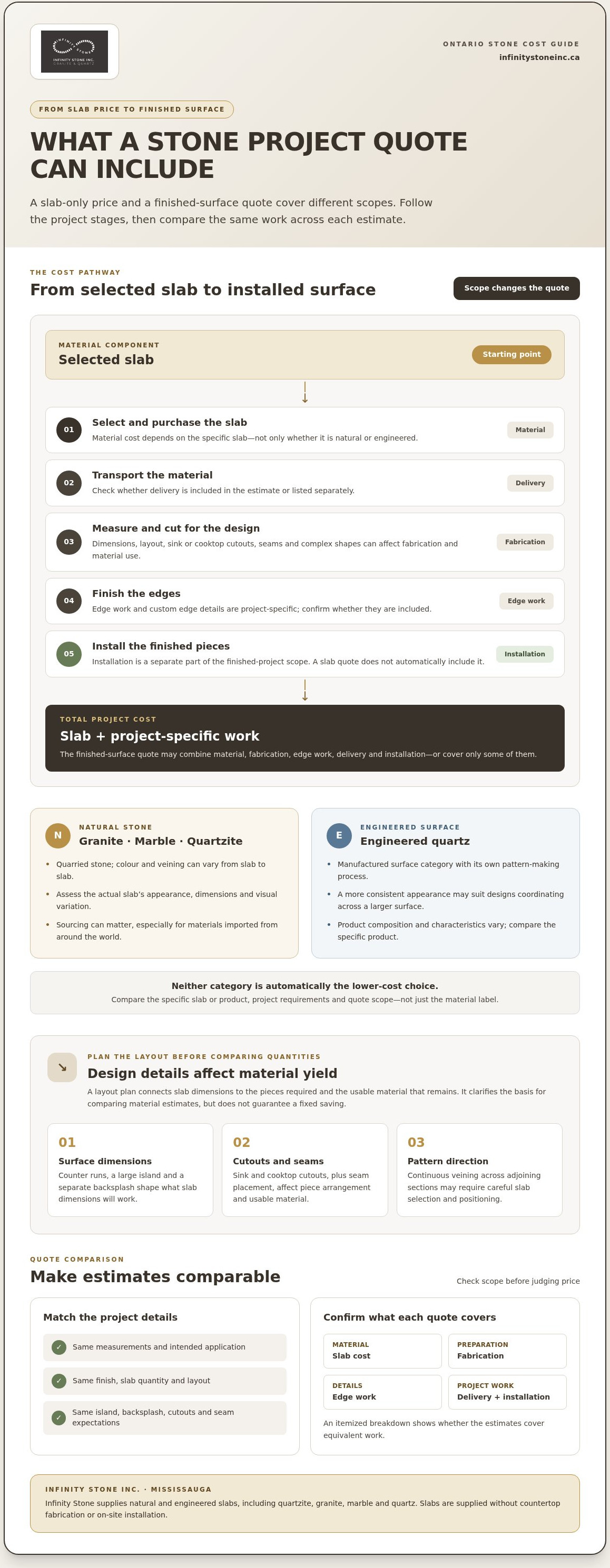
A finished project can involve several stages: selecting and purchasing the slab, transporting it, measuring and cutting it to suit the design, finishing the edges, and installing the completed pieces. Sink or cooktop cutouts, custom edge details, seams and complex layouts may affect fabrication or installation costs independently of the material. The intended application matters too. A kitchen counter and a vanity may require different dimensions, details and material quantities.
Material-only cost is the amount attributed to the slab. Total project cost includes the slab plus the project-specific work required to prepare and install the finished surface.
A slab quote and a finished-countertop quote aren’t interchangeable. One may cover material alone, while the other may include some combination of fabrication, edge work, delivery and installation. An itemized breakdown makes the scope clear and helps you tell whether two quotes cover equivalent work.
Infinity Stone supplies slabs, not countertop fabrication or on-site installation. To compare material costs fairly, use the same project dimensions, finish, intended application and slab quantity. Then consider the material component separately from fabrication and installation. This helps you avoid mistaking a difference in project scope for a difference in stone value.
Which Factors Shape Natural and Engineered Stone Slab Costs in Ontario?
Material category is only a starting point. In Ontario, a slab’s value can reflect its dimensions, thickness, finish, visual character and sourcing. The project design also determines how much material is needed and how it can be used. Assess the cost of natural stone vs engineered stone 2026 slab by slab and layout by layout, rather than assuming one category is always less expensive.
How slab characteristics influence the comparison
Natural stones such as quartzite, granite and marble are quarried and cut into slabs. The U.S. Geological Survey’s overview of dimension stone provides context for this material category. Within a natural stone type, colour, veining and overall appearance can vary between slabs. Sourcing can matter too, particularly for materials imported from around the world.
Engineered quartz is manufactured using its own pattern-making process. A more consistent appearance may suit a design that needs to coordinate across a larger surface, while a naturally varied slab may better suit a design centred on individual veining. Neither preference makes one option universally cheaper. Compare the specific slab or product instead of relying on a category label or a general assumption about rarity.
Thickness, overall dimensions and finish also belong in the comparison. Differences in thickness or surface finish may affect material selection and project requirements. Confirm that each option suits the intended application, and compare like with like. Product-specific details vary, so don’t assume that every engineered surface or natural slab has the same characteristics.
How layout and material yield affect project planning
The planned surface determines which slab dimensions will work. A large island, a separate backsplash, sink or cooktop cutouts, and seam placement all shape how pieces can be arranged. If the design calls for continuous veining across adjoining sections, the pieces may need to be selected and positioned with pattern continuity in mind. This affects how the slab is allocated and how much usable material remains.
Efficient layout planning connects the design to material yield by showing how slab dimensions, cutouts and pattern direction work together. It doesn’t guarantee a fixed saving, but it gives you a clearer basis for comparing material estimates.
For a meaningful comparison, use the same measurements, island and backsplash details, cutouts, seam expectations and finish for each option. Mississauga-based Infinity Stone supplies premium natural and engineered slabs to residential and interior projects across Ontario. Explore natural and engineered stone slabs with your colour, veining and layout priorities in mind.
Natural Stone vs. Engineered Stone: How Do Their Cost Drivers Compare?
Neither category is automatically the lower-cost choice. The comparison depends on the specific slab, the design and the work needed to shape the material for your project. With natural stone, individual variation makes slab selection central to the decision. Engineered quartz may appeal when a more controlled pattern is a priority. The table outlines factors to consider alongside the project scope.
| Cost driver | Natural stone | Engineered stone |
|---|---|---|
| Material variation | Quartzite, granite and marble have distinct characteristics, and individual slabs can differ in colour and veining. | Engineered quartz is manufactured, so its pattern-making process differs from natural stone. Compare the specific surface rather than assuming all products look or perform alike. |
| Pattern and visual effect | Distinctive veining or variation may suit a statement island or feature surface, but requires careful slab selection. | A more controlled visual pattern may suit a design that calls for consistency across a surface. |
| Slab selection | Assess the actual slab, including its colour, veining and dimensions, against the intended application. | Review the specific product’s pattern, dimensions and finish, as details vary between surfaces. |
| Layout and fabrication | Vein direction, seams and cutouts may affect how pieces are planned and positioned. | Cutouts, edges and layout also shape the work required. Compare the same project design for a fair assessment. |
| Care | Care guidance depends on the particular stone and finish. Confirm what suits the selected slab. | Care requirements depend on the specific engineered surface and its finish. Review the product guidance rather than generalizing across the category. |
When natural stone may suit the project better
Natural stone may appeal if the design calls for one-of-a-kind visual character, such as expressive veining on an island or a distinctive feature surface. Quartzite, granite and marble are distinct material choices, not interchangeable labels. Consider each slab’s appearance and intended use. The Natural Stone Institute offers educational resources for understanding natural stone and its applications.
When engineered stone may suit the project better
Engineered quartz may suit a design where a more controlled pattern is preferred. That preference alone doesn’t determine the finished project comparison. Slab dimensions, finish, cutouts, edge details and layout all matter. Compare the actual material options and their care guidance against the project specifications. Seeing slabs in person can help you assess how colour and pattern will look in the space.
For a useful cost of natural stone vs engineered stone 2026 comparison, start with your priorities: distinctive natural variation, a more consistent pattern, the intended application and the care routine you’re comfortable with. Then consider how the selected slab and fabrication requirements fit the design. The right match meets your project’s visual and practical needs, rather than following a universal ranking of material categories.
How Can You Compare Stone Costs for Your Own Project?
A useful comparison starts with your project, not a broad material label. Before reviewing the cost of natural stone vs engineered stone 2026, organize the details that affect slab quantity and finished scope. That makes it easier to see whether different estimates describe equivalent materials and work.
A five-step checklist for an apples-to-apples comparison
- Record the project basics. Note each surface’s dimensions, intended application and design priorities. Include islands, backsplashes, sink or cooktop cutouts, and preferred edge details.
- Shortlist suitable materials and finishes. Compare natural stone options such as quartzite, granite and marble with engineered quartz based on the look and application you want. Keep finish preferences consistent across the options.
- Match slab quantities and layout. Use the same measurements and design plan for each option. Account for slab dimensions, pattern direction and where seams may fall across the surface.
- Separate project components. Keep slab supply distinct from fabrication, edge work, delivery and installation. An itemized breakdown shows which parts are included in each estimate.
- Compare the complete scope. Review the same material quantity, finish, cutouts, layout and work components side by side. Note any differences before deciding which option best fits the project.
Stone cost comparisons are meaningful only when the project scope is consistent. A material-only estimate and a finished-surface estimate aren’t directly comparable if they cover different work.
Questions to resolve before selecting a slab
Clarify where the stone will be used and what role it should play. Is it intended as a subtle surface that complements cabinetry, or a focal point with prominent veining? Decide how much natural variation suits the design, and whether pattern continuity matters across an island, counter and backsplash.
Consider seam placement and cutouts alongside the proposed layout. A slab’s dimensions and visual movement may affect how the pieces can be arranged. Viewing slabs lets you assess colour and pattern directly instead of relying on a general material description. For a kitchen design centred on quartz, a guide to quartz countertops in Mississauga can also help frame the material choice.
For broader selection context, explore information about sourcing premium stone slabs in Ontario. To compare natural and engineered slab options in person, view premium stone slabs at Infinity Stone Inc. in Mississauga. Bring your measurements, application and design priorities so your selection reflects the project you’re planning.
Choose a Stone Slab That Fits Your Design and Project Priorities
The right slab balances visual character with the needs of the room, layout and care routine. Natural stone may bring distinctive variation to a feature island, while engineered quartz may suit a design that calls for a more controlled pattern. Neither is the automatic choice for every project. Consider the specific material and slab alongside the project scope before settling on a direction.
Match the material to the room and design intent
For a kitchen, bathroom or other interior surface, begin with the role the stone will play. Is it meant to anchor the room, complement cabinetry or create continuity across several surfaces? Quartzite, granite and marble each have their own natural character, and individual slabs can vary. Engineered quartz uses a different pattern-making process, but appearance and care details depend on the specific product and finish.
Consider practical priorities as well as appearance. The intended application, edge details and layout can affect the project scope. Review care guidance for the particular material and finish instead of assuming that every stone in a broad category has the same requirements. If natural quartzite is on your shortlist, a dedicated quartzite slab guide can help you explore that material category before making a selection.
Compare slabs with Infinity Stone in Mississauga
Colour and veining can look different across slabs, so viewing the material is a practical part of choosing. Examine the overall pattern, variation and dimensions, then consider how they relate to the room and planned layout. This is especially useful when you want a natural pattern to take a particular role or when visual consistency is a central design priority.
Infinity Stone Inc. supplies premium natural and engineered slabs in Mississauga for residential and interior projects across Ontario. Its selection includes quartzite, granite, marble and quartz, as well as porcelain slabs. The materials are handpicked and imported from around the world. Compare specific options with your measurements, application and design priorities in mind, rather than relying on category labels alone.
The cost of natural stone vs engineered stone 2026 is easier to assess when you consider the actual slab, intended use and project scope together. Choose a material whose character, care considerations and design role suit your space. Keep slab supply distinct from fabrication and installation as you plan the finished project.
Make Your Stone Selection With Confidence
The cost of natural stone vs engineered stone 2026 depends on more than the material category. Compare the actual slabs, project dimensions and finishes, then review slab supply separately from fabrication, delivery and installation. A consistent scope makes estimates easier to understand and helps prevent differences in design or project details from clouding the comparison.
Natural stone offers individual variation, while engineered quartz may appeal when a more controlled pattern suits your design. The best fit depends on the surface’s intended role, the visual character you want and the care considerations that work for your home. Viewing slabs lets you assess colour, veining and variation directly.
Infinity Stone Inc. is a Mississauga-based supplier serving Ontario, with handpicked natural and engineered slabs imported from around the world. Explore quartzite, quartz, granite and marble as you refine your project priorities. Explore Infinity Stone’s natural and engineered slabs and take the next step towards a surface that feels right for your space.
Frequently Asked Questions
How much does natural stone cost compared with engineered stone in 2026?
There isn’t one reliable figure for the cost of natural stone vs engineered stone 2026 because both the slab and project scope affect the total. Natural stone prices can vary by material and slab; engineered quartz options also differ by pattern and product. For an Ontario project, compare itemized estimates for equivalent quantities, finishes, layouts and work scopes rather than relying on a broad category average.
Is natural stone always more expensive than engineered stone?
No. The price depends on the particular slab, its sourcing, dimensions and visual character, as well as the work needed to complete the project. Some natural stone may be a more economical material choice than some engineered options, while distinctive or imported slabs may cost more. Compare actual selections and equivalent project details instead of assuming that either category always costs more.
What factors affect the cost of a natural stone slab?
Material type, sourcing, slab dimensions, thickness, finish and visual characteristics can all affect a natural stone slab’s value. Natural variation means colour and veining can differ from one slab to another, so the particular piece matters. Project planning also plays a part: an island, backsplash, cutouts or a layout that emphasizes vein direction can affect how much material is required and how pieces are arranged.
Can fabrication and installation cost more than the stone slab?
Yes, project-specific fabrication and installation can add substantially to the slab component, particularly when the design involves detailed edges, multiple cutouts, seams or a complex layout. The finished cost also depends on delivery and site conditions. Compare an itemized scope that separates material, fabrication, delivery and installation. Infinity Stone Inc. supplies slabs in Ontario; fabrication and on-site installation are separate project components.
What happens if a project needs more than one stone slab?
Additional slabs may be needed if the surface area, slab dimensions, cutouts or design layout leave insufficient usable material in one slab. Pattern direction and continuity can also influence how pieces are selected and positioned. Use consistent project measurements and layout details when comparing materials. Reviewing the actual slabs helps show how their dimensions and visual character may work across counters, an island or a backsplash.
Which is more cost-effective for a kitchen, natural stone or engineered quartz?
Neither is universally more cost-effective for every kitchen. Engineered quartz is often considered a cost-conscious option, while natural stone varies by material and individual slab. The total comparison depends on design choices, slab quantity, cutouts, edges, fabrication and installation. Compare specific options against the same kitchen plan, then weigh visual character and care requirements alongside the itemized project scope.
Does natural or engineered stone require more maintenance over time?
Care depends on the material and finish. Some natural stones may require periodic sealing, while engineered quartz is generally regarded as a lower-maintenance option. However, don’t assume every surface has identical care needs. Review guidance for the specific slab or product, including routine cleaning recommendations, before choosing. Consider whether that care fits your household’s expectations as well as the surface’s appearance and intended application.


