

A quartz countertop can be durable without being chip-proof. Quartz slab chip resistance depends not only on the engineered surface, but also on where an impact lands. Edges and cut-outs can be more vulnerable than broad, supported areas. A dropped pan or other hard object may leave a small nick, even when the rest of the surface remains in excellent condition.
If you’ve spotted a chip, you may be wondering whether it’s only cosmetic, whether a DIY filler will blend in, or whether the mark signals a deeper problem. Small chips can sometimes be repaired, but size, depth, position and visibility all matter. This guide explains why quartz countertops chip, how to assess the damage and when a cautious repair may make sense. You’ll also learn which warning signs call for closer assessment, why prominent edges can be difficult to disguise, and how everyday habits can reduce avoidable impacts. Understanding the material’s practical limits helps you choose a next step without expecting durable quartz to be chip-proof.
Key Takeaways
- Quartz slab chip resistance depends on factors such as impact location, contact angle and edge design, so durability isn’t a guarantee against damage.
- Record a chip’s size, depth and location, and look for spreading cracks before deciding on a next step.
- A small, stable chip may suit a careful DIY approach, but damage on a prominent edge can be harder to disguise.
- Reduce avoidable impacts by handling heavy items carefully, using suitable boards and keeping hard objects from striking countertop edges.
- Consider practical use alongside colour and pattern when exploring quartz slabs for your space.
Quartz Slab Chip Resistance: What a Chip Does, and Does Not, Tell You
A chip doesn’t automatically mean a quartz countertop has failed. Quartz slab chip resistance describes how well a surface withstands damage, not whether it is immune to impact. Engineered quartz combines mineral content with binding materials, and the proportions and composition can vary by product. The Engineered stone overview explains how these composite surfaces are made, providing useful context for understanding their performance.
Hardness describes resistance to scratching or indentation. Wear resistance describes how well a surface withstands gradual abrasion. Impact resistance describes its ability to withstand a sudden blow without chipping or cracking. These properties are related, but they aren’t interchangeable.
A small surface chip is a localized piece of material missing from an edge or surface. A crack is a visible line that may extend beyond the damaged spot. A loose fragment can indicate that material has separated, while a deeper fracture may involve more than a superficial nick. Appearance alone doesn’t establish the full extent of damage, so note the size and position, and watch for signs that it is spreading.
Is quartz chip-proof? Understanding the material’s limits
No. Durability describes how a countertop performs under ordinary use, not how it responds to every force. Setting cookware down is different from striking the surface with a heavy object at a concentrated point. A sudden blow can focus force on a small area, especially near an exposed edge, and cause a chip even when the broad surface has held up well.
Why countertop edges are more vulnerable than broad surfaces
Broad sections of a countertop are supported across a wider area, while exposed edges and corners can take direct contact from pots, pans or other hard objects. Sink and cooktop cut-outs, as well as narrow sections, change the shape and support around an opening, which can affect local vulnerability. The edge profile and finished details also matter, so no single description of quartz guarantees the same resistance in every location.
For example, a pan carried across a kitchen might brush a counter corner or the edge beside a sink. That contact may leave no mark, or it could chip the edge. The result depends on the impact and the countertop’s specific construction. A chip at an edge doesn’t by itself prove the entire slab is compromised, but a nearby crack or loose piece deserves closer attention. This distinction helps Ontario buyers assess damage without assuming quartz is either fragile or indestructible.
What Affects Quartz Slab Chip Resistance in Everyday Use?
Quartz slab chip resistance isn’t determined by the material alone. The location of an impact, the object’s weight, the angle of contact and the countertop’s edge design all influence how force reaches the surface. A light brush against a broad, supported area may leave no visible mark, while a heavier object hitting a small, exposed corner can concentrate force in one spot.
How impact location and edge profile influence chips
Corners are exposed on more than one side, so a direct strike can focus force there rather than spread it across the countertop. A mark on the broad surface may instead be a scratch or residue, depending on what made contact. Edge profiles, cut-outs and narrow sections affect how much material is exposed and supported. No profile makes a countertop immune to damage. The slab and its finished edges matter.
Object weight is only part of the picture. A hard object moving quickly or striking at an angle may create a sharper impact than the same object placed down gently. These variables make it difficult to predict an outcome from a material label alone.
Identify the mark before choosing a next step
Scratches, stains and chips can look similar at a glance, but they call for different responses. Use this guide as a starting point, not a definitive diagnosis.
Quartz durability versus other countertop materials
Engineered quartz combines mineral content with binding materials, while granite, marble and quartzite are natural stones with distinct geological compositions. Their appearance, surface characteristics and care considerations differ, so broad claims that one material is universally more chip-resistant can obscure the details that matter in a particular kitchen. For a closer look at engineered surfaces, see this quartz countertop slab guide. The Natural Stone Institute is also a reference for natural stone information and care.
As you compare materials, consider both the look you want and how the counter will be used. Explore quartz slab options as part of your selection.
How to Assess and Repair a Small Chip in a Quartz Countertop
Before deciding whether to repair a chip, establish what you’re looking at. A small, stable nick may be cosmetic, while a loose fragment, nearby crack or damage around a sink cut-out calls for a more cautious assessment. The condition and location matter more than a quick guess based on the countertop’s quartz slab chip resistance.
A cautious inspection before attempting a repair
Start by clearing the area and inspecting it in good light. Don’t pull at loose pieces or run your fingers over sharp edges. Note the chip’s approximate size and depth, its position on the counter, and whether a crack extends from it. Look for movement or separation around the damaged area. If the damage is extensive, close to a cut-out, or appears to be spreading, pause rather than attempting a DIY fix.
Once the surface is safe to examine, clean it gently with a soft cloth and a cleaner permitted by the manufacturer. Avoid abrasive pads, powders and tools that could scratch the finish or enlarge the damaged spot. Let the area dry, then photograph it in natural light. Take a wider view showing where the chip sits, as well as a close-up that records its appearance before any repair attempt.
What a small-chip repair can and cannot achieve
Some small cosmetic chips may be filled and levelled with a repair material suited to the specific quartz surface. Resin or epoxy compatibility, application method and curing requirements can vary by product and manufacturer. Don’t assume a generic compound or repair kit is suitable. Follow the countertop manufacturer’s care and repair instructions, including any directions about surface preparation and curing.
Colour matching is another consideration. A solid colour may be simpler to approximate than a patterned surface, where veining or flecks can make a repair more noticeable. Even a carefully completed fill may remain visible under certain light or from particular angles. Treat a repair as a way to address the damaged area, not as a promise of an invisible or permanent result.
- Small and stable: Review the manufacturer’s guidance before considering a compatible repair material.
- Cracked, loose or spreading: Avoid filling over the damage, which can obscure its condition.
- Uncertain or prominent location: An assessment can help clarify the extent of damage and suitable options.
Keep your photographs and notes for reference, and avoid using the area roughly until you’ve decided on a next step. A measured inspection can help distinguish a minor surface blemish from damage that needs closer attention.
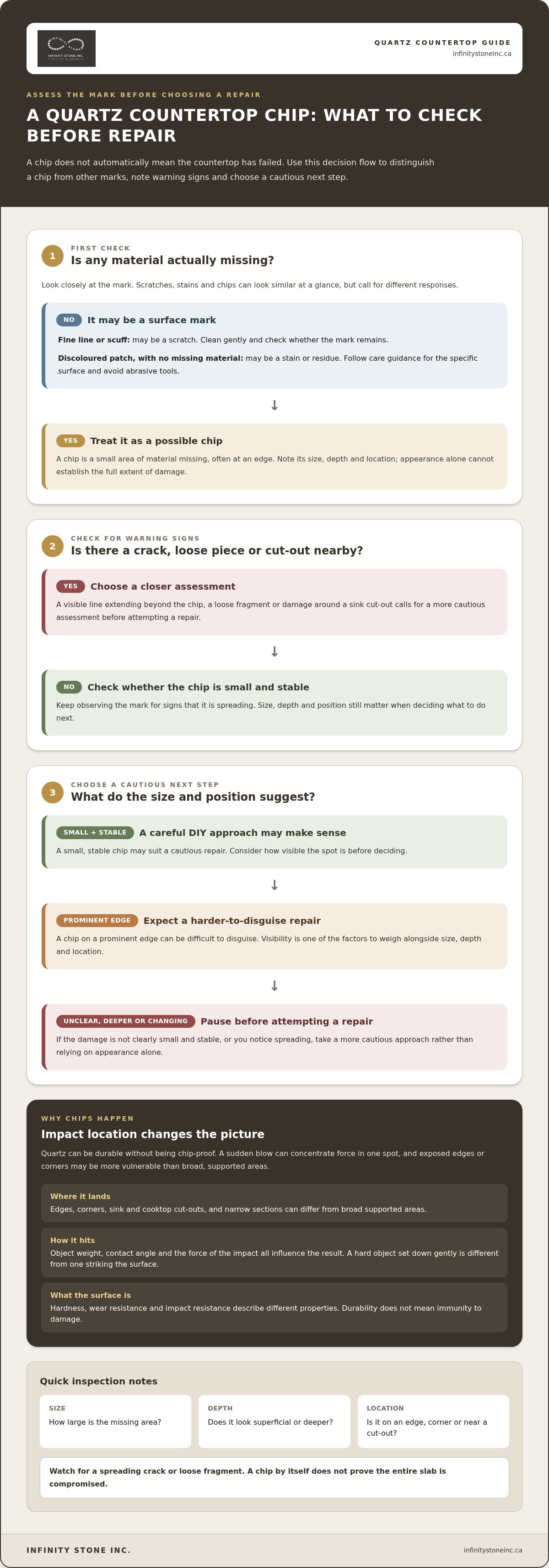
DIY Quartz Chip Repair or Professional Assessment: How to Decide
The right choice depends on more than whether a chip looks small. Its depth, location and stability help distinguish a cosmetic blemish from damage that could worsen or affect a vulnerable area. Quartz slab chip resistance doesn’t make every chip suitable for a home repair, and applying filler before understanding the damage can make a later assessment more difficult.
When a small DIY repair may be reasonable
A DIY approach may be worth considering for a minor, stable chip on an accessible area, away from a sink or cooktop cut-out and away from a complex or highly visible edge. Use only a repair material confirmed as compatible with the specific surface. Prepare the area and follow the product directions carefully, including instructions for application and curing. Work slowly. Excess material or uneven levelling can draw attention to the repair.
Expectations matter. A filler may reduce the appearance of missing material, but colour, veining, gloss and texture can be difficult to reproduce. The result may remain visible, especially on patterned quartz or under direct light. A DIY repair isn’t a guarantee of an invisible or permanent fix.
When to stop and seek an expert assessment
Pause if a crack is spreading, a large fragment is missing, damage has recurred, or the section feels unstable. Treat chips beside sinks, cooktops and other cut-outs with added caution because openings can affect support. Avoid sanding, aggressive scraping and household adhesives unless the manufacturer expressly approves them for the surface. These methods can alter the finish or complicate a suitable repair.
Decision rule: If the chip is shallow, stable and away from cut-outs and complex edges, consider a compatible DIY repair only after checking the manufacturer’s instructions. If it’s deep, near an opening, or accompanied by a crack that moves or spreads, stop and seek an expert assessment.
For any attempted repair, keep the surface clean and dry as directed, and don’t rush the curing process. If you’re unsure whether a product is compatible, avoid experimenting on the countertop. The slab manufacturer’s care and repair guidance should take priority.
For future projects, consider the practical demands of your space alongside colour and pattern. Explore quartz slab options with your intended countertop use in mind.
Preventing Quartz Countertop Chips and Choosing a Slab with Confidence
Everyday care can reduce avoidable impacts, though it can’t remove every risk. Quartz slab chip resistance is one consideration when choosing a surface, but habits and countertop design also shape how it performs in a kitchen or bathroom. Pay particular attention to exposed corners and edges, where hard objects can make direct contact.
Everyday habits that help protect quartz edges
- Handle heavy items with care. Set down cookware and appliances gently, and avoid placing or dropping them near exposed corners.
- Use suitable boards. Keep cutting boards between knives and the counter, and avoid treating the surface as a workbench for tools or heavy objects.
- Follow care guidance. Use cleaning products and methods recommended by the surface manufacturer, rather than abrasive tools or unapproved treatments.
These habits help limit unnecessary knocks and surface wear, but they can’t prevent every accident. A busy kitchen, a shifted appliance or a dropped pan can still create an impact. Consider how people move through the space and where objects are regularly handled.
What to consider when selecting a quartz slab
Start with the intended room and its everyday demands, then weigh colour, pattern and overall design. A bold veined slab can create a striking focal point, while a quieter pattern may suit a more restrained scheme. View the slab in the context of the room’s cabinetry and lighting, and consider which areas will have exposed edges or frequent activity.
Edge and cut-out planning belong in the wider countertop project, not as an afterthought. The chosen profile, corners, sink opening and cooktop opening affect how the finished surface meets daily use. Include these details in project planning, particularly where a narrow section or exposed corner may receive regular contact. No edge choice makes quartz chip-proof, but thoughtful planning can help limit exposure to avoidable impacts.
For a broader perspective on choosing material, finish and project requirements, read this guide to sourcing premium stone slabs in Ontario. It offers useful context as you compare natural and engineered surfaces for your space.
With practical use, edge exposure and design preferences in mind, you can make a more informed selection. Explore quartz countertop slabs to consider options for your project.
Choose a Surface with Confidence
Quartz offers a refined, durable surface, but quartz slab chip resistance isn’t the same as immunity from impact. A chip’s depth, location and any signs of spreading help determine whether it may be a minor cosmetic issue or needs closer assessment. For a stable, small mark, use only a repair approach compatible with the surface and follow the manufacturer’s instructions. If damage is deep, moving or close to a cut-out, pause before attempting a fix.
Thoughtful everyday use can help reduce avoidable impacts: handle heavy cookware carefully, protect the surface with suitable boards and take extra care around exposed edges. When planning a new countertop, consider how the slab’s colour and pattern will suit the room alongside edge exposure and intended use.
Infinity Stone Inc. supplies premium quartz slabs in Ontario, along with quartzite, granite, marble and porcelain slabs. Explore quartz slabs for your project and take the next step towards a surface that suits your space and design priorities.
Frequently Asked Questions
Can you repair a chip in a quartz countertop?
Yes, a small, stable chip may be repairable with a compatible colour-matched material, though the repair can remain visible. First assess its size, depth and location, and check for nearby cracks or loose fragments. Follow the surface manufacturer’s repair guidance rather than relying on a general method. If the damage is deep, spreading or beside a sink or cooktop cut-out, avoid a casual DIY repair and seek an expert assessment.
Is quartz resistant to chips?
Quartz countertops are designed for everyday use, but they aren’t chip-proof. Quartz slab chip resistance depends partly on the force and angle of an impact, and whether it strikes a broad surface or an exposed edge or corner. A heavy object hitting an edge can cause damage even if the counter withstands routine use. Treat descriptions of strength as general material characteristics, not guarantees, and handle hard objects with care.
Can a quartz chip be repaired at home?
A minor cosmetic chip may be suitable for a careful home repair if the material is compatible with the countertop and its care instructions. Even a neat fill may show against the surface, since colour, veining, gloss and texture can be difficult to match. Avoid household glue, abrasive tools and unapproved compounds. Deep chips, cracks, loose fragments or damage near a cut-out are better assessed before any repair is attempted.
What causes chips in quartz countertops?
A concentrated impact is a common cause, particularly when a hard or heavy object strikes an exposed corner or edge. The force, contact angle and precise location all affect the outcome. A countertop may perform well during ordinary use and still chip after a sudden blow. First distinguish a chip, where material is missing, from a scratch or stain. Each has different causes and calls for a different care approach.
Can a chipped quartz countertop crack further?
A small, stable chip doesn’t automatically mean a crack will spread, but inspect the surrounding area and monitor any visible lines. Look for loose pieces or changes in the damage, and avoid putting force on the spot. If a crack appears to be spreading, or the chip is beside a cut-out or narrow section, limit use around it and seek an expert assessment. For Ontario homeowners, the surface manufacturer’s care guidance is a useful reference.
How can I prevent chips in a quartz countertop?
Reduce hard impacts at exposed edges and corners by handling heavy cookware carefully and setting it down gently. Use cutting boards, and don’t treat the counter as a workbench for tools or heavy objects. During project planning, consider where edges and cut-outs will sit in relation to daily activity. These habits can lower the chance of avoidable damage, but no precautions can guarantee that a countertop will never chip.
Does a chip mean I need to replace my quartz countertop?
Not necessarily. A small cosmetic chip may be repairable, while extensive damage, a spreading crack or an unstable section needs closer assessment. Depth and location matter as much as appearance. Photograph the mark, avoid stressing the area and review the manufacturer’s guidance before deciding what to do. A minor chip alone doesn’t mean replacement is required; an assessment can help clarify whether repair or another option is appropriate.


