

The surface that seems tougher against stains may not be the one that best suits your kitchen. In the quartz vs porcelain stain resistance comparison, both materials offer low-porosity surfaces and strong everyday protection, but performance also depends on the slab, finish and what lands on it. A coffee spill, a mark from acidic food and a dull patch from heat can look similar at first, yet they’re different kinds of surface issues.
It’s reasonable to expect a premium slab to withstand daily spills without lasting marks. Both quartz and porcelain are highly stain-resistant and don’t require sealing, but “stain-proof” can oversimplify how a surface behaves in a busy Canadian home. Prompt cleanup and care suited to the specific material still matter.
This guide compares how quartz and porcelain respond to common spills, explains how to distinguish stains from etching, heat damage and residue, and outlines what to consider when choosing a surface for a kitchen, bathroom or other space. As you explore quartz and porcelain slabs from Infinity Stone Inc. in Mississauga, Ontario, compare practical details such as likely spills, finish and care instructions to narrow your choice.
Key Takeaways
- Understand what quartz vs porcelain stain resistance means in daily use, and why strong stain performance doesn’t make a surface damage-proof.
- Compare composition, spill response, finishes and care needs to see which material aligns with your household routines.
- Learn to distinguish visible discolouration from etching, heat damage and residue before deciding how to respond to a mark.
- Use the room, likely spills and preferred upkeep to narrow your options, then review care guidance for the specific slab and finish.
- Explore quartz and porcelain slabs from Infinity Stone Inc. in Mississauga as you weigh design priorities against practical use.
Quartz vs. porcelain stain resistance: what the comparison really means
Stain resistance describes a surface’s ability to resist visible discolouration when substances come into contact with it. It’s a practical consideration for kitchen spills, not a promise that a countertop is stain-proof, damage-proof or maintenance-free. The comparison between quartz and porcelain is most useful when it considers the particular slab and finish, the substances it may encounter, and how it’s cared for.
What counts as a stain on a countertop?
A stain occurs when a substance leaves visible colour or residue on a surface. Coffee, tea, cooking oil, tomato sauce and wine are familiar kitchen examples. Their effects can vary by slab, finish, exposure and cleanup, so don’t assume one spill will behave identically on every quartz or porcelain surface.
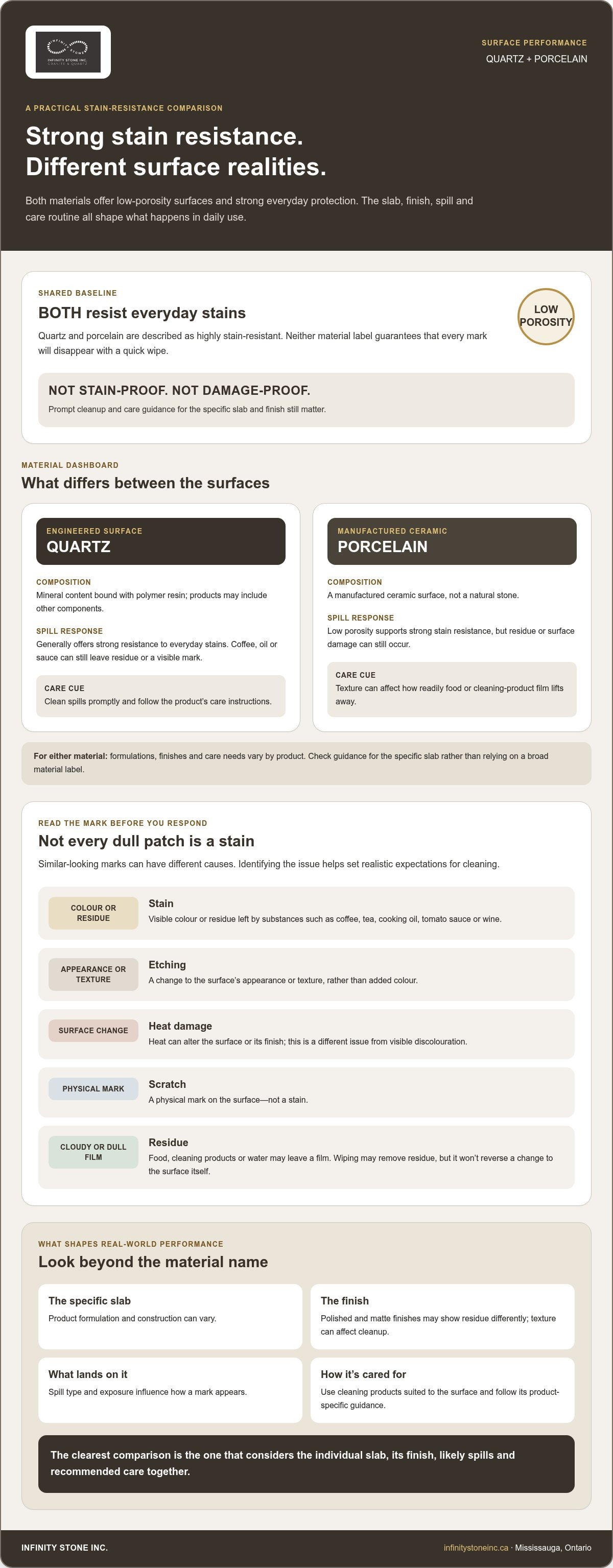
Not every mark is a stain. Etching changes a surface’s appearance or texture rather than adding colour, while heat damage can alter the surface or its finish. Scratches are physical marks. A cloudy film or dull patch may simply be residue from food, cleaning products or water. Identifying the type of mark matters: wiping may remove residue, but it won’t reverse a change to the surface itself.
Why stain-resistance claims need context
Quartz is an engineered stone made from crushed stone bound with polymer resin; Engineered stone provides an overview of this composition. Porcelain is a manufactured ceramic surface. Both are described as highly stain-resistant, but broad material labels can’t explain every slab’s behaviour or the care its finish requires.
Composition and finish influence how a mark appears and how readily it can be cleaned. A polished surface may show residue differently from a matte finish, for example. Visible performance can also depend on colour and pattern. Product formulations and finishes vary, so don’t treat “non-porous” or “stain-resistant” as a guarantee against every mark.
For a meaningful quartz vs porcelain stain resistance comparison, look beyond a single marketing claim. Consider the slab’s composition, finish, likely exposure to spills and recommended care routine together. Follow the instructions for the specific surface, and use cleaning products suited to that material rather than assuming one method works for every slab.
How quartz and porcelain differ in composition and stain response
Quartz and porcelain can both offer strong resistance to everyday staining, but they’re made differently. Engineered quartz combines mineral content with binders and other components, while porcelain is a manufactured ceramic surface. Those broad categories help explain their performance, but they don’t tell the whole story: the exact product, surface finish, spill and cleaning method all influence real-world care.
How engineered quartz responds to spills
Engineered quartz uses mineral particles bound with polymer resin and may include other components that affect its appearance and composition. Its surface is generally non-porous and highly stain-resistant, but products and finishes can differ. Don’t leave coffee, oil or sauce on the surface indefinitely on the assumption that it can’t leave a mark or residue. Prompt cleanup and the manufacturer’s care instructions are the more reliable approach.
How porcelain responds to spills
Porcelain is a manufactured ceramic material, not a natural stone. Its low-porosity character contributes to strong stain resistance, but that doesn’t make every finish immune to visible residue or surface damage. Texture can affect how easily food or cleaning-product film lifts away, and the appropriate care method depends on the specific slab. Follow its product guidance rather than relying on a general rule for all porcelain.
Low porosity describes how readily a material takes in liquid; it isn’t a guarantee that every mark will disappear with a quick wipe. Pigments and oils may leave visible residue, while abrasion, heat or an unsuitable cleaning product can create a different surface issue. These effects shouldn’t be mistaken for proof that one material is universally more stain-resistant.
Quotable takeaway: Quartz’s mineral-and-binder composition and porcelain’s ceramic construction are different, but a slab’s real-world care needs depend on its finished surface, likely exposure and product-specific instructions.
For a useful quartz vs porcelain stain resistance decision, compare the finish and care guidance for the individual slabs you’re considering, not just the material name. Infinity Stone Inc. supplies quartz and porcelain slabs from Mississauga, Ontario. Explore quartz and porcelain slab options as part of your material selection.
Quartz vs. porcelain stain resistance: a practical side-by-side comparison
Both materials are considered highly stain-resistant, but a broad label can’t predict how every slab will look after a spill. Use this comparison as a starting point, then check care guidance and performance information for the specific product and finish.
| Comparison point | Quartz | Porcelain |
|---|---|---|
| Composition | Engineered surface made from mineral content with binders and other components. Formulations vary by product. | Manufactured ceramic surface. Product construction and finishes vary. |
| Spill response | Generally offers strong resistance to everyday stains. Residue or a visible mark may still occur, depending on the spill and slab. | Generally offers strong stain resistance. Texture, residue and product-specific characteristics can affect cleanup. |
| Care | Wipe spills promptly and follow the product’s care instructions. Don’t assume every cleaner is suitable. | Use the recommended cleaning method for the particular surface, especially if it has a textured finish. |
| Finish considerations | Polished or matte finishes may make residue and water marks appear differently. | Surface texture can affect how residue looks and how easily it can be removed. |
| Best-fit priorities | Worth considering if you value the appearance and feel of engineered quartz and are comfortable following its care guidance. | Worth considering if porcelain’s design options and product-specific care characteristics align with your project. |
Which surface is better for common kitchen spills?
Think through the spills your countertop is likely to encounter. Coffee and red wine can leave coloured residue; cooking oil may create a film; tomato-based or other acidic sauces can leave pigment or residue that resembles a stain. On either material, wipe spills promptly and use the cleaning method recommended for that slab. What you see can depend on colour, finish, how much residue remains and how long it sits. Without comparable, product-specific test evidence, it isn’t reliable to declare one material the winner for every spill.
How finish and colour affect what you notice
A polished surface and a textured surface can show residue differently, and texture may make some marks more noticeable or require more attention during cleaning. Colour matters too: a pale surface may make dark coffee more visible, while a darker one may reveal light residue or water marks. These are differences in visibility, not proof of a difference in underlying stain resistance.
Takeaway: A material-wide winner can mislead because composition alone doesn’t determine what you’ll see or how you’ll care for a countertop. Compare the specific slab, finish, likely spills and care instructions together. That’s the practical basis of quartz vs porcelain stain resistance.
How to choose between quartz and porcelain for your project
Start with how the surface will be used, then compare specific slabs rather than relying on a broad material label. A kitchen island that sees frequent food preparation has different daily demands from a bathroom vanity, where managing moisture along backsplashes and edges is equally critical. For reliable perimeter joint protection around worktops and wet zones, sealing solutions from teleseal.de offer effective ways to keep water and grime from getting behind surfaces. Your preferred look and willingness to follow product-specific care instructions matter as much as general stain-resistance claims.
A four-step material selection checklist
- Name the room and use. Consider whether the surface is for a busy kitchen, a bathroom or another space, and how often it will be exposed to food, drinks, cosmetics or other substances.
- Think through likely spills. Note what may land on the surface and how quickly spills are usually cleaned. Your household’s routines can help set realistic care expectations.
- Choose the look and finish. Compare colour, pattern and surface texture in the context of the room. Consider how residue or water marks might appear against the design you prefer.
- Review slab-specific information. Read the care instructions and look for performance details that apply to the particular material and finish. General claims about quartz or porcelain aren’t a substitute for product guidance.
Questions to resolve before choosing a slab
Before deciding, clarify what routine cleaning the selected finish requires and which products are appropriate. If a mark is your concern, consider whether it may be removable residue, etching or another surface change. These issues can look alike, but they call for different expectations and care.
Also consider visibility: a colour or texture may make certain residue easier to notice, even if that doesn’t indicate lower stain resistance. If you’re weighing design and care together, explore this quartz countertop slab guide and porcelain countertop guide for additional material-selection context.
The most useful quartz vs porcelain stain resistance decision is based on your room, everyday habits, preferred finish and the care requirements of the slab itself. Explore quartz and porcelain slab options as you refine your material choice.
Explore quartz and porcelain slabs with a clearer decision
There isn’t one universal winner in quartz vs porcelain stain resistance. A considered choice comes down to the characteristics of the specific slab, its finish, where it will be used and the care it requires. A surface that suits a busy kitchen may not be the only strong option for a bathroom or another residential or commercial space. Focus on the priorities that matter in your project, then compare slab details against them.
What a slab supplier contributes to material selection
Reviewing slab options helps connect broad material categories with the appearance you want in the finished space. Colour, pattern and texture are easier to assess as part of a design decision, alongside practical considerations such as room use, likely exposure to spills and the product’s care instructions.
Infinity Stone Inc. supplies quartz and porcelain slabs, as well as other premium stone materials, from Mississauga, Ontario. Its role is material supply. Comparing slab appearance and product information helps homeowners and design professionals weigh design priorities alongside everyday-use considerations, rather than relying on broad claims alone.
A confident next step for Ontario projects
Before settling on a material, make sure you’re comparing like with like: the specific slab, finish and care guidance. A preferred colour or texture may influence how visible everyday residue is, while the slab’s documented characteristics and recommended care help set realistic expectations for use. These details provide a clearer basis for selection than the material name by itself.
For homeowners and design professionals planning projects in Ontario, Infinity Stone Inc.’s Mississauga location is a local source for exploring quartz and porcelain slabs. Consider the options in light of your room, design direction and maintenance preferences, then use the relevant product information to inform your project decisions.
Explore quartz and porcelain slabs.
Choose a surface with confidence
The clearest answer to quartz vs porcelain stain resistance is that neither material is a universal winner. Both are highly stain-resistant, but a slab’s composition, finish, colour and care requirements shape its everyday performance. A visible mark may also be residue or another surface change, rather than a stain, so knowing what you’re seeing helps guide the right response.
Base your choice on the room, the spills and use you expect, the appearance you want, and the care guidance for the specific slab. These practical details offer a more useful comparison than broad claims such as “stain-proof.”
Infinity Stone Inc. is a Mississauga-based stone slab supplier for Ontario projects, with quartz and porcelain slabs among its material offerings. Explore the material options to support your project decisions, keeping the finish and care details that matter to you in view.
Explore quartz and porcelain slabs and take the next step towards a surface that suits your space and priorities.
Frequently Asked Questions
Is porcelain more stain-resistant than quartz?
Not necessarily. Both quartz and porcelain are generally considered highly stain-resistant, but a broad comparison can’t predict how every slab will perform. Composition, finish, the substance spilled and cleanup all influence what you see. The practical answer to quartz vs porcelain stain resistance depends on the specific products being compared, including their care guidance and any relevant performance information, rather than a universal ranking of the two materials.
Can quartz countertops stain?
Yes, quartz can show visible discolouration or residue, even though it’s generally highly stain-resistant. Engineered quartz is made with mineral content and binders, and products and finishes can differ. Coffee, cooking oil or sauce left on a surface may leave a mark or film. Wipe spills promptly and follow the care instructions for the specific slab. A mark may also be residue or another surface change rather than a stain.
Does porcelain stain from coffee or red wine?
Porcelain is generally low in porosity and highly stain-resistant, but that doesn’t mean coffee or red wine can never leave a visible mark. Colour, surface texture, residue and exposure affect what you notice and how easily it cleans away. Wipe spills promptly, then use the cleaning method recommended for the slab. If discolouration remains, avoid aggressive scrubbing or cleaners until you’ve checked the product’s care guidance.
How do I remove a stain from quartz or porcelain?
Start by wiping the area with a soft cloth and a cleaner approved for the specific slab. If the mark persists, consult the manufacturer’s care instructions before trying a stronger product or abrasive tool. The mark may be residue, a scratch, etching or another surface change, not a stain that cleaning can remove. Avoid improvised treatments, since an unsuitable cleaner or scrubbing method may affect the finish.
What is the difference between a stain and etching?
A stain is visible colour or residue left by a substance on a surface. Etching is a change to the surface itself, which may appear dull, rough or altered rather than simply coloured. They can look similar, especially under certain lighting. A wipe may remove residue, but it won’t necessarily correct a surface change. Identify the mark before choosing a cleaning method, and follow the slab’s care instructions.
Which is easier to maintain, quartz or porcelain?
Neither is automatically easier to maintain in every situation. Both are generally highly stain-resistant and don’t require sealing, but surface texture, finish and product-specific care recommendations can affect everyday cleaning. Consider how the surface will be used and whether you prefer a finish that makes residue easy to see and wipe away. Compare the care instructions for the particular slabs, and use products approved for the selected material.
Should I choose quartz or porcelain for a kitchen countertop?
Choose based on the kitchen’s use, your design priorities and the care guidance for the specific slab, rather than stain-resistance claims alone. Consider likely spills, preferred colour and finish, and how you want to clean the surface. Homeowners and design professionals planning Ontario projects can explore quartz and porcelain slabs from Infinity Stone Inc., a Mississauga-based supplier. Infinity Stone Inc. supplies the material; fabrication and on-site installation are separate services.


