
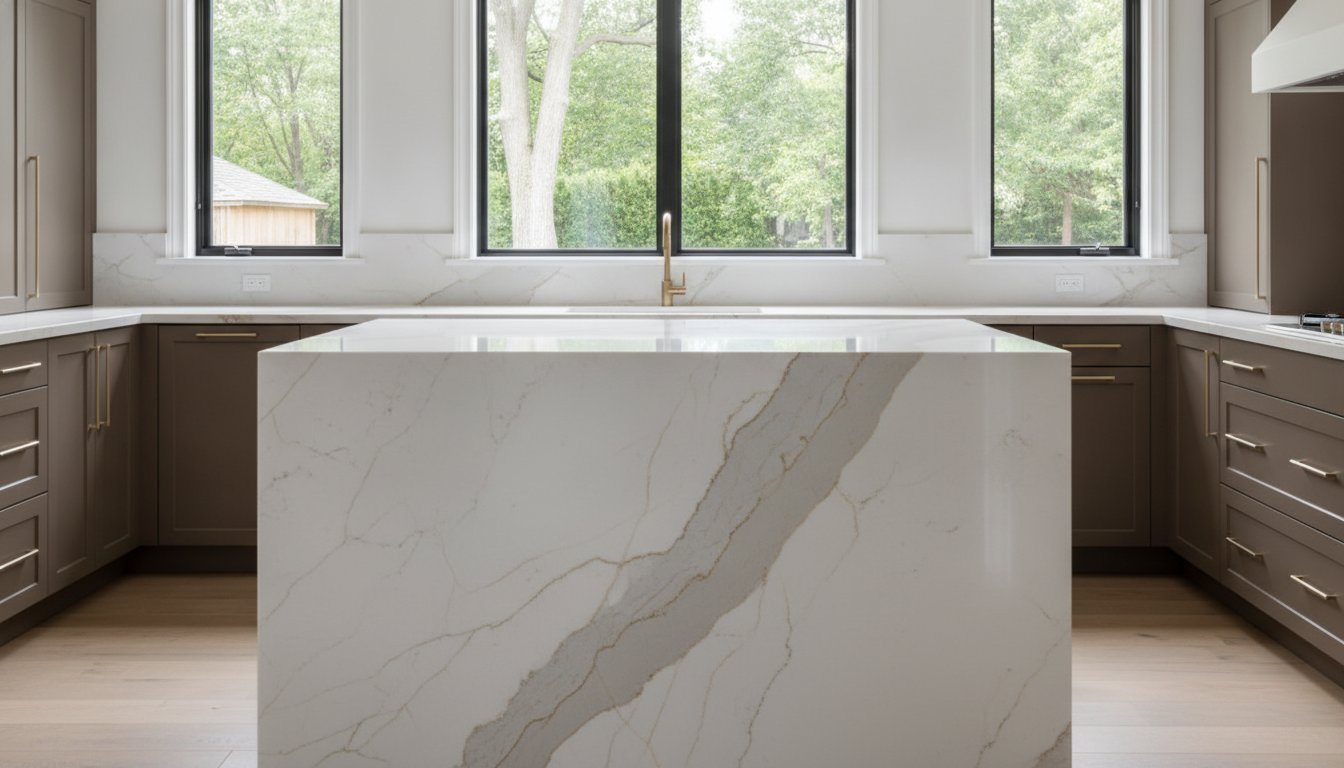
What if you could enjoy the ethereal veining of Calacatta marble without the constant anxiety of a single lemon wedge ruining your investment? For many Canadian homeowners, the dream of a luminous, stone-clad kitchen is often dampened by the reality of etching, staining, and high-maintenance rituals. You likely appreciate the prestige of a natural aesthetic but require a surface that withstands the rigours of a high-performance culinary space. Finding the right white marble alternatives for kitchen designs involves balancing geological beauty with modern resilience.
You deserve a surface that reflects a taste for excellence without compromising on daily functionality. This guide explores premium materials like quartzite, porcelain, and high-grade quartz, which currently holds a 51% market share for its fusion of beauty and utility. We'll examine technical specifications, material classifications, and maintenance requirements to help you select a durable masterpiece from our Mississauga collection. From the heat resistance of porcelain to the unique crystalline structures of quartzite, you'll discover how to achieve a sophisticated look that remains pristine for years.
Key Takeaways
- Identify why sophisticated white marble alternatives for kitchen designs are necessary to prevent permanent etching from common household acids like lemon juice and wine.
- Discover why quartzite slabs represent the pinnacle of natural stone performance, offering the depth of marble with enhanced geological durability.
- Evaluate the technical advantages of engineered porcelain and quartz to achieve a non-porous, high-definition finish that requires minimal maintenance.
- Gain insights into the slab selection process, including why full-sized viewing at a Mississauga gallery is critical for verifying veining patterns and colour consistency.
- Determine the ideal material for your specific architectural application by comparing impact resistance and thermal stability across different premium surfaces.
The Marble Dilemma: Why GTA Homeowners Seek High-Performance Alternatives
The visual language of a luxury Canadian kitchen often begins with the timeless allure of white marble. Slabs of Calacatta and Carrara provide an unmatched depth, characterized by soft grey veining and a luminous, crystalline background that defines high-end design in the Greater Toronto Area. This aesthetic remains a cornerstone of prestigious residential projects. However, the prestige of natural marble comes with a notorious vulnerability. Homeowners frequently face a difficult choice: accept the fragility of the stone or sacrifice the look they love. The desire for classic beauty often clashes with the practical demands of a busy, functional culinary space.
While some purists argue that the inevitable scratches and dull spots create a desirable "patina" over time, most discerning clients in Ontario prefer their surfaces to remain flawless. The search for white marble alternatives for kitchen applications has intensified as a result. The ideal substitute must deliver three critical performance markers: a high Mohs hardness rating to resist scratching, low porosity to prevent bacterial harbouring, and authentic veining that satisfies the trained eye of a professional designer. You don't have to settle for a delicate surface to achieve an elite aesthetic.
The Science of Etching and Staining
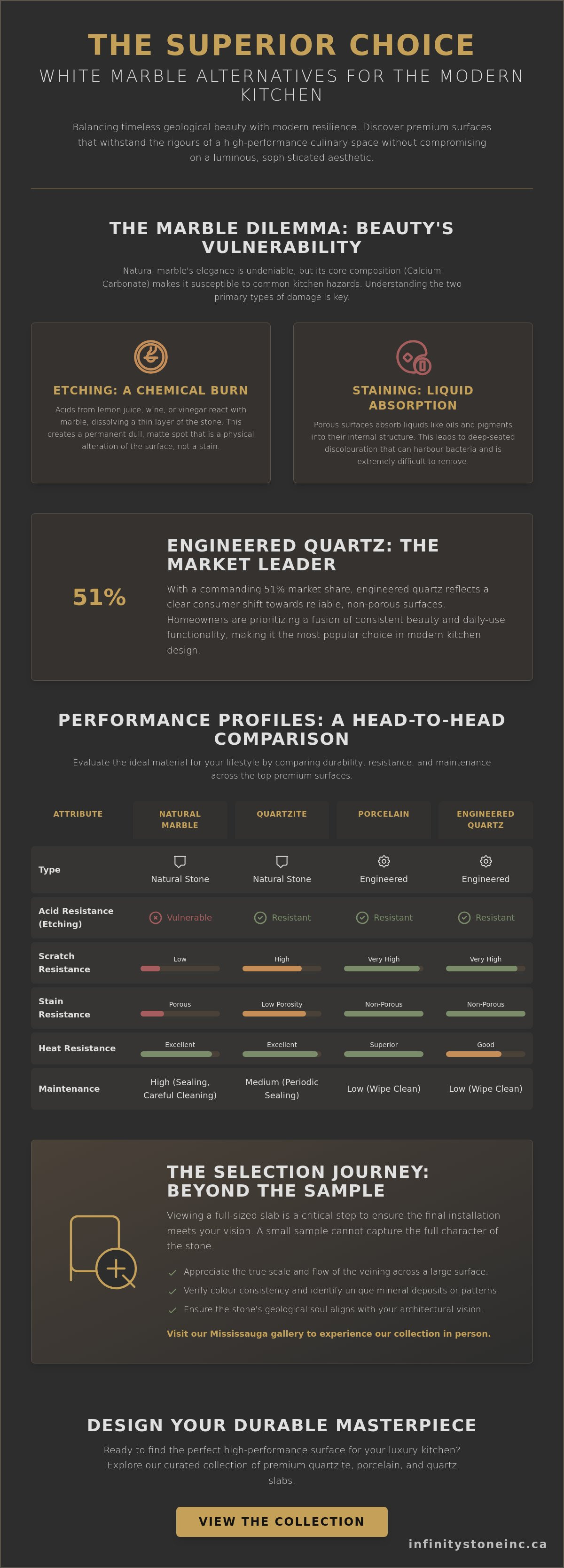
Marble is primarily composed of calcium carbonate, a mineral that reacts instantly with acidic substances. When lemon juice, vinegar, or red wine touches the surface, a chemical reaction occurs that physically dissolves a thin layer of the stone. This results in an etch, which is essentially a chemical burn that appears as a dull, matte spot on a polished surface. This process is distinct from a stain, which occurs when liquids penetrate the stone's pores. Porosity is the ratio of void spaces within a material's structure that determines its susceptibility to moisture absorption and deep-seated discolouration.
Understanding this distinction is vital for long-term kitchen hygiene. A surface that etches will lose its lustre regardless of how well it's sealed, while a porous surface will trap oils and pigments. Modern homeowners are moving toward materials that eliminate these chemical vulnerabilities entirely, ensuring the workspace remains as sanitary as it is beautiful.
The Evolution of the "Marble Look" in 2026
In 2026, the technological gap between natural marble and its high-performance counterparts has narrowed significantly. Modern manufacturing allows for the creation of quartzite and porcelain slabs that mirror the complex, multi-layered veining once exclusive to Italian quarries. This shift towards "quiet luxury" emphasizes materials that offer visual serenity without the constant maintenance requirements of traditional stone. Engineered quartz currently commands a 51% market share, reflecting a clear preference for reliable, non-porous surfaces that handle the rigours of daily use.
Evaluating the Engineered Stone Composition of various materials is a necessary step for any informed buyer. By selecting a surface that utilizes advanced resins or high-heat vitrification, you ensure your investment withstands high-traffic environments. For those prioritizing long-term value, sourcing premium stone slabs ensures that the chosen material possesses the structural integrity required for sophisticated architectural features. The focus has moved from merely mimicking a pattern to replicating the geological soul of the stone in a more resilient form.
Quartzite Slabs: The Natural Stone Alternative for Pure Elegance
Quartzite is a metamorphic masterpiece. It begins its life as quartz-rich sandstone. Over millennia, intense heat and tectonic pressure fuse these grains into a solid crystalline rock. This process creates a material with unparalleled structural density. For those seeking white marble alternatives for kitchen islands, quartzite offers a rare combination of natural geological soul and superior physical performance. It's the only natural stone that possesses the translucent depth and luminous white background traditionally associated with premium Italian marble.
The technical superiority of quartzite is best measured by the Mohs scale of mineral hardness. While marble typically sits at a 3 or 4, making it susceptible to scratches from steel blades, genuine quartzite reaches a 7. This rating exceeds that of granite, providing a surface that resists abrasions from daily culinary activity. Popular varieties like White Macaubas or certain cuts of Taj Mahal offer the linear veining and crisp white tones that mimic Calacatta marble while maintaining a much higher threshold for wear.
Quartzite vs. Marble: A Performance Comparison
The primary functional advantage lies in thermal stability and mineral composition. Quartzite is highly heat resistant, allowing it to withstand the temperature fluctuations common near professional-grade ranges without cracking or discolouring. It's essential to address the industry's "soft quartzite" myth. Some stones sold as quartzite are actually dolomitic marbles that still contain acid-sensitive calcium carbonate. True quartzite consists almost entirely of silica, which does not react to acids. You can verify this by visiting a reputable showroom to inspect the crystalline structure of individual slabs before making a final selection.
Sourcing the Perfect Slab in Ontario
Selecting a natural stone requires a visual commitment. Because every block is unique, viewing full-sized quartzite slabs is the only way to appreciate the expansive colour variations and directional veining. This is especially critical for large island installations where bookmatching, the practice of mirroring two adjacent slabs, creates a seamless, high-impact architectural statement. Handpicked slabs from Mississauga suppliers offer better aesthetic consistency because they're curated specifically for the discerning Ontario luxury market. Small samples simply can't convey the majestic scale of a complete slab.
Engineered Excellence: Porcelain and Quartz Marble-Look Slabs
While natural quartzite provides a geological masterpiece, engineered materials offer a level of precision and consistency that is increasingly favoured in the Greater Toronto Area. Modern manufacturing has elevated these white marble alternatives for kitchen designs from simple imitations to high-performance architectural features. These surfaces provide the specific, high-contrast veining of Calacatta or the subtle clouding of Carrara without the structural vulnerabilities of calcium-based stone. For homeowners seeking a pristine, "zero-maintenance" environment, engineered slabs represent the pinnacle of contemporary material science.
The Sophisticated Appeal of Luxury Porcelain
The rise of large-format porcelain countertops has transformed the luxury market in Ontario. By utilizing state-of-the-art inkjet technology, manufacturers can now replicate the specific, dramatic veining of rare marble blocks with microscopic precision. This process allows for the creation of massive, thin slabs that are ideal for seamless backsplashes and dramatic waterfall islands. Unlike natural stone, porcelain is vitrified at extreme temperatures, making it essentially impervious to heat, scratches, and chemicals.
- UV Resistance: Porcelain is one of the few premium surfaces that remains stable under direct sunlight, making it the premier choice for outdoor kitchens in the GTA.
- Hygienic Surface: The non-porous nature of the material ensures that bacteria and mould cannot penetrate the surface, supporting a healthier culinary environment.
- Architectural Versatility: The lighter weight of porcelain slabs allows for applications on vertical surfaces where traditional stone might be too heavy.
Quartz Slabs: The Industry Standard for Durability
It's easy to see why quartz countertops in Mississauga remain a dominant choice for active families. These slabs combine approximately 90 to 93 percent crushed natural quartz with high-quality resins and pigments. This composition creates a surface that never requires sealing or specialized stone soaps. While older engineered products sometimes suffered from a "pixelated" appearance, today's premium quartz features through-body veining that flows across the edge of the slab, mimicking the organic growth of natural marble.
High-tier quartz avoids the flat, artificial look of mass-market alternatives. When inspecting slabs at a professional gallery, look for depth in the background and a lack of repetitive patterns. These engineered surfaces handle heavy impact and resist staining from high-pigment ingredients like turmeric or balsamic vinegar, making them a reliable partner for the home chef. Choosing a high-grade quartz ensures that your kitchen maintains its prestigious aesthetic regardless of how frequently it is used for entertaining.
Sustainability also plays a significant role in the selection of engineered stone. Many modern slabs utilize recycled minerals and efficient manufacturing processes that reduce waste. By choosing a material built for longevity, you reduce the need for future replacements, aligning your design choices with a more sustainable, long-term perspective on luxury living.
Performance Profiles: Choosing the Material That Fits Your Lifestyle
Selecting white marble alternatives for kitchen surfaces requires an honest assessment of your daily habits. A professional culinary environment demands different material properties than a social hub for a growing family. While aesthetic appeal is the primary driver, structural integrity ensures the kitchen remains a long-term asset in your Ontario home. You shouldn't have to choose between a designer look and a surface that survives a Tuesday night dinner. Understanding how each stone reacts to the rigours of a Canadian kitchen is the first step toward a successful renovation.
Heat, Scratch, and Stain Resistance
Performance varies significantly across material categories. Porcelain offers the highest thermal stability, comfortably handling hot pans directly from the stove because it is vitrified at temperatures exceeding 1200 degrees Celsius. Quartzite follows closely, though its natural crystalline structure prefers moderate protection. Engineered quartz, while durable, is susceptible to thermal shock due to its resin content; always use trivets to prevent permanent discolouration or cracking. For those who frequently prep food directly on the surface, quartzite’s Mohs hardness of 7 provides the best defence against metal utensils.
- Heat Tolerance: Porcelain > Quartzite > Quartz.
- Scratch Resistance: Quartzite > Quartz > Porcelain.
- Stain Immunity: Porcelain > Quartz > Quartzite.
The Aesthetic Decision: Natural Movement vs. Controlled Pattern
Designers often favour natural stone for one-of-a-kind statement pieces where the organic flow of minerals dictates the room's energy. If your project involves complex bookmatching for a central island, natural quartzite provides a depth that engineered products strive to emulate. Conversely, engineered stone offers controlled patterns. This is essential for large-scale projects requiring multiple slabs with identical veining and background tones. It eliminates the risk of colour mismatching across long runs of cabinetry or integrated backsplashes.
The "Home Chef" test focuses on heat and precision. If you are a high-volume cook, porcelain's extreme heat resistance makes it an undisputed leader. The "Busy Family" test, however, prioritizes impact and stain resistance. While quartzite is incredibly hard, it is still a natural stone that can chip if a heavy cast-iron pot is dropped on an edge. Engineered quartz provides slightly better flexural strength, making it more forgiving in a chaotic kitchen environment. Resistance to high-pigment spills like turmeric or balsamic vinegar is also higher in porcelain and quartz, which lack the microscopic fissures found in even the best natural slabs.
Maintenance cycles also dictate long-term satisfaction. Natural stone requires periodic sealing to maintain its resistance to oils and pigments. Engineered surfaces offer a "wipe-and-go" lifestyle, perfect for high-traffic GTA households where time is at a premium. Analysing the return on investment involves weighing these maintenance costs against the initial prestige of the material. A well-chosen alternative can increase property value by providing the marble look with modern performance. To find the perfect balance for your project, view our premium slab inventory to compare these performance profiles in person.
The Selection Journey: Visiting a Mississauga Slab Gallery
The final stage of securing the perfect surface involves moving beyond digital catalogues and small swatches. While a handheld sample provides a basic colour reference, it cannot convey the sweeping, organic movement of a full-sized slab. This is particularly true when evaluating white marble alternatives for kitchen islands, where the scale of the veining dictates the entire room's visual rhythm. Visiting a professional warehouse allows you to witness the depth, lustre, and tactile quality of the stone in its entirety. This physical inspection ensures that the slab you fall in love with is the exact one that arrives at your home.
Understanding the distinction between a material supplier and a fabricator is essential for a seamless renovation. As a premier supplier in Mississauga, we curate and provide the raw slabs, while your chosen fabricator handles the precise measuring, cutting, and installation. This partnership ensures you have access to a vast, high-quality inventory that a typical fabrication shop might not stock. By selecting your material directly from the source, you maintain control over the aesthetic outcome and structural grade of your kitchen surfaces.
Inspecting Your Chosen Slab
Warehouse lighting is intentionally bright and unforgiving. Use this to your advantage by checking the "face" of the slab from multiple angles to identify natural fissures, resin fills, or minor surface imperfections. Consistency is key, especially for engineered quartz or porcelain where you want to ensure the pattern doesn't appear repetitive or pixelated. You must also verify the slab thickness, typically 2cm or 3cm, as this choice influences the weight of your cabinetry and the possible edge profiles your fabricator can achieve. Homeowners should bring a cabinet door sample to the Mississauga showroom to ensure colour harmony between the slab’s undertones and the kitchen’s cabinetry.
Partnering with Infinity Stone Inc.
Our Mississauga gallery serves as a steady partner for the Ontario design community, offering a meticulously curated inventory of both natural marble slabs and their high-performance alternatives. We understand that luxury is found in the details, which is why our collection focuses on materials that meet the highest standards of durability and aesthetic prestige. Whether you're a builder requiring technical data on porcelain vitrification or a homeowner seeking the perfect quartzite veining, our experts provide the professional validation needed for a confident selection.
Preparation is the hallmark of a successful gallery visit. Along with your cabinet samples, bring your floor plans and any existing flooring swatches to see how the stone interacts with your specific lighting and layout. Our team is ready to guide you through the 2026 collection, helping you identify the specific slab that captures the timeless elegance of marble with the resilience your lifestyle demands. Visit our Mississauga location today to experience these elite surfaces in person and finalize the foundational elements of your high-end kitchen design.
Realizing Your Vision with High-Performance Surfaces
Achieving a prestigious kitchen aesthetic no longer requires the fragility of traditional marble. By understanding the performance profiles of various materials, you can select a surface that withstands the rigours of a high-traffic Canadian household while maintaining a flawless appearance. The evolution of white marble alternatives for kitchen designs ensures that your investment remains protected against the etching and staining that once plagued luxury renovations. Whether you choose the structural hardness of quartzite or the zero-maintenance appeal of porcelain, your selection should reflect a balance of geological beauty and modern utility.
Since 2017, we've served Mississauga and the GTA as direct importers of exotic quartzite and marble. We specialize in sourcing large-format luxury slabs that satisfy the technical requirements of designers and architects. Our curated collection is built on a foundation of quality and exclusivity, ensuring you find a masterpiece that serves as the centrepiece of your home. Explore our premium slab inventory in Mississauga to view the 2026 collection in person. Your journey toward a resilient, sophisticated kitchen begins with a slab that passes the highest standards of professional inspection.
Frequently Asked Questions
Does quartzite etch like white marble?
Genuine quartzite does not etch when exposed to acidic substances like lemon juice or vinegar. Unlike marble, which is calcium-based, quartzite is composed of silica. This chemical makeup ensures the surface remains pristine even after contact with household acids. It's vital to distinguish between true quartzite and dolomitic marble; the latter will etch despite being sold as a durable alternative in some showrooms.
Is porcelain better than quartz for a marble-look kitchen?
Porcelain is superior for heat resistance and UV stability, while quartz offers better flexural strength against heavy impacts. Porcelain's high-definition printing allows for more realistic marble veining that extends across massive, thin slabs. However, quartz remains a favourite for its ease of fabrication and resilience in high-traffic environments. Both are excellent white marble alternatives for kitchen projects, depending on your specific architectural requirements.
How often do I need to seal a quartzite countertop?
Most natural quartzite slabs require sealing approximately once every twelve months to maintain their resistance to moisture and oils. The frequency depends on the specific density of the stone and the intensity of daily use. You can perform a simple water test: if water beads on the surface, the seal is intact. If it absorbs, it's time for a professional-grade resealing treatment to protect your investment.
Can I put hot pans directly on a marble alternative slab?
Porcelain is the only marble alternative that allows for direct contact with hot cookware without the risk of damage. Quartzite is heat resistant but can suffer from thermal shock if exposed to extreme temperature changes too quickly. Engineered quartz should never be in direct contact with hot items; the resin binders can discolour or crack when exposed to temperatures exceeding 150 degrees Celsius.
Why is some quartzite labelled as "soft" in Ontario showrooms?
The term "soft quartzite" is a misnomer used to describe stones that are geologically closer to marble than true quartzite. These slabs contain higher levels of calcium carbonate, which leads to the etching and scratching typically associated with softer stones. Discerning buyers should look for geological validation and perform a scratch test to ensure the material is a true, silica-based quartzite before finalizing their purchase.
What is the best material for a marble-look waterfall island?
Large-format porcelain is ideal for waterfall islands because its thin profile and realistic veining create a seamless, monolithic appearance. If you prefer a thicker edge, premium through-body quartz provides a consistent pattern that flows from the top surface down the vertical mitred edge. Both materials ensure the dramatic marble aesthetic is maintained across the entire architectural feature without the structural fragility of natural stone.
Are engineered stone slabs more environmentally friendly than natural marble?
Many engineered stone manufacturers utilize recycled minerals and closed-loop water systems, reducing the environmental impact compared to large-scale quarrying operations. Porcelain and quartz are also designed for extreme longevity, which minimizes the need for future replacements and reduces long-term waste. Choosing a durable, high-performance slab is an investment in a sustainable residential design that values resource efficiency and material permanence.
Do white marble alternatives increase the resale value of my Mississauga home?
High-performance white marble alternatives for kitchen surfaces are significant value-drivers in the Mississauga real estate market. Potential buyers recognize the prestige of the marble look but increasingly prioritize the low-maintenance benefits of quartzite, quartz, or porcelain. Installing these premium surfaces signals a commitment to quality and modern functionality, which often results in a higher appraisal value and faster closing times for luxury properties.


