

A common misconception in luxury design is that a higher price tag automatically ensures superior durability. Selecting the right material requires a balance of geological authenticity and architectural performance, as the wrong choice can lead to years of maintenance anxiety. You likely appreciate the prestige of natural stone but feel overwhelmed by the technical nuances separating various types of stone slabs available on the market today. Distinguishing between the porous nature of marble and the ironclad resilience of quartzite is essential for any discerning homeowner or designer.
This guide provides a comprehensive look at the world’s finest surfaces, detailing the distinct characteristics and performance profiles of premium materials. You'll gain the confidence to choose a stone that aligns with your specific lifestyle demands without sacrificing aesthetic elegance. From the heat resistance of granite to the innovative appeal of large-format porcelain, we preview the essential inventory found at our Mississauga centre. Discover how to identify rare patterns and high-performance engineered options that turn your architectural vision into a permanent, sophisticated reality.
Key Takeaways
- Distinguish between geological formations and industrial engineering to identify which types of stone slabs best suit your project's durability requirements.
- Master the performance nuances of natural stone, including the prestigious veining of marble and the crystalline resilience of granite and quartzite.
- Evaluate the benefits of engineered surfaces like quartz and porcelain for applications requiring non-porous reliability and modern, ultra-thin profiles.
- Align your material selection with the specific traffic levels and maintenance thresholds of your residential or commercial space to ensure long-term elegance.
- Recognize the importance of viewing full-scale inventory at a professional distribution centre to verify the unique aesthetic nuances of every handpicked slab.
Understanding Stone Slabs: Natural vs. Engineered Surfaces
A stone slab represents the largest format of architectural surfacing. These massive units, typically extracted or manufactured in 2cm or 3cm thicknesses, provide the seamless aesthetic required for high-end kitchen islands and feature walls. Understanding the different types of stone slabs begins with recognizing their origin. Every surface is either a product of millions of years of geological pressure or the result of advanced industrial engineering. This fundamental distinction dictates the material's performance, maintenance requirements, and visual depth.
Natural materials, often classified as Dimension stone, are quarried directly from the earth. These include marble, granite, and quartzite. In contrast, engineered surfaces like quartz and porcelain are manufactured by combining mineral aggregates with resins or through high-heat sintering processes. The choice between these categories impacts the entire project lifecycle. Fabricators must adjust their cutting speeds and tooling based on the stone's hardness and internal tension, making material selection a foundational decision for any build.
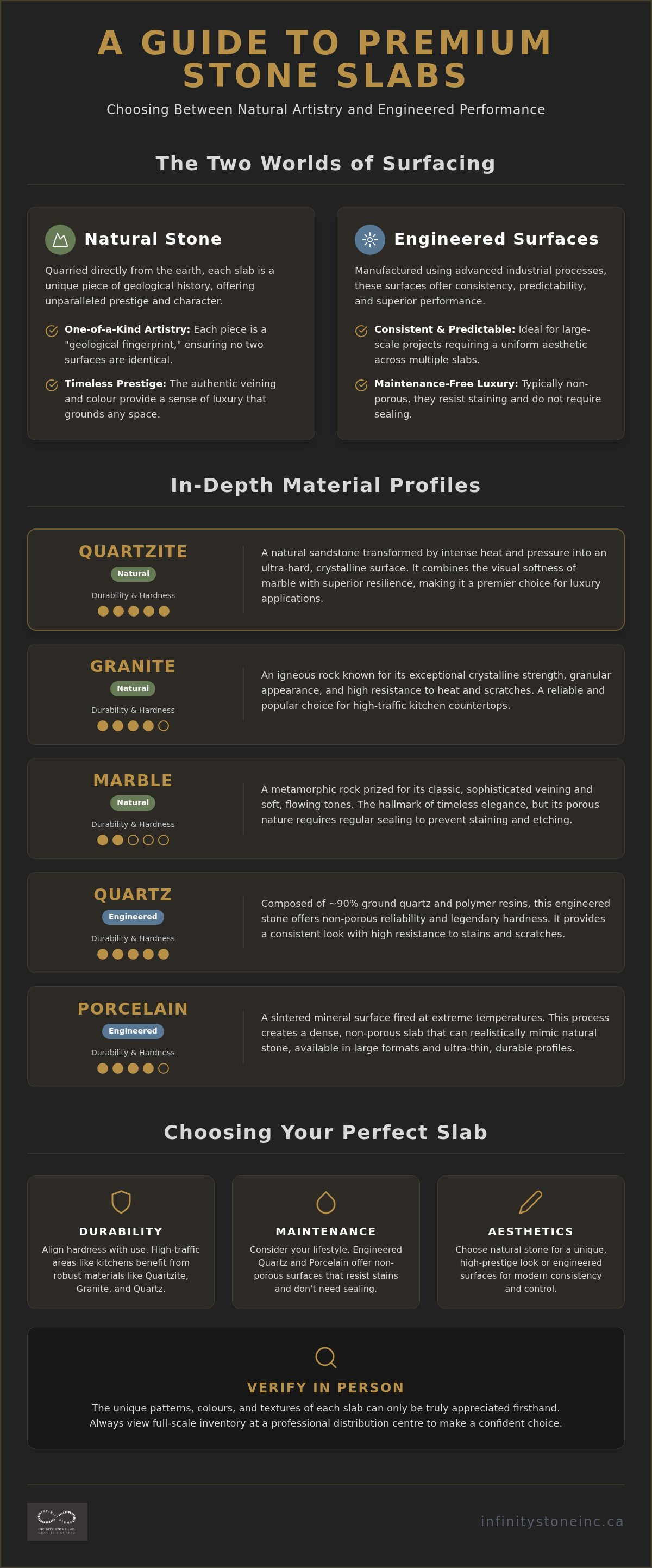
- Marble: A metamorphic rock prized for classic veining and soft, sophisticated tones.
- Granite: An igneous rock known for its crystalline strength and heat resistance.
- Quartzite: A natural sandstone transformed by heat and pressure into an ultra-hard surface.
- Quartz: An engineered stone with high silica content and resin binders for non-porous reliability.
- Porcelain: A sintered mineral surface fired at extreme temperatures to mimic natural stone in thin, durable profiles.
The Appeal of Natural Stone
Natural stone offers a level of prestige that mass-produced materials can't replicate. Each slab serves as a unique geological fingerprint. No two pieces are identical. This inherent variety is a hallmark of high-end Canadian real estate, where authenticity is a key value driver. The subtle shifts in colour and the intricate patterns of natural veining provide a sense of character that grounds a room. It's an investment in a piece of history that continues to evolve with the home's aesthetic. For designers, the challenge lies in selecting the specific slab that captures the desired movement and tone for a specific space.
The Rise of Engineered Materials
Modern design often demands a level of predictability that nature doesn't always provide. Engineered materials have risen to prominence by offering visual consistency across multiple slabs. Technological advancements in porcelain and quartz manufacturing allow for surfaces that mimic rare natural patterns while providing non-porous reliability. It's essential to recognize that most standard quartz slabs currently contain 90% or more crystalline silica. This high mineral density contributes to their legendary hardness. These products meet the growing demand for maintenance-free luxury. They don't require sealing and resist staining, making them ideal for high-traffic environments. When comparing different types of stone slabs, engineered options offer a controlled aesthetic for large-scale commercial or residential installations.
The Prestige of Natural Stone: Marble, Granite, and Quartzite
Natural stone remains the definitive identity marker for luxury interiors. While engineered surfaces offer utility, the geological complexity of natural types of stone slabs provides a depth that synthetic processes cannot replicate. According to U.S. Geological Survey dimension stone information, these materials are categorized by their mineral composition and physical properties, which determines their suitability for specific architectural applications. In a showroom environment, distinguishing between these materials requires a keen eye for crystalline structure and veining patterns. Marble often displays soft, flowing movement; granite features a more granular, speckled appearance. Identifying the right natural stone involves examining the slab's edge and surface under focused lighting to reveal its true mineral character.
Quartzite: The Ultimate Luxury Surface
Quartzite has emerged as a premier choice for high-end projects, particularly for those seeking the visual softness of marble without the maintenance liabilities. These quartzite slabs are trending across Mississauga and the GTA due to their exceptional technical performance. On the Mohs scale of mineral hardness, quartzite typically ranks around 7. This makes it harder than glass and significantly more resistant to physical abrasions than most other natural stones. It's essentially immune to acid etching from citrus or wine, a common pain point for marble owners. Taj Mahal Quartzite remains a notable favourite for its neutral, creamy colour palette and subtle veining, offering a versatile foundation for both contemporary and traditional designs. This material represents the pinnacle of natural performance for the modern connoisseur.
Marble and Granite: Aesthetics vs. Utility
Choosing between marble and granite often involves a calculated trade-off between visual drama and functional resilience. Marble is the global standard for elegance, but its calcium carbonate composition makes it porous. When sourcing marble slabs like Calacatta Viola with its dramatic purple veining, homeowners must commit to professional sealing to preserve the stone's integrity in active kitchens. Granite remains the traditional powerhouse of the industry. Its igneous origin provides superior heat resistance, allowing it to withstand hot cookware without the risk of thermal shock. For heavy-duty applications where utility is paramount, granite's crystalline beauty offers a reliable, low-maintenance solution among the various types of stone slabs available. If you're looking for a specific aesthetic, you can view our handpicked natural inventory to find a slab that matches your lifestyle and performance expectations.
Innovation in Surfaces: Quartz and Porcelain Slabs
Modern architectural requirements often demand performance characteristics that geological formations cannot always guarantee. This necessity has driven a sophisticated shift among GTA designers toward engineered types of stone slabs. While natural stone provides prestige, engineered surfaces utilize industrial innovation to achieve pattern consistency and non-porous reliability. By combining mineral aggregates with high-performance resins and pigments, manufacturers create high-fidelity stone looks that remain predictable across multiple installations. This predictability is vital for large-format projects where seamless transitions and matching veining are paramount for a cohesive design.
The Benefits of Engineered Quartz
Engineered quartz provides a zero-maintenance alternative for high-traffic residential spaces. Its resin-bonded structure ensures a stain-resistant surface that does not require the periodic sealing common with natural stone. According to the Natural Stone Institute design manuals, these materials are designed to withstand the rigours of daily use while maintaining aesthetic clarity. For those managing custom builds, partnering with an established quartz slab supplier in Mississauga ensures access to a vast array of colours. Options range from pristine pure whites to sophisticated concrete textures, satisfying the technical requirements of modern builders and architects. It's important to realize that most standard quartz countertops contain 90% or more crystalline silica, contributing to their legendary hardness and durability.
Porcelain Slabs: The New Frontier
Porcelain slabs represent the latest frontier in architectural surfacing technology. These sintered materials are fired at extreme temperatures, resulting in a surface that is virtually impervious to heat and UV radiation. This technical profile makes porcelain uniquely suitable for both indoor and outdoor living areas, supporting the 2026 trend of seamless transitions between interior and exterior spaces. The sophisticated look of porcelain countertops is particularly effective in minimalist environments. These slabs are often available in ultra-thin profiles, allowing for applications on vertical surfaces and cabinetry where weight considerations are critical. Large-format porcelain panels offer a monolithic appearance that rivals the world's finest natural stones while providing superior resistance to thermal shock and physical wear among all types of stone slabs.
Selection Criteria: Matching Stone Types to Your Project
Selecting from the various types of stone slabs available requires an objective analysis of your daily habits and architectural goals. A high-traffic kitchen island demands a different performance profile than a decorative feature wall or a master ensuite vanity. You must determine your maintenance threshold before committing to a material. Natural stones often require periodic sealing to maintain their integrity, whereas engineered surfaces offer a more hands-off approach. Ontario’s seasonal light cycles also play a critical role in material selection. The cool, blue-toned light of a Canadian winter can make certain grey marbles appear stark, while warmer quartzites maintain their depth. When budgeting for stone slabs, remember that rarity and geological origin are the primary price drivers. Materials sourced from exclusive quarries in Brazil or Italy naturally command a higher investment due to their unique mineral signatures.
High-Performance Kitchens
Professional chefs and active families typically gravitate toward quartzite and granite for their primary work surfaces. These materials offer the highest resistance to physical impact and thermal shock. A common anxiety for homeowners is "etching," which occurs when acidic substances like lemon juice react with calcium-based stones. Quartzite effectively addresses this fear. It provides the soft, sophisticated aesthetic of marble but possesses a chemical composition that resists acid reactions. Porcelain is another excellent contender for high-heat environments. It withstands hot cookware placed directly on the surface, making it a functional powerhouse for modern culinary spaces where utility is as important as design.
Statement Walls and Vanities
Low-traffic areas allow for the use of more delicate, high-impact materials. Marble and onyx are ideal for these applications, where their intricate veining can be preserved without the risk of heavy wear. One of the most prestigious design techniques involves bookmatching. This process mirrors two consecutive slabs to create a perfectly symmetrical focal point, turning a simple wall into a piece of fine art. This technique is particularly effective for feature walls in grand entryways or behind freestanding tubs. Ensure your chosen slab complements existing elements like white oak cabinetry or brushed brass fixtures to maintain a cohesive interior. If you're ready to see how these materials interact with your specific design plan, you can browse our Mississauga slab gallery to find your perfect match.
Sourcing Premium Slabs: The Infinity Stone Experience in Mississauga
Relying on a small sample to select a material for a ten-foot kitchen island is a significant architectural risk. The true character of the various types of stone slabs can only be fully appreciated when viewing the full-scale material in person. At Infinity Stone Inc., we recognize that every high-end project requires a foundational partner who understands the nuances of geological movement and mineral depth. Our team handpicks every piece for the Ontario market, ensuring our inventory meets the rigorous aesthetic standards of the luxury sector. While we focus strictly on slab distribution, we facilitate a professional environment where you can inspect every vein and crystalline cluster. Visiting our Mississauga showroom allows you to explore our curated selection of granite slabs and rare quartzites under professional-grade lighting before they reach your home.
The Designer-Supplier Partnership
We position ourselves as an essential partner for the design community, specifically catering to the technical and aesthetic needs of builders and architects. Our role involves more than simple inventory management; we provide the logistical support necessary to move massive architectural surfaces from our warehouse to your chosen fabricator. Quality control begins at the quarry and continues until the moment the material is loaded for delivery. We ensure that every slab maintains its structural integrity and visual clarity. By focusing exclusively on distribution, we avoid the distractions of installation and fabrication, allowing us to concentrate entirely on sourcing the world's most exclusive natural and engineered materials for your project.
Why Mississauga is the Hub for Stone Sourcing
Mississauga has established itself as the primary hub for stone sourcing within the Greater Toronto Area. Our strategic location provides GTA homeowners and industry professionals with efficient access to a diverse, globally sourced inventory in a single visit. We stay ahead of shifting industry movements, such as the 2026 trend toward warm, earthy tones and textured matte finishes like leathered or honed surfaces. Understanding these shifts in the types of stone slabs preferred by top designers allows us to maintain a forward-looking inventory. Whether you are seeking the neutral versatility of Taj Mahal Quartzite or the innovative resilience of large-format porcelain, our Mississauga centre serves as a reliable authority. We provide the professional guidance needed to help you select a surface that matches both your aesthetic vision and your long-term performance requirements.
Defining Your Architectural Legacy
Selecting the right material is more than a design choice; it's a foundational investment in the character of your home. Whether you prioritize the raw, geological prestige of natural marble or the technical consistency of engineered porcelain, understanding the distinct types of stone slabs is essential for a successful build. You now possess the criteria to match material performance with your specific lifestyle demands, ensuring that your choice stands up to the rigours of daily use while maintaining its aesthetic depth.
At Infinity Stone Inc., we specialize in rare quartzite and marble, supplying the GTA’s most prestigious projects with handpicked global inventory. Our team offers expert material guidance for designers and fabricators to ensure every architectural detail is realized with precision. Explore our curated collection of premium stone slabs at our Mississauga showroom and find the perfect surface to ground your next project. We look forward to helping you select a piece that resonates with your vision for high-end living.
Frequently Asked Questions
What is the most durable type of stone slab for a kitchen?
Quartzite and granite represent the most durable types of stone slabs for high-performance kitchens. Granite provides exceptional heat resistance, while quartzite offers a Mohs hardness rating of approximately 7. These materials resist scratches from stainless steel utensils and withstand the rigours of daily culinary activity. Unlike softer stones, they don't easily chip or etch, making them the preferred choice for GTA homeowners seeking a permanent, low-maintenance work surface that retains its crystalline beauty.
Is there a difference between quartzite and quartz slabs?
The distinction lies in their origin; quartzite is a natural metamorphic rock, whereas quartz is an engineered surface. Quartzite forms when sandstone is subjected to extreme heat and pressure, resulting in a unique geological fingerprint. Quartz slabs are manufactured using roughly 90% crushed silica bound with resins and pigments. While both offer high durability, quartzite provides the heat resistance of natural stone, whereas quartz offers superior non-porous consistency for modern architectural applications.
Do natural stone slabs always need to be sealed?
Most natural stone slabs require periodic sealing to maintain their resistance to moisture and oils. Marble is particularly porous and needs consistent care to prevent deep staining. Even high-density materials like granite and quartzite benefit from a professional-grade sealer to protect their mineral structure. In contrast, engineered surfaces like porcelain and quartz are non-porous by design and never require sealing, making them an ideal alternative for those seeking a maintenance-free luxury environment.
Which stone slabs are best for outdoor kitchens in Ontario?
You can certainly visit our Mississauga showroom to select your material, but the final purchase and delivery are typically coordinated through your professional fabricator. As a specialized distributor, Infinity Stone Inc. focuses on sourcing and providing premium types of stone slabs rather than cutting or installing them. We work as a foundational partner with your chosen stone professional to ensure the slabs are transported safely and processed according to your specific architectural requirements.
Why do prices vary so much between different types of marble?
Pricing for marble is primarily determined by quarry exclusivity, mineral composition, and the drama of the veining. A rare block of Calacatta Viola from a specific Italian quarry commands a higher investment than more abundant varieties like Carrara. The grade of the slab also factors in, with higher value assigned to pieces that exhibit exceptional colour clarity and minimal structural fissures. These high-tier identity markers ensure that every premium slab serves as a unique architectural statement.
What are the benefits of large-format porcelain slabs over traditional tiles?
Large-format porcelain slabs provide a monolithic, seamless appearance that traditional tiles cannot replicate. By minimizing grout lines, these slabs create a cleaner aesthetic and reduce the maintenance associated with cleaning joints. Porcelain's ultra-thin profile allows for innovative applications, such as cladding cabinetry or creating lightweight feature walls. This material satisfies the technical requirements of modern minimalist design while offering superior resistance to thermal shock and physical wear compared to smaller ceramic formats.
How do I maintain the shine on my granite slab?
Maintaining the lustre of a granite slab requires the use of pH-neutral cleaners specifically formulated for natural stone. You should avoid acidic substances like vinegar or lemon-based cleaners, which can dull the polished surface over time. Wiping away spills immediately prevents moisture from penetrating the mineral pores. Periodic resealing, typically every one to three years depending on usage, ensures the stone remains protected and continues to exhibit the crystalline depth that defines high-quality granite.


