
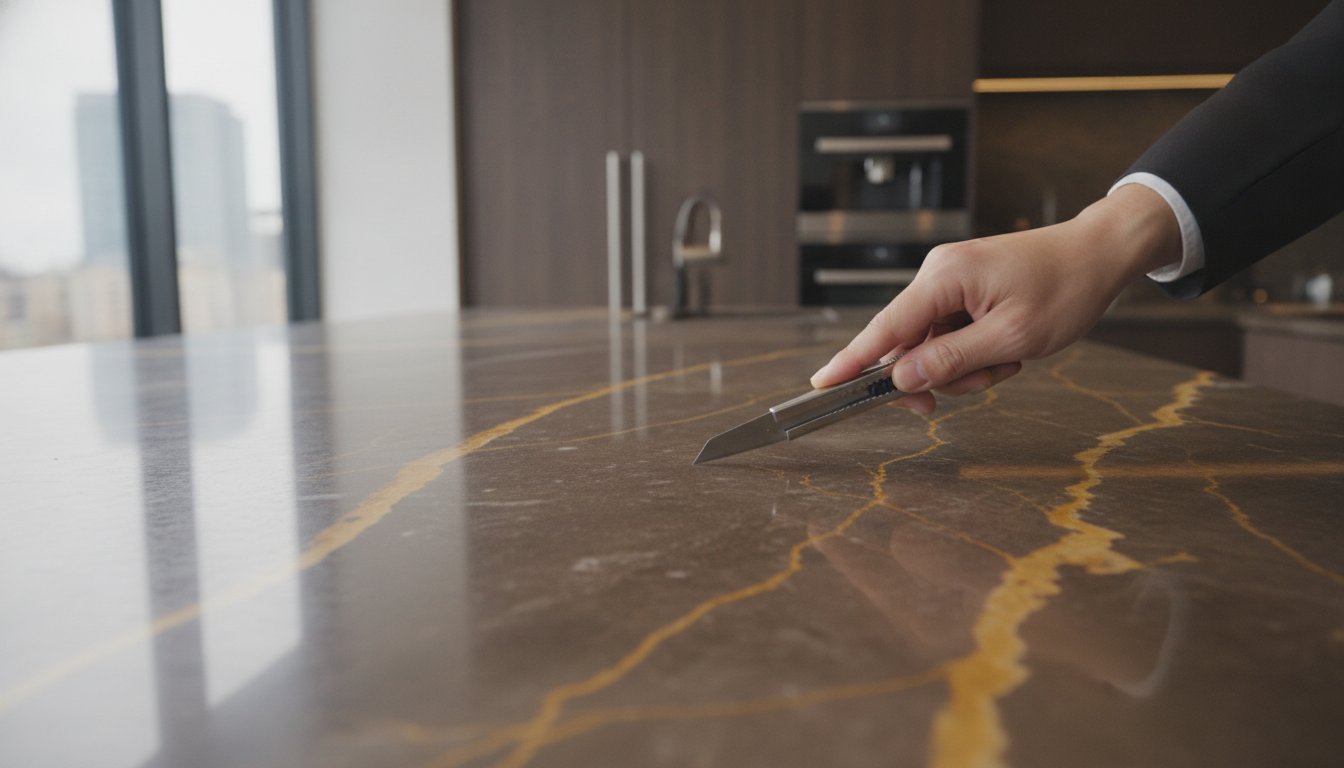
A $15,000 kitchen investment shouldn't be held hostage by a single slip of a paring knife. You've likely felt that familiar pang of anxiety while hosting, watching a guest slide a heavy ceramic platter across a surface you spent months selecting. It's a common frustration; many homeowners prioritize aesthetic prestige only to realize they've inherited a high-maintenance burden. Finding a truly scratch resistant stone for countertops requires moving beyond showroom labels and into the realm of geological hardness and material science.
We recognize that your home requires surfaces that behave like armour while looking like art. This guide provides the technical clarity needed to distinguish between engineered quartz and natural quartzite, offering expert validation on which slabs actually withstand the daily rigours of a sophisticated kitchen. You'll discover how to source the most durable, high-tier materials in the GTA, ensuring your next project delivers both lasting value and effortless elegance. We'll examine the specific performance profiles of granite, porcelain, and quartzite to help you select a foundational element that thrives under pressure.
Key Takeaways
- Learn how the Mohs Scale of Mineral Hardness identifies a truly scratch resistant stone for countertops, moving beyond marketing claims to geological facts.
- Discover why natural quartzite is the premier choice for Mississauga homeowners seeking the prestigious look of marble with vastly superior durability.
- Compare the performance profiles of traditional granite and high-density porcelain slabs to determine the most resilient surface for high-traffic culinary spaces.
- Understand how 2026 design trends like leathered and honed finishes provide a functional advantage by concealing daily wear and tear more effectively than polished surfaces.
- Identify the essential criteria for selecting premium slabs at a professional Mississauga warehouse to ensure both material density and aesthetic excellence.
Understanding the Mohs Scale: What Makes a Stone Genuinely Scratch Resistant?
True scratch resistance isn't a vague marketing term; it's a measurable physical property. In the context of premium architectural surfaces, it refers to a material's ability to resist permanent surface deformation from abrasive force. When you're investing in a high-end kitchen, you're looking for a scratch resistant stone for countertops that can withstand the friction of daily life without losing its lustre. This resistance is determined by the internal atomic structure of the minerals within the slab.
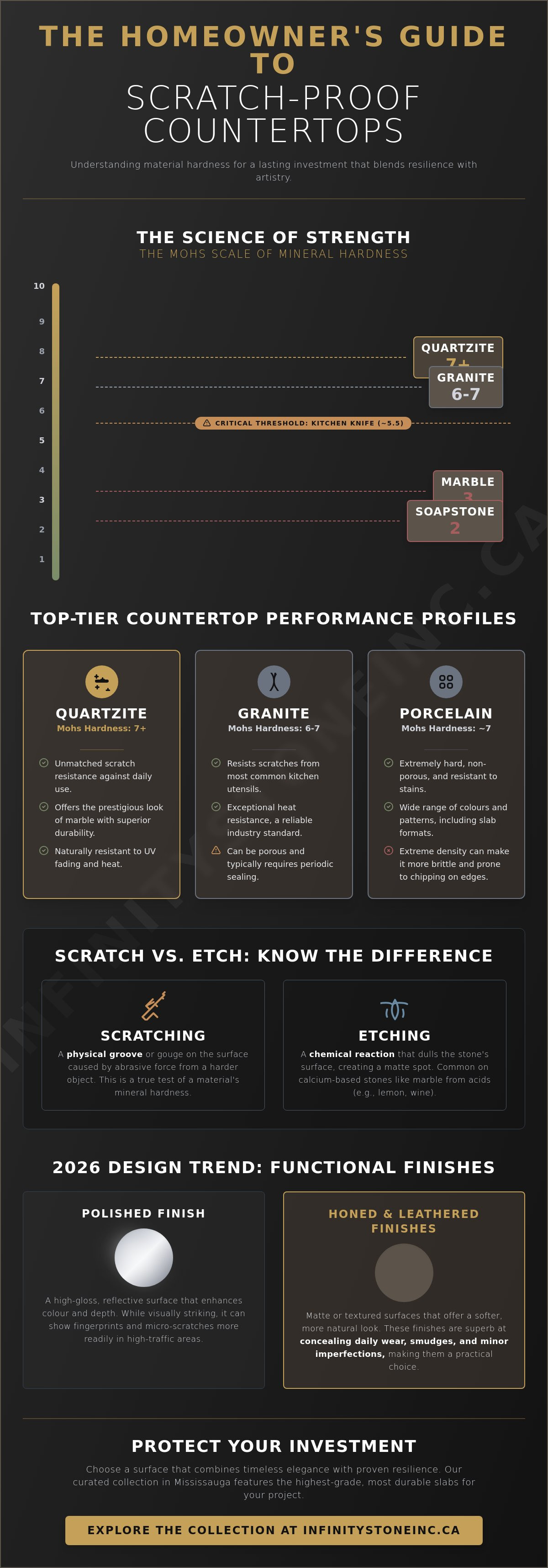
To quantify this, industry professionals rely on the Mohs scale of mineral hardness. This qualitative scale, ranging from 1 to 10, characterizes the scratch resistance of various minerals through the ability of a harder material to scratch a softer one. A standard stainless steel kitchen knife typically measures approximately 5.5 on this scale. If your chosen surface ranks lower than a 5.5, the steel will physically remove material from the stone, leaving a permanent mark. It's also vital to distinguish between physical scratching and chemical etching. Etching occurs when acidic substances, such as lemon juice or wine, react with the calcium carbonate found in stones like marble. This chemical reaction creates a dull, matte spot that homeowners often mistake for a physical scratch.
The Geological Hierarchy of Countertop Materials
The material you select dictates the functional longevity of your workspace. In high-traffic Ontario kitchens, the correlation between mineral hardness and long-term value is absolute. The ranking below illustrates the significant variance in natural stone performance:
- Soapstone (Mohs 2): Velvety and heat-resistant but easily gouged by a fingernail or a dropped fork.
- Marble (Mohs 3): Prestigious and aesthetically unmatched, yet highly susceptible to both deep scratches and severe etching.
- Granite (Mohs 6-7): A reliable industry standard that generally resists most metal utensils and kitchen tools.
- Quartzite (Mohs 7+): The pinnacle of natural performance, often outranking even the highest quality steel in hardness.
This hierarchy is determined by mineral composition. Slabs with high concentrations of crystalline quartz offer the most resilient defence against abrasive forces, ensuring the surface remains pristine over decades of use.
Why Durable Does Not Always Mean Scratch Resistant
Durability is a broad term that often masks specific material vulnerabilities. A stone can exhibit exceptional heat resistance, as seen in many granites, while remaining susceptible to scratches from specialized ceramic tools or heavy cast iron cookware. The Mohs scale remains the industry standard for verifying mineral hardness in 2026. Hardness specifically measures surface integrity, whereas impact resistance refers to how well a stone resists chipping or cracking upon heavy contact. A material might be incredibly hard and scratch resistant stone for countertops, like porcelain, but its extreme density can make it more prone to edge chipping if struck by a heavy pot. Balancing these mechanical traits is the hallmark of a sophisticated design choice.
Quartzite Slabs: The Pinnacle of Natural Scratch Resistance
Quartzite represents the ultimate marriage of geological resilience and high-end aesthetics. Formed through the intense metamorphic transformation of sandstone under tectonic heat and pressure, this stone emerges with a crystalline structure that is remarkably dense. For Mississauga designers and homeowners who desire the ethereal veining of marble without its characteristic fragility, quartzite is the premier choice. It offers a level of surface integrity that few natural materials can match, establishing itself as a top-tier scratch resistant stone for countertops in modern Canadian homes.
While many materials claim durability, the technical performance of quartzite is grounded in its high silica content. As noted in Forbes' guide to countertop materials, selecting the right surface requires balancing visual appeal with practical longevity. Varieties like Taj Mahal or Perla Venata provide the creamy, sophisticated palettes often found in luxury estates across the GTA, yet they possess a hardness that far exceeds traditional limestone or marble alternatives. To truly understand the breadth of these materials, you may wish to explore our detailed analysis of Premium Quartzite Slabs in Ontario: The Connoisseur’s Guide to Luxury Surfaces.
Natural Quartzite vs. Marble: The Hardness Gap
The visual similarities between quartzite and marble often lead to confusion during the selection process. While they may share similar colour profiles, their performance in a functional kitchen is vastly different. Marble is a soft, calcium-based stone that yields easily to metal pressure. In contrast, quartzite can withstand direct contact from glass bottles or stainless steel blades that would leave permanent gouges in softer materials. Professionals often use the "Glass Test" at the warehouse to verify authenticity; a true piece of quartzite will easily scratch a glass tile, whereas a glass tile will scratch a piece of marble. This simple verification ensures you are investing in a genuine metamorphic powerhouse rather than a delicate look-alike.
Investment Value of High-Hardness Natural Stone
Choosing a high-hardness surface is a strategic financial decision for any long-term residence. True quartzite is harder than steel, making it virtually immune to common kitchen implements. This inherent strength significantly reduces the need for professional refinishing or restoration over a 20-year period, as the surface maintains its factory-polished lustre despite heavy use. Within the competitive GTA real estate market, the presence of premium quartzite slabs serves as a marker of quality and exclusivity, often positively influencing property resale value. Because these slabs are geologically rare compared to standard granite, they offer a unique architectural signature for your home. If you are ready to elevate your space, you can view our latest quartzite inventory to find a slab that aligns with your design vision.
Granite and Porcelain: Comparing Durability Across Premium Surfaces
While quartzite remains the pinnacle of natural hardness, granite and porcelain offer diverse advantages for those seeking a scratch resistant stone for countertops. These materials provide a versatile spectrum of design possibilities, ranging from the intricate, organic patterns of igneous rock to the hyper-realistic, large-format aesthetics of modern engineered surfaces. Selecting between them requires a nuanced understanding of how geological composition and manufacturing techniques influence daily performance in a high-end kitchen environment.
Granite has long been the foundational standard for luxury surfaces in Ontario. Its resilience is a direct result of its formation from molten magma, which cools slowly to create a dense, interlocking crystalline structure. On the Mohs Hardness Scale, most premium granites rank between 6 and 7. This rating indicates that the stone is harder than the carbon steel found in many professional-grade kitchen knives, providing a reliable defence against accidental slips during food preparation. Unlike softer stones, granite maintains its surface integrity under significant abrasive pressure, making it a perennial favourite for active households.
The Resilience of Premium Granite Slabs
The mineral matrix of granite is not uniform across all varieties. Darker granites often exhibit superior density and scratch resistance compared to lighter, more porous options. This is largely due to the high concentration of quartz crystals and feldspar within the stone, minerals that are naturally resistant to physical deformation. For homeowners sourcing exotic slabs in Mississauga, choosing a variety with a tight grain structure ensures a sophisticated balance of deep, saturated colour and long-term structural strength. These slabs resist the micro-scratching that can dull the finish of inferior materials over time.
Porcelain Slabs: The Modern Engineered Alternative
Porcelain represents a significant technological advancement in architectural surfaces. If you are exploring this category, our Luxury Porcelain Countertops in Ontario: The Sophisticated Homeowner’s Guide provides an essential overview of its unique properties. Engineered through a process of extreme heat and pressure known as sintering, porcelain achieves a hardness of Mohs 7 to 8. This makes the surface virtually impervious to scratching from domestic implements.
However, sophisticated buyers should recognize a critical distinction: surface hardness does not always equate to impact resistance. While a porcelain slab is nearly impossible to scratch, its extreme density can make the edges more brittle than natural granite. Edge chipping is a more common concern than surface scratching in porcelain installations, particularly in high-traffic areas. From a maintenance perspective, porcelain offers an advantage as it is non-porous and requires no sealing, whereas granite benefits from periodic treatments to preserve its pristine condition against oils and pigments.
Beyond the Surface: How to Protect Your Investment in a Busy GTA Kitchen
Selecting a scratch resistant stone for countertops is only the first step in ensuring the longevity of a luxury kitchen. While geological hardness provides the foundation, the specific finish applied to the slab determines how well it conceals the inevitable micro-abrasions of a high-traffic household. In the Greater Toronto Area, where open-concept kitchens serve as both culinary hubs and social centres, the aesthetic preservation of these surfaces is paramount. Even the most resilient metamorphic rocks require a nuanced approach to daily care to maintain their prestigious showroom appearance.
A common question among sophisticated homeowners is whether any material is truly scratch-proof. In a strictly technical sense, no surface is entirely immune to damage if subjected to extreme force or specialized abrasives. However, premium quartzite and porcelain come remarkably close to this ideal. The goal for a connoisseur is not just to find an indestructible material, but to choose a stone and finish combination that manages wear with grace. This strategic selection ensures that your investment remains a focal point of elegance rather than a source of maintenance fatigue.
Choosing the Right Finish for High-Use Areas
The relationship between surface texture and visible wear is a critical consideration for 2026 interior design. Polished surfaces offer high glamour and a mirror-like reflection that many find irresistible. However, these high-gloss finishes are more likely to reveal micro-scratches over time, as the light reflects unevenly off any disrupted area. For busy families in the GTA, honed and leathered finishes have emerged as the sophisticated choice. Honed surfaces provide a velvety, matte look that diffuses light, effectively masking minor surface marks. Leathered finishes are particularly trending this year for their tactile, organic texture. This undulating surface not only hides wear and tear but also adds a layer of architectural depth to the kitchen island or backsplash.
Daily Care for Professional-Grade Kitchens
Maintaining the integrity of your stone requires a departure from aggressive, mass-market cleaning habits. Professional-grade kitchens thrive on a schedule of simple, PH-neutral cleaning. Abrasive powders or highly acidic cleaners can eventually dull the factory finish of even the hardest granite or quartzite. Despite the extreme hardness of these materials, the myth of the "knife-safe" countertop should be disregarded. While a quartzite slab may technically be harder than a stainless steel blade, cutting directly on the stone will quickly dull your professional cutlery and can, over years of repetition, create localized dull spots. Using a dedicated cutting board preserves both your high-end knives and the pristine surface of your scratch resistant stone for countertops. To see how these finishes look in person, you can browse our Mississauga slab gallery and experience the textures firsthand.
Sourcing the Hardest Slabs: The Infinity Stone Inc. Collection in Mississauga
Identifying the ideal scratch resistant stone for countertops is a technical endeavour that requires more than a cursory glance at a small sample. It demands a partner who understands the geological nuances of mineral density and the specific requirements of high-end Canadian interiors. At Infinity Stone Inc., our role as a specialized supplier is to bridge the gap between global quarrying excellence and the refined needs of the GTA design community. We focus on hand-selecting slabs that meet rigorous standards for both aesthetic depth and structural integrity.
Our warehouse in Mississauga serves as a curated repository for homeowners and industry professionals who refuse to compromise on durability. By maintaining a deep inventory of quartzite, granite, and porcelain, we provide the physical evidence of quality that digital catalogues cannot replicate. Every slab in our collection is evaluated for its geological density, ensuring that the materials we provide behave as intended in a professional-grade kitchen. This commitment to quality verification allows our clients to invest with quiet confidence, knowing their selected surface is geologically prepared for the rigours of daily life.
Our Curation Process for Premium Materials
The journey of a premium slab begins in global quarries known for producing minerals with superior hardness. We prioritize sourcing quartzite and granite from regions where tectonic history has created the densest crystalline structures. Seeing a full slab in person is essential; it's the only way to realize the true scale of the veining and the consistency of the mineral matrix. While we do not provide fabrication or installation, we work alongside your chosen professionals to ensure the material's technical properties are respected throughout the project. This collaboration ensures that the inherent hardness of our stone is preserved from our warehouse to your final installation.
Visit Our Mississauga Stone Gallery
A visit to our gallery is a purposeful step toward completing a sophisticated design project. To make the most of your viewing, we recommend bringing cabinet door samples, paint swatches, and flooring offcuts to see how the stone interacts with your specific colour palette. Our team provides professional guidance on matching material hardness to the functional demands of your space, whether you're outfitting a high-traffic kitchen island or a serene master bath. We invite you to explore our current inventory of premium stone slabs in Mississauga and discover the perfect scratch resistant stone for countertops. Experience the tactile difference of leathered quartzite or the sleek density of large-format porcelain in a professional environment designed for discerning tastes.
Secure the Foundation of Your Luxury Kitchen
Investing in a premium surface requires a balance between aesthetic ambition and geological reality. You've learned that true durability is measured on the Mohs scale, where materials like natural quartzite and high-density porcelain outperform traditional alternatives. By selecting a scratch resistant stone for countertops with a sophisticated honed or leathered finish, you ensure your space maintains its prestigious character despite the rigours of a busy household. These strategic choices transform a simple kitchen feature into a lasting architectural asset.
Infinity Stone Inc. has served the Mississauga and GTA design community since 2017 as a specialized supplier of handpicked quartzite and porcelain. Our expert curation process focuses on identifying slabs that offer both unparalleled mineral density and striking visual appeal. We invite you to visit our gallery to experience the tactile quality and depth of our inventory in person. Our team is ready to help you navigate our collection to find the perfect match for your design requirements.
View Our Curated Collection of Premium Stone Slabs and find the architectural cornerstone your project deserves. Your vision for a resilient, high-end home is within reach.
Frequently Asked Questions
Which stone is the most scratch resistant for a kitchen island?
Natural quartzite is the most scratch resistant stone for countertops currently available on the market. It consistently ranks at a 7 or higher on the Mohs scale, which means it's geologically harder than most common kitchen implements. While porcelain is a formidable engineered alternative, quartzite remains the premier natural choice for homeowners seeking maximum surface integrity in high-traffic culinary spaces.
Can I cut directly on a quartzite countertop without scratching it?
You shouldn't cut directly on quartzite, even though the stone is technically hard enough to resist the blade. The primary issue isn't the stone scratching, but rather "metal transfer," where the steel of the knife rubs off onto the harder stone surface, leaving dark, stubborn marks. Furthermore, the extreme density of the quartzite will instantly dull your professional cutlery, making a cutting board essential for tool maintenance.
Does quartz scratch more easily than natural stone like granite?
Engineered quartz is generally more susceptible to scratches than natural granite because of its resin binders. While the quartz crystals themselves are hard, the petroleum-based resins used to hold the slab together are relatively soft and can be abraded by heavy pots or sharp objects. Granite, an entirely mineral-based igneous rock, offers a more uniform level of hardness across its entire surface.
How do I tell the difference between marble and quartzite at a stone warehouse?
The glass test is the most reliable method for distinguishing these two stones during a warehouse visit. A true piece of quartzite will easily leave a permanent scratch on a glass tile, while marble is too soft to do so. Additionally, you can inspect the slab for a "sugary" crystalline structure on the unfinished edges, a characteristic geological marker of quartzite that's absent in marble.
Will a honed finish hide scratches better than a polished finish?
A honed finish is exceptionally effective at concealing micro-abrasions and daily wear. Because the surface is matte, it diffuses light rather than reflecting it like a mirror, which prevents small scratches from becoming visible focal points. Polished finishes, while glamorous, highlight any disruption in the surface integrity because the light reflects unevenly off the scratched area.
Is porcelain more scratch resistant than granite for outdoor kitchens?
Porcelain offers superior scratch resistance and environmental durability for outdoor applications in the Ontario climate. It typically ranks between 7 and 8 on the Mohs scale, giving it a slight hardness advantage over many granite varieties. Since porcelain is a vitrified, non-porous material, it also resists UV fading and the structural stress of freeze-thaw cycles more effectively than natural stone.
What should I do if my stone countertop gets a deep scratch?
Deep scratches require professional restoration to ensure the repair is invisible and the surface remains level. You should avoid DIY buffing kits, as they often create a permanent "haze" or a physical dip in the stone's profile. A specialist will use diamond-polishing pads and colour-matched resins to fill the void and mechanically blend the texture back to its original factory specifications.
Do I need to seal my quartzite slabs to prevent scratches?
Sealing your quartzite won't provide any protection against physical scratches. Impregnating sealers are designed to fill the microscopic pores of the stone to prevent liquid absorption and staining, but they don't create a hard shell on the surface. To maintain a scratch resistant stone for countertops, you must rely on the inherent mineral hardness of the slab rather than topical chemical treatments.


