
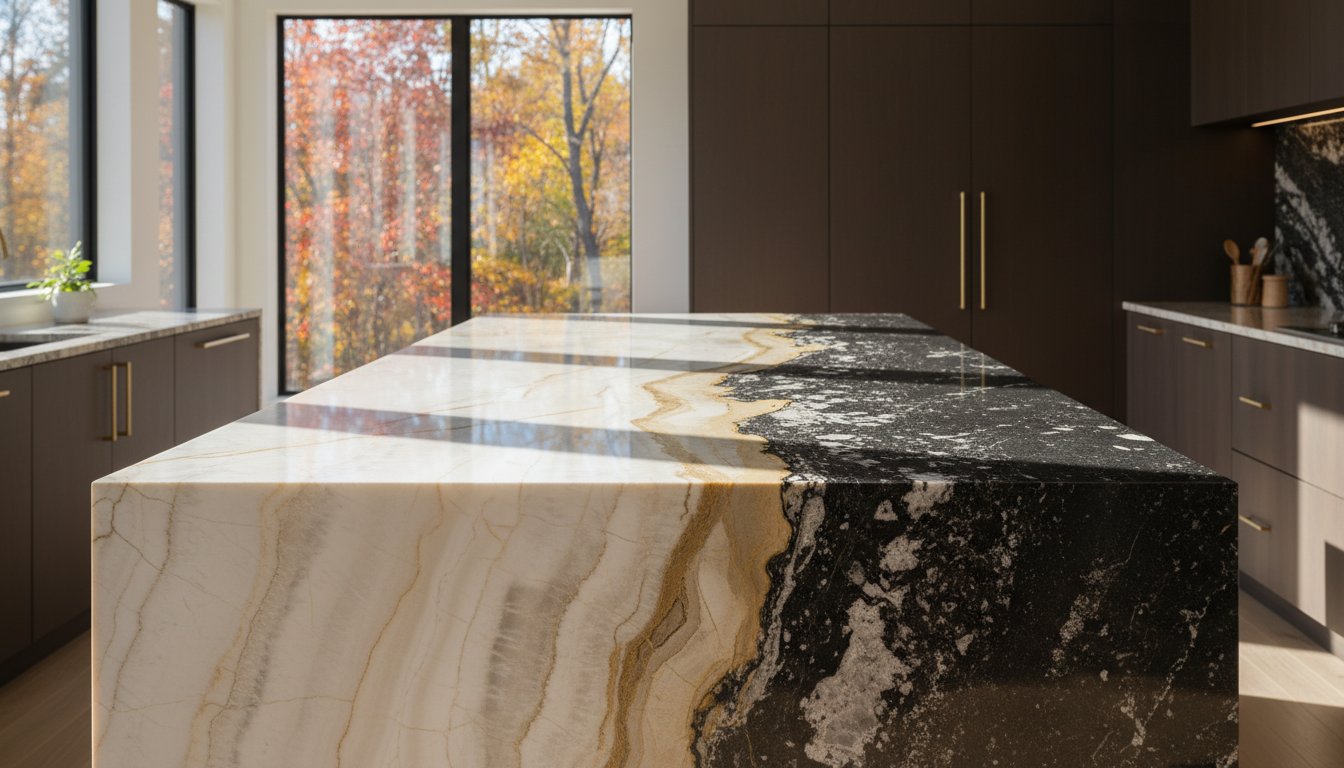
If you believe that granite is the undisputed champion of geological resilience, you might be overlooking a stone that actually surpasses it on the Mohs scale. For homeowners across the Greater Toronto Area, selecting a surface isn't just about the depth of its colour; it's a commitment to long-term performance. You likely already recognize that natural stone is the gold standard for luxury interiors, yet the technical nuances of quartzite vs granite durability can feel surprisingly complex. It’s natural to feel uneasy about the risk of staining a high-cost investment or to feel confused by the differences between natural quartzite and engineered alternatives.
This comparison clarifies the physical properties of these elite materials so you can invest with quiet confidence. You'll discover the specific benchmarks for heat and scratch resistance that define high-end living. We provide a definitive look at how these stones behave in functional residential spaces, from chemical stability to maintenance cycles. This guide serves as your professional partner, moving from geological facts to practical applications. By the end of this analysis, you'll have the insight needed to select a foundational element that perfectly aligns with your architectural vision.
Key Takeaways
- Identify the geological distinctions between igneous granite and metamorphic quartzite to understand their inherent structural strengths and long-term performance.
- Evaluate quartzite vs granite durability through the Mohs scale to ensure your selected material resists scratches from culinary tools and high-traffic use.
- Master the difference between true quartzite and "soft" varieties like dolomite to protect your investment from chemical etching and acidic damage.
- Determine the specific maintenance and sealing requirements based on stone porosity and colour to maintain a pristine aesthetic for a lifetime.
- Learn why hand-selecting slabs from a curated Mississauga inventory is essential for verifying the technical integrity and visual excellence of high-tier natural stone.
Geological Origins: Why Composition Dictates Durability
Understanding the technical nuances of quartzite vs granite durability begins far beneath the earth's surface. The structural integrity of a luxury countertop isn't arbitrary. It's a direct result of the intense heat and pressure that forged the stone millions of years ago. To appreciate why these materials are the foundational elements of high-end living, one must first recognize their distinct origins.
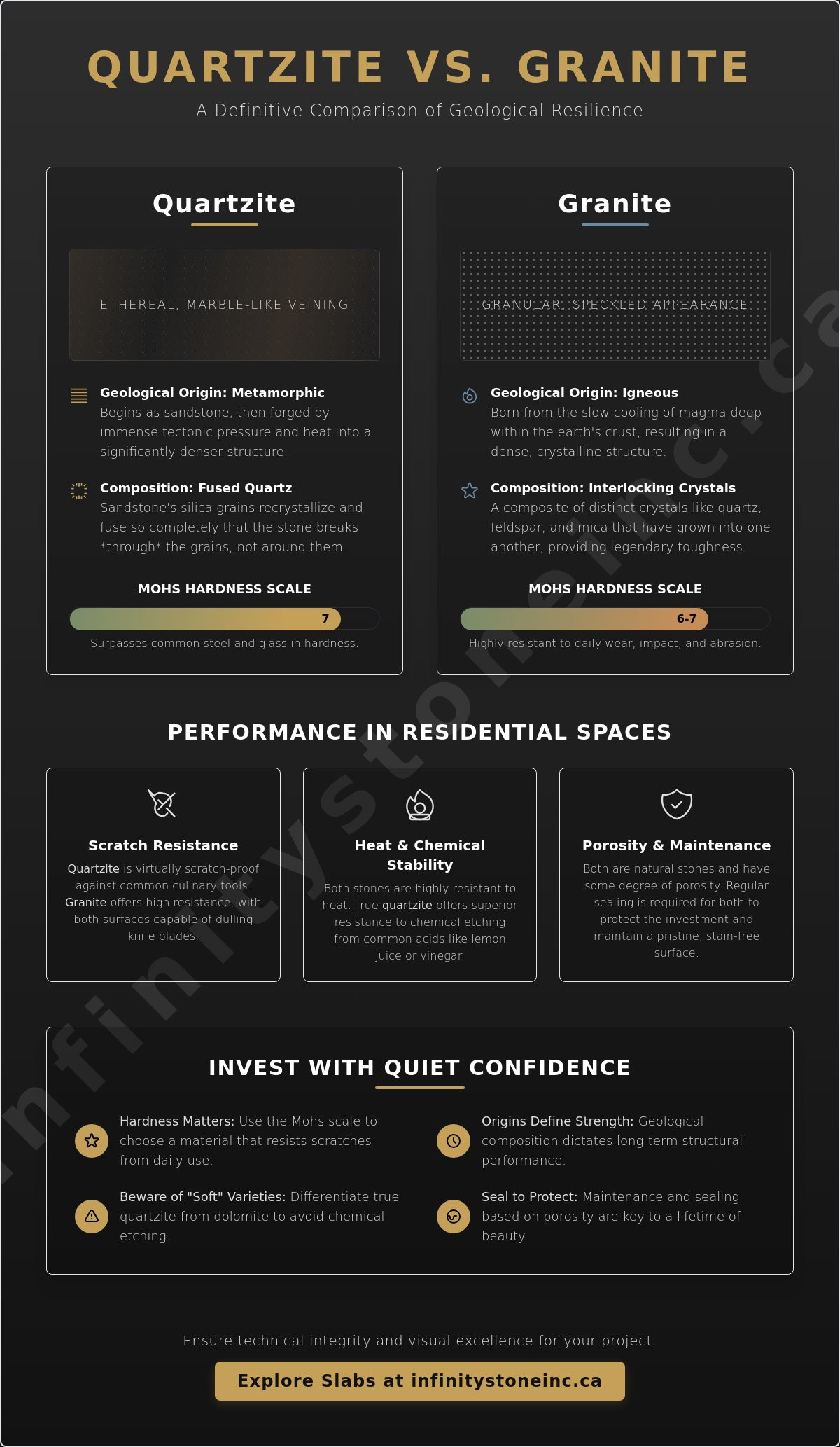
Granite is an igneous rock, born from the slow cooling of molten magma deep within the crust. This process allows minerals like quartz, feldspar, and mica to crystallize into a dense, interlocking matrix. Conversely, quartzite is a metamorphic rock that begins as sandstone. Under extreme tectonic pressure and geothermal heat, the individual quartz grains recrystallize into a fused, mosaic-like structure that is significantly denser than its original form.
The captivating palettes and textures of these stones are dictated by mineral impurities. Iron oxides produce deep reds and pinks, while minerals like chlorite introduce subtle greens. These variations ensure that every slab is a singular work of natural art, offering a curated aesthetic for discerning Ontario interiors.
The Metamorphic Strength of Quartzite
The Quartzite geological formation involves a process where silica grains fuse so completely that the stone will actually break through the grains rather than around them. This creates a material that frequently mimics the ethereal, translucent aesthetic of marble but possesses vastly superior structural strength. High-tier quartzite slabs are among the hardest natural materials available to the design community. They offer a level of permanence that few other stones can match, resisting the pressures of a busy household with ease.
The Igneous Resilience of Granite
Granite relies on its interlocking crystalline structure for its legendary toughness. Unlike the fused grains of quartzite, granite is a composite of distinct crystals that have grown into one another. The presence of feldspar is crucial; it provides the stone with high resistance to daily wear and impact. While quartzite is known for elegant, flowing veining, granite typically displays a granular, speckled appearance. This visual density reflects its internal stability, contributing to the overall quartzite vs granite durability profile that makes both stones industry standards for high-traffic culinary environments.
Hardness and Scratch Resistance: The Mohs Scale Comparison
Quantifying physical resilience requires more than anecdotal evidence. Professionals rely on the Mohs Scale of Hardness to determine how a surface performs under the daily rigours of an active household. This ranking system measures the ability of one mineral to scratch another. A higher numerical value indicates a more formidable surface, directly influencing how a countertop maintains its lustre over time. In the context of quartzite vs granite durability, these technical ratings reveal why certain stones remain pristine despite years of heavy use.
For high-traffic Ontario homes, hardness is a functional necessity rather than a mere aesthetic preference. Surfaces ranking higher on the scale effectively resist abrasions from stainless steel cutlery, ceramic dishware, and heavy cast-iron cookware. However, even the most robust natural materials require thoughtful care. While a knife won't scratch a high-tier slab, the stone's density will quickly dull a professional-grade blade. Using a dedicated cutting board is a standard practice that preserves both the stone's finish and your culinary investment.
Quartzite: The Hardest Natural Countertop Surface
Quartzite typically achieves a rating of 7 on the Mohs scale, surpassing both glass and common steel in terms of sheer hardness. This extreme density makes it virtually impossible to scratch with standard kitchen implements. Because of this structural intensity, these premium stone slabs require specialized diamond-tipped tools for precision cutting. This inherent hardness makes the material more challenging to fabricate, which often reflects in the final project cost. For those seeking the pinnacle of scratch resistance, quartzite stands as the undisputed leader in the natural stone category.
Granite: A Close Second in Daily Durability
Granite remains a stalwart of daily durability, typically ranking between 6 and 6.5 on the scale. While it sits slightly below quartzite in absolute hardness, it offers exceptional resistance to the common accidents of a busy kitchen. One notable advantage of granite's composition is its relative lack of brittleness. Some exotic quartzites can be slightly more prone to edge chipping if struck with force, whereas granite's interlocking crystalline structure provides a resilient buffer. This makes granite an ideal choice for families prioritizing a balance of hardness and impact resistance.
Homeowners looking for technical excellence can view our high-tier natural stone inventory to see these material differences first-hand.
Chemical Sensitivity and Heat: Navigating Etching and Thermal Shock
While hardness determines resistance to physical abrasion, chemical and thermal stability define the daily utility of a stone surface. In the discussion of quartzite vs granite durability, homeowners often express concern regarding etching. Etching is not a stain; it's a chemical reaction that occurs when acidic substances like lemon juice, wine, or vinegar come into contact with calcium-based minerals. This reaction creates a dull, matte mark on the polished surface of the stone. Understanding which materials are prone to this reaction is vital for maintaining a pristine luxury kitchen in any Ontario home.
High-quality sealants act as a sacrificial barrier, providing an essential window of time to wipe away spills before they can penetrate the stone's surface. While granite is generally more consistent in its chemical resistance across different varieties, selecting a true, hard quartzite provides a similar level of protection against the acids common in culinary spaces. Partnering with a knowledgeable curator ensures that the material you select is technically suited for its intended placement, preventing the heartbreak of a damaged investment.
Heat Resistance: From Stove to Surface
Both granite and quartzite possess exceptional heat resistance, far surpassing engineered quartz products which contain resin binders that can scorch or melt. These natural stones are forged in subterranean heat, making them capable of withstanding hot cookware placed directly on the surface. However, the concept of thermal shock remains a factor for all natural materials. Rapid temperature fluctuations can cause the stone to expand and contract unevenly, potentially leading to micro-fissures over time. While the stone itself is resilient, the sealant layer can degrade under extreme heat; consequently, the use of trivets remains a prudent choice for long-term preservation.
The Etching Myth: True Quartzite vs. Dolomite
A common misconception in the design community is that all quartzite is prone to etching. In reality, pure quartzite is chemically inert and won't react to household acids. The confusion arises from "soft quartzite," which is often actually dolomite, a stone containing calcium carbonate. When a slab is mislabelled or misunderstood, the resulting etching can be a source of frustration for homeowners. To verify the technical integrity of a slab, professionals often perform a "glass test." Because true quartzite is harder than glass, it'll easily leave a scratch on a glass tile, whereas softer stones will not. This simple validation ensures that your choice for quartzite vs granite durability meets the high standards of a functional luxury environment.
Porosity and Maintenance: Protecting Your Investment
Porosity is the silent factor in the quartzite vs granite durability debate. While both stones are remarkably dense, they contain microscopic networks of pores that can draw in liquids if left unprotected. The risk of staining is largely a function of this porosity. Generally, darker stones like deep charcoal granites are almost naturally impervious. Lighter-coloured varieties, particularly those with the ethereal look of marble, often possess a higher absorption rate. This doesn't diminish their quality; it simply dictates a more proactive maintenance schedule to ensure the stone remains a pristine foundational element of your interior.
Many designers prefer granite slabs for their predictable performance. The porosity of granite is well-documented across common colour groups, allowing for a standardized care routine. Exotic quartzites, while stunning, can be more variable. Some are as dense as glass, while others require more frequent attention. Understanding the specific geological profile of your individual slab is the key to a lifetime of satisfaction.
Sealing Requirements for Ontario Homes
A high-quality penetrating sealer is the primary defence for natural stone. These products don't sit on top of the surface like a wax; instead, they sink into the stone to fill the microscopic voids. This creates tension that causes liquids to bead rather than soak in. In the specific climate of Ontario, where indoor life centres around the kitchen, sealing frequency is paramount. You can easily perform a "water droplet test" by placing a small amount of water on the surface. If the water beads, your seal is intact. If it absorbs and darkens the stone within 10 to 15 minutes, it's time for a fresh application. While some dense stones only need sealing every few years, high-traffic areas or lighter slabs may benefit from a bi-annual refresh.
Daily Cleaning Best Practices
Maintaining the technical integrity of your investment requires a gentle touch. Use only pH-neutral cleaners specifically formulated for natural stone. Harsh chemicals or acidic "natural" cleaners like vinegar will gradually degrade the sealant, leaving the stone vulnerable to deep-seated stains. Avoid abrasive scrubbers at all costs. Even though these materials are incredibly hard, repetitive abrasion can dull the factory polish over time. Wiping up spills immediately, especially oils, red wine, and citrus juices, remains the most effective way to preserve the aesthetic excellence of your surfaces.
For more expert advice on material selection, you can contact our Mississauga team for a professional consultation.
Sourcing the Finest Slabs in Mississauga: The Infinity Stone Difference
Selecting the ideal slab is the final, critical stage in securing a high-performance interior. While understanding the technical benchmarks of quartzite vs granite durability is essential, the physical inspection of the material remains irreplaceable. At Infinity Stone Inc., we serve as a dedicated partner for Ontario's design community, providing access to a curated inventory that meets the most rigorous architectural standards. Our Mississauga gallery is designed for professionals and homeowners who demand technical excellence alongside aesthetic beauty. We source our materials from elite global quarries, ensuring that every piece of quartzite or granite reflects the pinnacle of geological development.
Hand-selecting your exact slab is the only way to guarantee the visual and structural results of your project. Natural stone is inherently unique; the veining patterns and mineral clusters you see on a full-sized slab cannot be fully captured by a small sample. By visiting our local inventory in person, you can verify the stone's integrity and ensure the movement of the patterns aligns with your design vision. This direct engagement with the material provides a level of confidence that mass-market digital catalogues simply cannot offer.
Why a Specialized Supplier Matters
Mass-market retailers often provide limited samples that fail to represent the true character of a natural stone. In contrast, a specialized slab distributor offers the opportunity to view full-sized material, allowing you to witness the authentic scale of veining and mineral distribution. Our focus remains exclusively on material supply. This specialization ensures that every slab in our collection is selected for its structural integrity and visual depth. By prioritizing the quality of the stone itself, we provide the foundational elements required for a luxury project that lasts a lifetime. You'll find a breadth of inventory here that far exceeds the standard options found in general hardware stores, including rare exotic quartzites and classic, high-performance granites.
Realizing Your Design Vision in the GTA
We collaborate closely with builders and decorators across the Greater Toronto Area to source materials that align with specific project requirements. Transparency is a cornerstone of our process. We provide detailed information regarding the geological properties of every slab, from its Mohs scale rating to its specific porosity profile. This ensures you can choose between quartzite vs granite durability with absolute certainty, knowing exactly how your investment will perform in a functional residential space. Our knowledgeable curators are available to guide you through the technical specs of our exotic stones, helping you navigate the nuances of mineral composition and chemical stability. We invite you to experience our collection in person, where you can examine the textures and colours of our premium slabs under professional lighting. Visit our Mississauga gallery today to view our current inventory of high-tier natural and engineered surfaces and find the perfect stone for your next architectural masterpiece.
Investing in Permanent Excellence
Selecting the right surface involves balancing geological facts with practical lifestyle needs. You've seen how the nuances of quartzite vs granite durability dictate everything from scratch resistance to maintenance cycles. While quartzite offers a higher Mohs ranking, granite provides a reliable crystalline structure that has served as an industry standard for decades. Realizing your design vision depends on identifying a slab that matches both your aesthetic sensibilities and the technical requirements of your space. Success lies in distinguishing true natural materials from softer alternatives to ensure your investment remains pristine.
With over 7 years of expertise in luxury stone distribution, Infinity Stone Inc. remains an essential partner for those seeking foundational elements of the highest calibre. Our handpicked inventory is sourced from the world’s most prestigious quarries, specifically curated for the discerning requirements of architects and designers. We maintain a specialized focus on high-end slabs to ensure every project benefits from elite craftsmanship and technical transparency. Browse our curated collection of premium quartzite and granite slabs in Mississauga to find the perfect match for your interior. Your journey toward a sophisticated, long-lasting interior begins with a single, well-informed choice.
Frequently Asked Questions
Is quartzite more durable than granite for a kitchen island?
Quartzite is technically harder on the Mohs scale, but both materials represent the pinnacle of natural stone performance. While quartzite's rating of 7 makes it more resistant to scratches from kitchen tools, granite's interlocking crystalline structure often provides superior resistance to edge chipping. The choice for a kitchen island typically depends on whether you prioritize the extreme hardness of quartzite or the proven all-around resilience of granite.
Does quartzite scratch as easily as marble?
No, quartzite is significantly harder than marble and won't scratch under normal kitchen conditions. While marble typically ranks at a 3 on the Mohs scale, true quartzite achieves a 7, making it harder than glass and most stainless steel blades. This technical distinction ensures that genuine quartzite remains pristine in high-traffic areas where marble would quickly show signs of wear and abrasion.
How often do I need to seal a quartzite slab compared to granite?
Sealing frequency is determined by the specific porosity of the slab rather than its geological classification. Darker granites are often exceptionally dense and may only require sealing every few years. Conversely, lighter quartzites that mimic the look of marble often have higher absorption rates, requiring a fresh seal every six to twelve months to ensure your investment remains protected from deep-seated stains.
Can I put a hot pan directly on a granite or quartzite surface?
Both stones are highly heat-resistant, but the use of a trivet is always the professional recommendation to prevent thermal shock. While these natural materials won't melt or scorch like resin-based engineered surfaces, sudden temperature fluctuations can cause micro-fissures over time. Additionally, excessive heat can gradually degrade the protective sealant layer, making the stone more vulnerable to liquids.
Why do some people say their quartzite etched like marble?
Etching occurs when "soft" quartzite, which is actually dolomitic stone containing calcium carbonate, is mislabelled. True quartzite is chemically inert and doesn't react to acidic substances like lemon juice or vinegar. If a surface develops dull matte spots after contact with acids, it's a definitive sign that the material is a dolomitic variety rather than a pure metamorphic quartzite.
Is granite or quartzite better for a high-traffic bathroom vanity?
Both materials are excellent choices, though granite is often favoured for its exceptional chemical stability in the presence of cosmetics and toiletries. When evaluating quartzite vs granite durability for a vanity, granite's predictable resistance to various household chemicals provides an added layer of reliability. However, a properly sealed quartzite slab will perform equally well while offering a more translucent, high-end aesthetic.
How can I tell if a slab is true quartzite or dolomitic quartzite?
You can verify the technical integrity of a slab by performing a simple "glass test" on a sample piece. Because true quartzite is harder than glass, it'll easily leave a visible scratch on a glass tile or bottle. If the stone fails to scratch the glass, it's likely a softer dolomitic variety that will be prone to etching and scratching in a functional kitchen environment.
Are darker granite slabs more durable than lighter quartzite slabs?
Darker granites are typically less porous and more stain-resistant, but they aren't harder than light-coloured quartzites. In the context of quartzite vs granite durability, colour is often a reliable indicator of density and absorption rates. While a black granite might be nearly impervious to liquids, a white quartzite will still offer superior scratch resistance due to its higher mineral hardness.


