

Can you distinguish between a premium slab and a builder-grade imitation just by looking at the surface? Most homeowners can't, yet the choice between them determines whether a kitchen retains its lustre or suffers from yellowing and scratches within a few years. Understanding quartz countertop grades is essential because the difference lies beneath the polished exterior, hidden in the ratio of resin to natural stone. You aren't just selecting a colour; you're choosing the foundational durability and structural integrity of your living space.
We've designed this 2026 guide to help you master these nuances, ensuring your selection balances aesthetic elegance with the long-term reliability your home deserves. We'll demystify the resin-to-mineral ratios that separate commercial materials from designer-grade surfaces. You'll learn how to identify the markers of high-tier slabs, from through-body veining to sophisticated matte finishes. This framework provides the technical knowledge needed to evaluate slab quality, helping you move from design inspiration to a refined architectural application with absolute confidence.
Key Takeaways
- Distinguish between structural quality and aesthetic complexity to ensure your investment reflects both durability and design artistry.
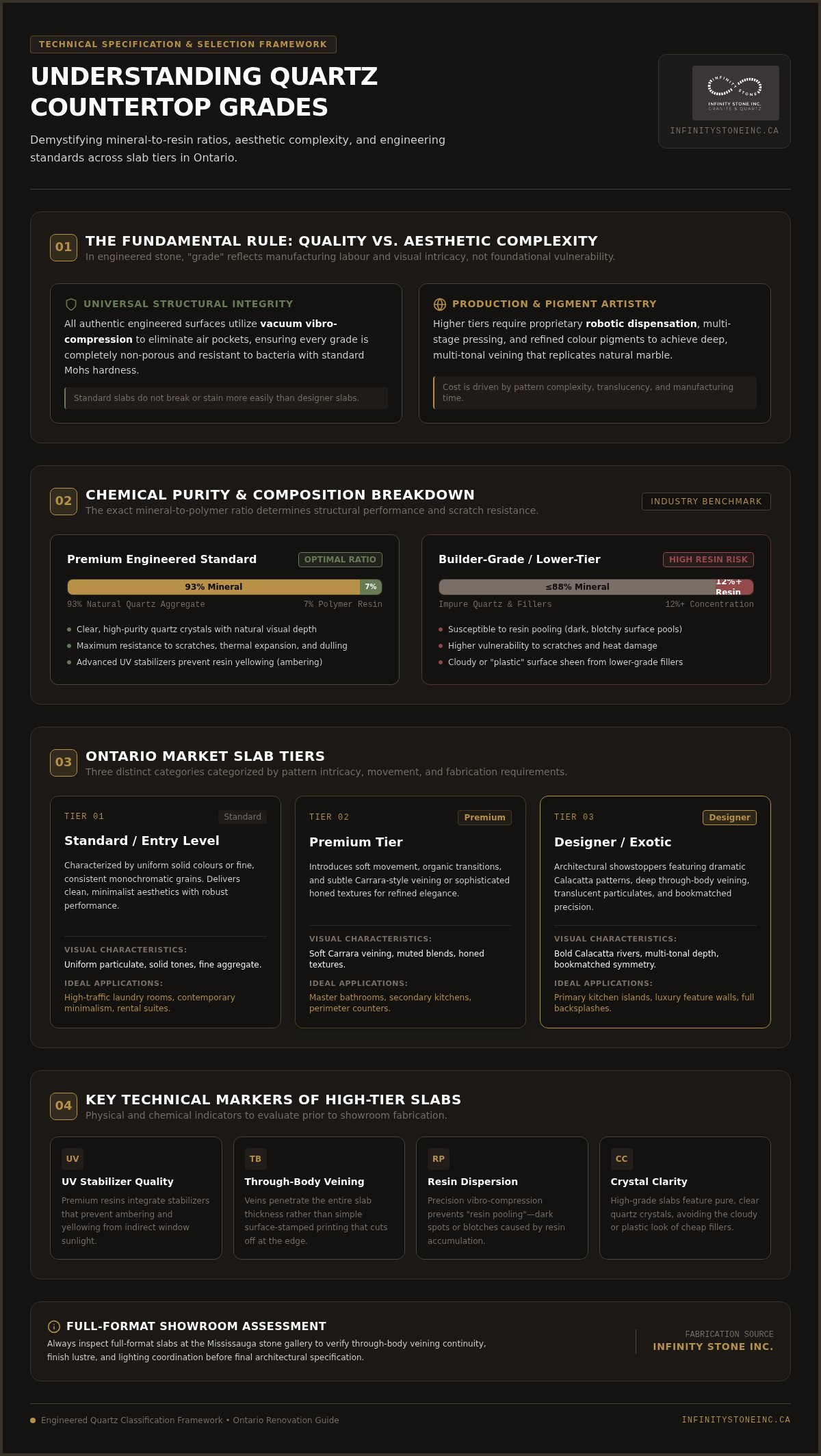
- Master the technical side of understanding quartz countertop grades by looking for the 93% mineral to 7% resin ratio found in premium slabs.
- Navigate the three primary tiers available in Ontario stone galleries to find the "sweet spot" that balances cost with sophisticated visual movement.
- Learn how to coordinate quartz finishes with existing natural stone and architectural lighting to enhance the overall lustre of your kitchen.
- Discover why viewing full-format slabs at a Mississauga showroom is vital for assessing through-body veining before final selection.
Defining Quartz Countertop Grades: Quality vs. Aesthetic Complexity
Understanding quartz countertop grades is often a source of confusion for homeowners planning a luxury renovation. In the stone industry, a "grade" isn't a measurement of how likely a slab is to crack or stain. Instead, it serves as an index for visual intricacy and manufacturing labour. A slab classified as "Standard" possesses the same foundational strength as a "Designer" piece. The distinction lies in the artistry. Manufacturers categorize these materials based on the complexity of the pattern and the cost of the pigments used to achieve specific looks.
The Distinction Between Durability and Design
Every engineered surface relies on a specific engineered quartz composition and manufacturing process involving vacuum vibro-compression. This method ensures that even entry-level slabs remain non-porous and resistant to bacteria. The primary ingredients, crystalline silica and polymer resins, are consistent across the board. High-end aesthetics, however, require significantly more production time. Creating deep, multi-tonal veining that mimics natural marble involves proprietary robotic dispensation and multi-stage pressing. These extra steps increase the cost without necessarily changing the stone's Mohs hardness rating. It's a misconception that lower-tier slabs are prone to breaking; they simply lack the visual depth found in more expensive counterparts.
Common Grading Terminology in the Ontario Market
In Mississauga showrooms, you'll typically encounter three distinct tiers. These categories help designers and builders organize project specifications based on the desired visual impact and budget requirements.
- Standard / Entry Level: These slabs feature solid colours or fine, consistent grains. They're ideal for contemporary, minimalist designs where a uniform look is preferred.
- Premium: This tier introduces subtle movement. You'll see soft Carrara-style veining or honed textures that provide a more organic feel than basic slabs.
- Designer / Exotic: These are the showstoppers. This grade includes dramatic Calacatta patterns, translucent particulates, and slabs specifically engineered for bookmatching on large kitchen islands.
Recognizing these tiers allows for precise budget allocation during a renovation. If you're designing a high-traffic laundry room, a standard slab offers peak durability at a sensible price point. For a primary kitchen island in a luxury home, investing in a designer grade ensures the space becomes a focal point of architectural elegance. Balancing these tiers across different rooms is a hallmark of sophisticated interior planning.
Key Factors That Influence Quartz Slab Grading
A slab's market value depends on its chemical purity and the sophistication of its visual design. Understanding quartz countertop grades requires looking past the brand name to the actual mineral content and the precision of the manufacturing process. While two slabs might look similar from a distance, their long-term performance in a high-traffic kitchen depends on specific technical factors that define their tier.
The industry benchmark for premium engineered stone is a ratio of approximately 93% natural quartz aggregate to 7% polymer resin. Slabs with higher resin concentrations, sometimes reaching 12% or more, are often classified as builder-grade. These lower-tier materials are more susceptible to heat damage and scratching. Manufacturing precision also dictates how well pigments are dispersed. High-grade slabs avoid "resin pooling," which are unsightly dark spots or inconsistent blotches where the resin has accumulated during the curing process.
The Role of Resin and Mineral Composition
The quality of the resin binder is a primary differentiator in luxury interiors. Premium resins are formulated with stabilizers that prevent yellowing, also known as ambering, when the surface is exposed to indirect UV light through kitchen windows. High-grade manufacturing utilizes a vibratory compression vacuum process to eliminate air pockets and ensure a dense, non-porous structure. As you navigate different quartz countertop grading tiers, you'll notice that first-choice slabs also use higher-quality, clearer quartz crystals. This results in a surface with greater depth and clarity, whereas lower grades may appear cloudy or "plastic" due to cheaper fillers and impure minerals.
Aesthetic Artistry: Veining and Pattern Complexity
Design complexity is the most visible factor in grading. Entry-level slabs often feature "stamped" patterns that repeat every few inches, which can look artificial on a large island. In contrast, designer-grade quartz features randomized, multi-tonal veining that mimics the organic movement of natural marble or quartzite. One of the most significant technical achievements in high-end quartz is through-body veining. This means the pattern isn't just printed on the surface; it flows through the entire thickness of the slab. This is essential for mitred edges and under-mount sinks where the side profile is visible.
Bookmatched slabs, where two mirrored slabs are cut to create a symmetrical pattern across a seam, represent the pinnacle of quartz grading. These require immense precision during the casting phase to ensure the veins align perfectly. When selecting materials for a sophisticated project, inspecting full-format slabs is the only way to appreciate these intricate details. Finally, slab thickness plays a role in Ontario residential standards. While 2cm slabs are suitable for vertical cladding or backsplashes, 3cm slabs remain the premium choice for countertops because they offer superior structural integrity without the need for plywood support layers.
Entry-Level to Designer: Navigating the Tiers of Quartz Slabs
Mississauga stone galleries typically categorize inventory into three distinct price groups. These tiers don't reflect a difference in stone hardness, but rather the complexity of the engineering required to achieve specific visual effects. Understanding quartz countertop grades helps homeowners prioritize their budget where visual impact matters most, ensuring that high-traffic areas remain both functional and beautiful. While every slab we distribute meets rigorous standards for durability, the aesthetic payoff varies significantly between a builder-grade solid and a bookmatched designer slab.
Standard Grade: The Functional Foundation
Standard grade slabs are defined by their uniform colour, fine-grained texture, and lack of movement. These materials provide a clean, minimalist foundation for modern kitchen designs. Builders often favour this tier for large-scale developments because it offers a consistent look that's easy to coordinate with various cabinetry styles. In luxury residential projects, this grade finds its "sweet spot" in secondary spaces. Laundry rooms, mudrooms, and secondary bathrooms benefit from the non-porous nature of quartz without the need for the high-cost artistry found in primary living areas.
Premium and Designer Grades: The Luxury Standard
Premium and designer tiers represent the pinnacle of engineered surfacing. These slabs utilize advanced pigment technology to mimic rare natural stones like Calacatta marble or exotic quartzite. You'll notice multi-layered veining, translucent particulates, and "large-format" dimensions that allow for seamless installations in expansive GTA kitchens. When reviewing a quartz countertop selection and fabrication guide, professionals often emphasize that these higher grades are essential for high-impact areas like central islands or full-height backsplashes.
Several visual cues signal a slab belongs in a designer category. You should look for:
- Depth of Colour: High-grade slabs avoid a flat, "printed" look, offering a three-dimensional quality to the pattern.
- Randomized Veining: Unlike standard slabs with repetitive patterns, designer grades feature organic, non-repeating movement.
- Translucency: Premium slabs often incorporate crystalline minerals that allow light to penetrate the surface, mimicking the glow of natural marble.
For most luxury renovations in Ontario, the ideal strategy involves a mix of tiers. Using a premium slab for the perimeter counters and a dramatic designer slab for a waterfall island creates a sophisticated hierarchy of design. This approach ensures the most intricate materials are positioned where they receive the most light and attention, maximizing the architectural impact of the space.
How to Select the Right Grade for Your Mississauga Home
Selecting the perfect surface requires a strategic approach that considers the architectural context of your home. While understanding quartz countertop grades provides the technical foundation, the final decision often rests on how the material interacts with the specific environment of a Mississauga residence. Architects and interior designers prioritize grades based on light exposure, room volume, and the proximity of other high-end finishes. The way natural light hits a honed surface compared to a high-gloss polished slab can dramatically alter the perceived depth of the stone.
Project-Specific Selection Strategies
In high-traffic areas like main kitchens, the grade selection is often driven by visual maintenance. While all grades offer non-porous benefits, designer-grade patterns with complex veining are exceptionally effective at masking the daily wear of a busy household. While structural durability remains relatively consistent across first-choice materials, premium grades often utilize superior resin stabilizers that enhance long-term performance in sun-drenched Ontario kitchens. Beyond horizontal surfaces, premium and designer grades are increasingly utilized for vertical feature walls and fireplace surrounds. For a truly cohesive design, many homeowners are integrating quartz with porcelain countertops in adjacent spaces like butler's pantries or outdoor kitchens to maintain a consistent luxury aesthetic throughout the property.
The Showroom Experience in the GTA
Mississauga has established itself as the premier hub for stone sourcing in Ontario. This concentration of expertise allows homeowners to move beyond the limitations of small 4x4-inch samples. Relying on a small swatch is a common mistake; it cannot convey the full movement or the scale of a Calacatta-style vein. When you visit a professional slab gallery, you can inspect the material under controlled lighting that mimics residential environments. This perspective is vital for identifying the subtle colour shifts that define higher-tier slabs.
During your inspection, pay close attention to the lustre and the clarity of the mineral aggregate. It's essential to ask your supplier about batch consistency and dye lots. Because quartz is an engineered product, slight variations in pigment can occur between different production runs. If your project requires multiple slabs for a large island and matching backsplash, ensuring they come from the same dye lot is critical for a seamless finish. To ensure the highest level of design precision, visit our Mississauga gallery to inspect full-format slabs and hand-select the exact material for your project.
Sourcing Premium Quartz Slabs at Infinity Stone Inc.
Infinity Stone Inc. operates as a discerning authority within the Ontario luxury market. We prioritize quality over quantity, handpicking a global inventory that satisfies the aesthetic requirements of the most demanding design professionals. Understanding quartz countertop grades is simpler when you have access to a curated collection where every slab meets a baseline of elite craftsmanship. Our Mississauga facility serves as a steady partner for those seeking the foundational elements of high-end living, offering a sophisticated environment to explore the juxtaposition of modern engineered surfaces and traditional natural stone.
A Curated Selection of High-End Surfaces
Our portfolio spans the entire spectrum of architectural surfaces, from tech-forward engineered materials to geological rarities. You can explore our range of quartz countertops in Mississauga, where each slab is selected for its mineral purity and design complexity. We bridge the gap between contemporary innovation and the timeless allure of premium marble slabs, providing a comprehensive resource for multi-surface residential projects. This specialized focus ensures that whether you require quartzite, granite, or porcelain, the material quality remains uncompromised. Our inventory includes:
- Premium quartz slabs with intricate through-body veining
- Exotic quartzite featuring rare geological patterns and depth
- High-lustre granite for both traditional and modern applications
- Large-format porcelain for seamless vertical and horizontal surfaces
Visit Our Mississauga Gallery
Realizing a design vision requires more than viewing digital catalogues. We invite homeowners, architects, and designers to our gallery to experience the scale and lustre of our large-format slabs in person. Viewing a full slab is the only way to appreciate the technical nuances that define premium grading, such as the clarity of mineral aggregate and consistent pigment distribution. Our team acts as a knowledgeable curator, guiding you through the selection process to ensure your chosen slab complements your architectural plans and specific lighting conditions.
Once you've selected your ideal material, the next steps involve coordinating with your professional fabricator. While we specialize exclusively in slab distribution to maintain our focus on material excellence, we provide all the technical specifications your fabricator needs for precise cutting and edge treatments. This clear division of expertise ensures you receive the highest grade of stone available in the GTA, backed by the reliability of a dedicated Mississauga supplier. We don't just provide products; we offer the essential components for prestigious living spaces across Ontario.
Elevating Your Architectural Vision with Premium Quartz
Mastering the nuances of stone selection ensures your interior remains a timeless reflection of quality. Understanding quartz countertop grades allows you to distinguish between structural integrity and the aesthetic artistry of high-end manufacturing. By prioritizing slabs with optimal resin-to-mineral ratios and through-body veining, you secure a surface that resists the passage of time while maintaining its original lustre. The right grade balances functional necessity with prestigious design, transforming a standard renovation into a bespoke living space.
Infinity Stone Inc. stands as a trusted partner for GTA design professionals, providing the technical foundation for elite residential projects. As a specialized distributor of large-format slabs, we maintain a handpicked global inventory that bridges the gap between modern engineering and traditional elegance. Our commitment to material excellence ensures every project benefits from curated, high-tier surfaces that meet the rigorous demands of architects and builders alike. Explore our curated collection of premium quartz slabs at our Mississauga gallery. We look forward to helping you select the definitive elements for your next high-end interior.
Frequently Asked Questions
Does a higher quartz grade mean the countertop is more durable?
A higher grade primarily reflects aesthetic artistry rather than raw structural strength. While all first-choice slabs are non-porous and scratch-resistant, understanding quartz countertop grades is vital for avoiding builder-grade materials. Low-tier slabs often contain higher resin-to-mineral ratios, which increases vulnerability to heat damage. Premium slabs utilize a 93% mineral to 7% resin standard, ensuring the surface maintains its integrity in high-traffic kitchens across the GTA.
Why is there such a large price difference between quartz grades?
Production complexity drives the price variation between tiers. Solid colours or fine grains require simple manufacturing processes and less time in the pressing stage. In contrast, designer slabs featuring dramatic Calacatta veining or translucent minerals involve proprietary robotic dispensation and multi-layered pigment technology. These advanced methods mimic the organic movement of rare natural stones, requiring significant labour and specialized equipment to achieve a sophisticated, non-repeating visual result.
Can I use different grades of quartz in the same kitchen project?
Integrating multiple tiers is a sophisticated design strategy for Ontario homes. Many homeowners select a dramatic Designer slab for a central waterfall island to serve as a focal point, while using a Standard or Premium slab for perimeter counters. This approach allows for precise budget allocation without compromising the overall architectural elegance of the space. It's essential to ensure that the base colours of both grades coordinate well under your specific kitchen lighting.
What are the visual signs of a low-grade quartz slab?
Low-grade slabs often exhibit visual inconsistencies that detract from a luxury aesthetic. You might notice resin pooling, which appears as dark, concentrated blotches where the binder has settled unevenly. Other signs include a repetitive stamped pattern that looks artificial on large surfaces and a cloudy, plastic-like finish. Premium slabs avoid these issues through precise manufacturing, offering a crisp mineral clarity and randomized veining that looks indistinguishable from natural stone.
Is Designer grade quartz better than natural stone like quartzite?
The choice depends on your maintenance priorities and aesthetic goals. Designer quartz offers a non-porous, maintenance-free surface that never requires sealing, making it ideal for busy households. Natural quartzite provides unique geological variations and a level of heat resistance that engineered stone cannot match, though it requires periodic sealing. As a specialized distributor of both natural and engineered surfaces, we recommend viewing full slabs to compare the depth of each material.
How do I know if a quartz slab is a Premium grade?
Identifying a Premium slab involves checking both technical specifications and visual markers. These materials typically adhere to the 93% natural quartz aggregate standard and utilize high-quality resins that resist yellowing. Visually, you'll see subtle movement and natural stone mimicry rather than flat, solid colours. Visiting a Mississauga showroom to inspect full-format slabs is the most reliable way to verify the lustre and clarity that distinguish premium materials from entry-level alternatives.
Does slab thickness (2cm vs 3cm) affect the grade and price?
Thickness is a primary factor in both the cost and application of the stone. In the Ontario market, 3cm slabs are the residential standard for countertops because they provide superior structural integrity without requiring plywood sub-tops. While 2cm slabs are more affordable due to lower material volume, they are typically reserved for vertical cladding, backsplashes, or weight-sensitive condo installations. Choosing the right thickness ensures your project meets both aesthetic and structural requirements.
Are certain quartz grades better for outdoor use in Ontario?
Most standard quartz grades are not suitable for Ontario's outdoor environments because the resin binders can yellow or warp under UV exposure. While specialized outdoor-rated quartz is available, many designers prefer porcelain slabs for exterior kitchens in the GTA. Porcelain offers exceptional UV resistance and can withstand the extreme temperature fluctuations of the Canadian climate. Always consult with your supplier to ensure the material grade is rated for its intended placement.


