

"Soft quartzite" is a geological impossibility that costs GTA homeowners thousands in avoidable restoration fees every year. You've likely been captivated by the luminous, marble-like veining of a white slab; however, you may be deterred by warnings of etching, staining, or permanent water shadowing. It's a valid concern. No one wants to risk a significant investment on a surface that cannot handle a spilled lemon or a heavy pan in a high-traffic Mississauga kitchen.
Many documented problems with white quartzite are actually the result of misidentified dolomitic marble masquerading as high-performance stone. We provide the technical clarity you need to protect your interior design. You'll discover the scientific realities behind these common issues and learn how to distinguish premium, dense slabs from inferior alternatives. This guide establishes a clear framework for testing slab quality at the source, explains the critical distinction between true quartzite and its "soft" counterparts, and equips you to choose a durable white surface with absolute confidence.
Key Takeaways
- Distinguish between true metamorphic quartzite and dolomitic imitations to ensure your selected surface resists etching and chemical damage.
- Identify the technical causes behind common problems with white quartzite, including porosity issues and the "water shadowing" effect found in inferior slabs.
- Utilize the glass scratch and acid sensitivity tests to objectively verify the mineral composition of any slab at the distribution centre before purchase.
- Appreciate the necessity of sourcing hand-picked, premium-grade inventory from a reputable Mississauga distributor to minimize long-term maintenance requirements.
- Understand specific fabrication requirements for high-density slabs to prevent edge chipping and ensure a flawless architectural finish for your interior.
The Soft Quartzite Controversy: Misidentification and Mineral Composition
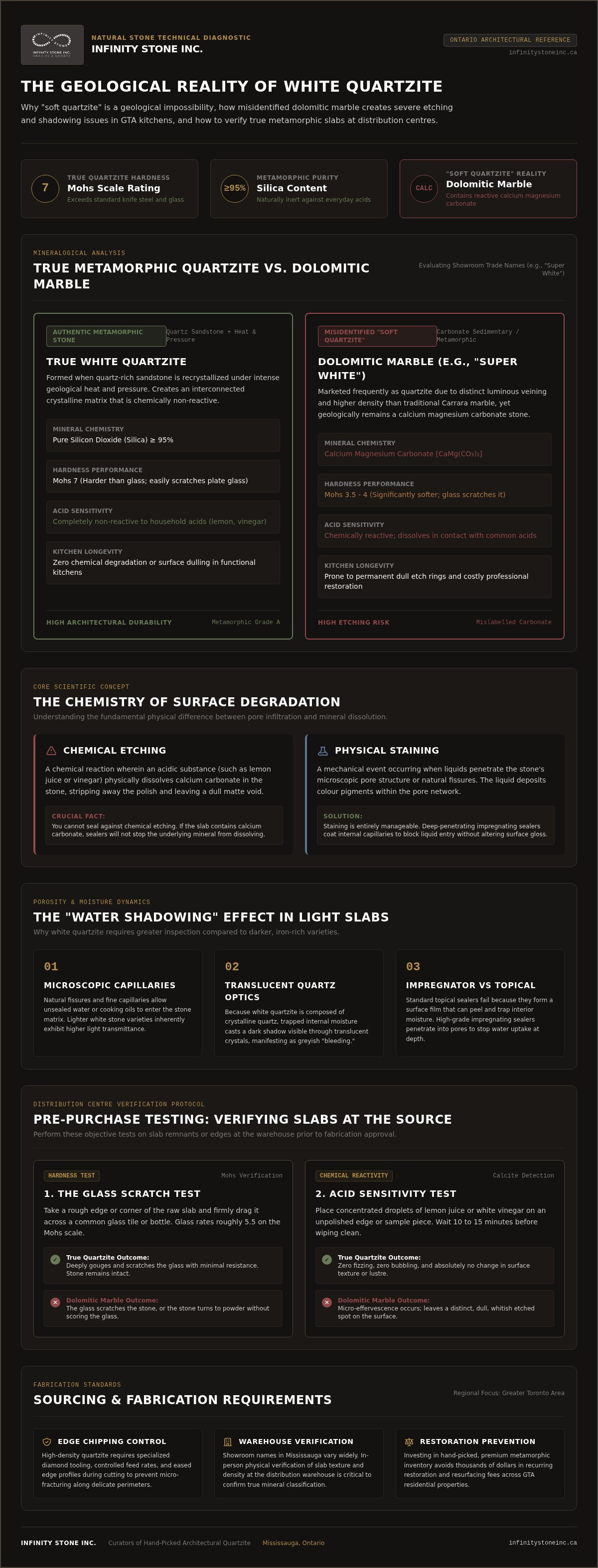
The primary source of most problems with white quartzite stems from a fundamental misunderstanding of geology. While the term "soft quartzite" frequently appears in Ontario showrooms, it represents a geological contradiction. According to the geological definition of quartzite, this material is a metamorphic rock formed when quartz-rich sandstone is subjected to intense heat and pressure. This process creates a surface composed of at least 95% silica. True quartzite reaches a 7 on the Mohs hardness scale, making it harder than glass. By contrast, many white slabs marketed under this label are actually dolomitic marble. These stones contain high levels of calcium magnesium carbonate, making them significantly softer and chemically reactive.
The Super White phenomenon perfectly illustrates this market confusion. It's often categorized as a quartzite for its aesthetic appeal, yet it's geologically a dolomitic marble. While it offers more density than traditional Carrara, it lacks the chemical stability of true metamorphic stone. Homeowners who select these slabs without realizing the mineral composition often encounter the very problems with white quartzite they intended to avoid, such as surface dulling and permanent etch marks from everyday kitchen use.
The Chemistry of Etching vs. Staining
Etching is frequently confused with staining, yet the two represent entirely different physical processes. A stain occurs when a liquid penetrates the stone's pores. Etching is a chemical reaction where acidic substances like lemon juice or vinegar dissolve the calcium carbonate in the stone, leaving a dull, matte mark. Because premium quartzite slabs consist of silica rather than calcite, they're naturally resistant to this chemical damage. Understanding this distinction is vital for your investment. You can seal a stone against stains, but you cannot seal a stone against the chemistry of etching if the minerals themselves are reactive. True quartzite provides an architectural solution that withstands the rigours of a functional luxury kitchen without the fear of surface degradation.
Why Naming Conventions Vary in Mississauga Showrooms
The lack of industry-wide standardization means trade names often prioritize marketing over mineralogy. A slab might be labelled as quartzite in one Mississauga warehouse and dolomitic marble in another. This inconsistency makes it difficult for homeowners to discern quality. To mitigate risk, ask your distributor for specific geological classifications or hardness test results. Reliable curators focus on mineral hardness rather than trends. They ensure that the material you select for a high-traffic kitchen actually meets the technical requirements of your lifestyle. Seeing the slab in person at a Mississauga showroom allows you to verify the texture and density alongside a knowledgeable expert. Verification at the source is the only way to avoid the heartbreak of a misidentified investment.
Porosity and Water Absorption in White Quartzite Slabs
One of the most persistent problems with white quartzite involves its inherent porosity compared to darker, iron-rich varieties. This geological reality means that liquids can penetrate the stone's microscopic capillaries more easily. When water or oils enter these spaces, they create a phenomenon known as "shadowing" or "bleeding," where the stone appears darker or greyish in specific zones. The light colour palette of white stone makes even minor internal moisture visible, as the translucent quartz crystals transmit the shadow from within the slab. Natural fissures, which are common in white stone, can also act as conduits for liquid absorption if they aren't properly addressed during the selection and treatment phases.
Understanding the porosity and metamorphic variation in quartzite is essential for any homeowner. While some slabs are nearly as dense as granite, others require meticulous care to prevent moisture-related issues. If you're concerned about these technical realities, viewing our handpicked inventory in Mississauga ensures you select a slab with superior density and structural integrity.
The Importance of High-Grade Impregnating Sealers
Protecting your investment requires a move away from standard topical coatings. Topical sealers sit on the surface and can peel or trap moisture; deep-penetrating impregnating sealers enter the stone's pores to repel liquids from within. For high-traffic GTA kitchens, we recommend a strict maintenance schedule. A high-quality solvent-based sealer should be applied during installation and refreshed every one to two years depending on usage. You'll know it's time to re-seal when water no longer beads on the surface but instead starts to darken the stone upon contact.
Managing Moisture Around Sink Cutouts
The sink area represents the most vulnerable point for potential problems with white quartzite. Because the edges of the stone are exposed at the cutout, capillary action can draw water horizontally into the slab. This often results in a permanent dark halo around the undermount sink if the edges aren't sealed with the same precision as the surface. While Infinity Stone Inc. provides the premium stone slabs, the success of the installation depends on your fabricator. They must ensure that all raw edges are thoroughly dried and treated with a high-performance sealer before the sink is set. This preventive measure is the most effective way to maintain a pristine aesthetic over the long term.
Surface Vulnerabilities: Scratching and Chipping Risks
High-end residential surfaces require an objective understanding of mineral resistance. While many homeowners fear scratching, true metamorphic quartzite provides exceptional protection. According to the Mohs Hardness Scale scratch testing guidelines, quartz ranks at a 7. This makes it harder than common kitchen utensils, including carbon steel blades which typically sit around 5.5. Consequently, "true" white quartzite is virtually impossible to scratch during routine meal preparation. However, problems with white quartzite often arise when homeowners unknowingly purchase softer dolomitic imitations that rate closer to a 3.5 or 4, leading to surface damage from basic kitchen activity.
Hardness should not be confused with impact resistance. The interlocking crystalline structure that gives quartzite its legendary strength also contributes to a specific degree of brittleness. This physical trait becomes especially relevant when considering modern Mississauga kitchen designs featuring sharp, mitered edges. These edge treatments create a focal point of structural stress. Without careful handling, heavy cast-iron cookware or accidental impacts can cause unsightly chipping at the seams. It's a technical trade-off; the same density that prevents scratches makes the stone less forgiving under blunt force, which is why many reported problems with white quartzite are actually edge-related issues.
Quartzite vs. Marble: The Durability Reality
While marble slabs are often selected for their classic patina and soft veining, they remain geologically vulnerable to both etching and deep scratches. Quartzite serves as the superior choice for clients who require a bright, white aesthetic without the fragility of calcite-based stone. It's the definitive performance material for those who realize they cannot tolerate the wear patterns inherent to marble. Choosing quartzite means opting for a surface that maintains its polished or honed finish despite the rigours of a busy household.
The Impact of Slab Thickness and Edge Profiles
Structural integrity often depends on the chosen slab thickness. While 2cm slabs are suitable for certain applications, 3cm material offers significantly better resistance to structural stress on large-format islands. At approximately 160 lb/ft³, these slabs are exceptionally heavy and require precision-engineered cabinetry support to prevent cracking. To minimize the risk of impact chipping, we recommend pencil or radius edge profiles rather than razor-sharp 90-degree miters. These rounded profiles distribute kinetic energy more effectively during an impact. Professional fabricators in the GTA typically suggest a 1/8 inch or 1/4 inch roundover to ensure long-term edge durability.
Pre-Purchase Testing: How to Verify White Quartzite Quality
Many documented problems with white quartzite can be avoided entirely before the material ever leaves the distributor's warehouse. While digital portfolios provide a glimpse of a slab's aesthetic, they cannot communicate mineral density or chemical stability. Empowering yourself with a few simple field tests ensures that the material you select meets the technical standards required for a high-traffic Mississauga interior. These diagnostic tools allow you to verify whether a slab is a true metamorphic stone or a softer carbonate imitation that will fail under routine kitchen conditions.
To ensure your investment meets these rigorous standards, we invite you to visit our Mississauga showroom to inspect and test our premium quartzite inventory in person alongside our geological experts.
Performing the Glass Scratch Test
The glass scratch test serves as the definitive method for identifying "soft" imitations. To perform this, take an unpolished, sharp corner of a stone sample and press it firmly against a glass tile. True quartzite, which rates a 7 on the Mohs scale, will slice into the glass with ease; it should feel like a diamond cutting through a surface. If the stone merely leaves a trail of white powder without marking the glass, the stone itself is wearing down. This residue indicates a dolomitic or calcitic composition. Because silica is harder than glass and carbon steel, a successful scratch test confirms the slab's immunity to common kitchen scratches.
The Lemon Juice Etch Test
Acid sensitivity is a primary concern for any homeowner desiring a white kitchen. To verify chemical resistance, apply a small amount of lemon juice or white vinegar to an unsealed sample piece and allow it to sit for 15 to 20 minutes. After wiping the liquid away, inspect the area under a bright, angled light. A dull spot, a chalky ring, or a change in texture indicates that the acid has reacted with calcite minerals. This test is essential before committing to varieties like "Super White" or "Fantasy Brown," as it reveals whether the stone will etch when exposed to everyday food acids.
Beyond chemical and hardness checks, you should also perform a porosity and "flashlight" inspection. The porosity test involves placing water droplets on a raw, unsealed edge to see if they absorb and darken the stone within minutes. Rapid absorption signals a more porous variety that will require high-performance solvent-based sealers. Finally, use a high-intensity flashlight held parallel to the slab surface. This technique reveals internal fissures or "dry veins" that might not be visible to the naked eye but could lead to structural problems with white quartzite during the fabrication process. Identifying these vulnerabilities early protects your budget and your design vision.
Sourcing and Fabrication: Minimizing Risk in the GTA
The technical problems with white quartzite often manifest during the transition from the distribution warehouse to the residential kitchen. Mitigating these risks requires a collaborative effort between a discerning slab distributor and a highly skilled fabricator. At Infinity Stone Inc., our role as a specialized curator involves hand-selecting global inventory based on mineral density and structural integrity. We focus on sourcing low-porosity bundles that resist the "shadowing" effects common in inferior white stones. Before any material is dispatched to your project site, we encourage a thorough inspection of your selected white quartzite slab at our Mississauga warehouse. This personal verification allows you to confirm the veining patterns and surface quality under professional lighting, ensuring the material meets your architectural standards.
Choosing a fabricator in Mississauga with specific quartzite experience is non-negotiable for a successful installation. While the aesthetic of white quartzite is often compared to marble, its fabrication requirements are closer to those of precious gemstones. The total "installed" price of your countertops will reflect this complexity. Unlike softer materials, quartzite's extreme hardness increases labour time and requires specialized equipment. Homeowners should understand that the investment covers not just the raw stone, but the technical expertise required to manipulate one of nature's most resilient materials.
Why Hardness Requires Specialized Fabrication
The mineral density of quartzite presents unique challenges for standard stone-working tools. Because it rates a 7 on the Mohs scale, it quickly dulls standard bridge saw blades. Fabricators must utilize diamond-tipped tools and high-volume water cooling systems to prevent the stone from overheating or fracturing during the cut. Consequently, labour costs for quartzite are typically higher than those for quartz countertops in Mississauga. Precision is also required for seam placement. In large white quartzite layouts, the crystalline structure makes seams more visible if they aren't executed with CNC-guided accuracy and colour-matched resin. Professional GTA fabricators prioritize these details to maintain the visual continuity of the white veining.
The Infinity Stone Inc. Selection Process
Our commitment to excellence begins with a rigorous vetting process at the quarry level. We prioritize high-density white quartzite slabs that exhibit the metamorphic strength required for high-traffic Ontario homes. We invite you to our Mississauga showroom to realize the luminous beauty and tactile quality of these stones in person. While Infinity Stone Inc. focuses strictly on slab supply, we maintain a network of the finest fabrication professionals in Ontario. This partnership ensures that the premium material you select from our inventory is handled with the technical respect it deserves, resulting in a foundational element for high-end living that remains pristine for decades.
Securing Your Investment in Architectural Excellence
The luminous allure of white quartzite remains a premier choice for Ontario's most discerning homeowners. While the market frequently discusses potential problems with white quartzite, these issues are almost always preventable through precise geological identification and expert sourcing. Success in high-end design requires more than an eye for beauty. It demands a technical understanding of stone realities. By distinguishing true metamorphic stone from softer dolomitic imitations, you ensure your selected surface delivers both aesthetic elegance and long-term durability.
As a trusted supplier to Ontario's elite fabricators, we provide the foundational elements for a sophisticated lifestyle. Our handpicked collection of rare, high-density quartzites is backed by expert geological guidance for every client. This specialized focus ensures your investment remains protected from the first day of installation. We invite you to experience our curated inventory in person to witness the superior quality that defines our brand.
Visit our Mississauga showroom to hand-select your premium white quartzite slabs today.
We look forward to partnering with you to realize a kitchen space that reflects your uncompromising standards for quality and craftsmanship.
Frequently Asked Questions
Is white quartzite more likely to stain than grey or dark varieties?
White quartzite isn't inherently more porous than darker stones, but its light colour makes any absorbed liquids significantly more visible. Darker varieties often contain higher iron content or denser mineral structures that naturally mask minor imperfections. To prevent aesthetic issues, you must apply a high-grade impregnating sealer. This treatment fills the microscopic pores of the stone, ensuring that common household spills remain on the surface rather than penetrating the slab's luminous interior.
Can I use bleach to clean a stain on my white quartzite countertop?
You should avoid using bleach or harsh abrasive chemicals on your white quartzite slabs. While the stone is geologically resilient, bleach can degrade the protective sealer and lead to surface dulling over time. Instead, use a pH-neutral stone cleaner or a simple mixture of warm water and mild dish soap. These gentle solutions maintain the stone's natural lustre without compromising the chemical barrier that prevents staining and moisture absorption in your kitchen.
Why does my quartzite have a dark shadow around the sink area?
A dark shadow around the sink area is typically caused by moisture penetration through the raw edges of the stone. This occurs when the unsealed cross-cuts of the sink cutout absorb water through capillary action. To fix this, the stone must be thoroughly dried with a heat gun and then properly re-sealed by a professional. Ensuring your fabricator treats these vulnerable edges before the sink is set is the most effective way to avoid these problems with white quartzite.
Does white quartzite need to be sealed more often than granite?
White quartzite generally requires a more rigorous sealing schedule than most granite varieties due to its varying porosity levels. While dense granites might only need treatment every few years, we recommend sealing white quartzite annually or whenever water stops beading on the surface. High-traffic Mississauga kitchens benefit from solvent-based impregnating sealers that penetrate deep into the stone's crystalline structure, providing a robust defence against daily moisture exposure and potential staining.
What is the difference between Super White and true quartzite?
Super White is geologically a dolomitic marble, whereas true quartzite is a metamorphic rock composed almost entirely of silica. This distinction is critical because Super White contains calcite, which reacts with acidic substances like lemon juice to cause etching. True quartzite rates a 7 on the Mohs scale and won't etch or scratch under normal kitchen conditions. Understanding this difference helps you anticipate how your slab will perform over years of functional residential use.
Can I cut directly on my white quartzite surface?
You can technically cut on true quartzite without scratching the stone, but it's not recommended because the surface's extreme hardness will quickly dull your professional knives. Quartzite is harder than carbon steel, meaning your blade will likely lose its edge before the stone shows any wear. Additionally, heavy chopping can cause localized impact stress that might lead to minor chipping. Using a dedicated cutting board preserves both your culinary tools and the stone's polished finish.
Why is quartzite more expensive to install than quartz or marble?
Quartzite is more expensive to install because its extreme hardness requires specialized diamond-tipped tools and significantly more labour time for cutting and polishing. The stone's brittleness also increases the risk of breakage during the fabrication process, requiring a higher level of technical expertise. While Infinity Stone Inc. provides the premium slabs, the total project cost reflects the specialized skills needed to manipulate a material that is significantly denser than marble or engineered quartz.
How can I tell if my quartzite slab is actually a dolomitic marble?
You can identify a dolomitic marble by performing a simple acid etch test or a glass scratch test on a sample piece. If the stone fizzes or develops a dull spot when exposed to lemon juice for fifteen minutes, it contains calcite minerals. Additionally, a true quartzite slab will easily scratch a glass tile without the stone itself wearing down. These diagnostic tests are the most reliable ways to avoid common problems with white quartzite before finalizing your selection.


