
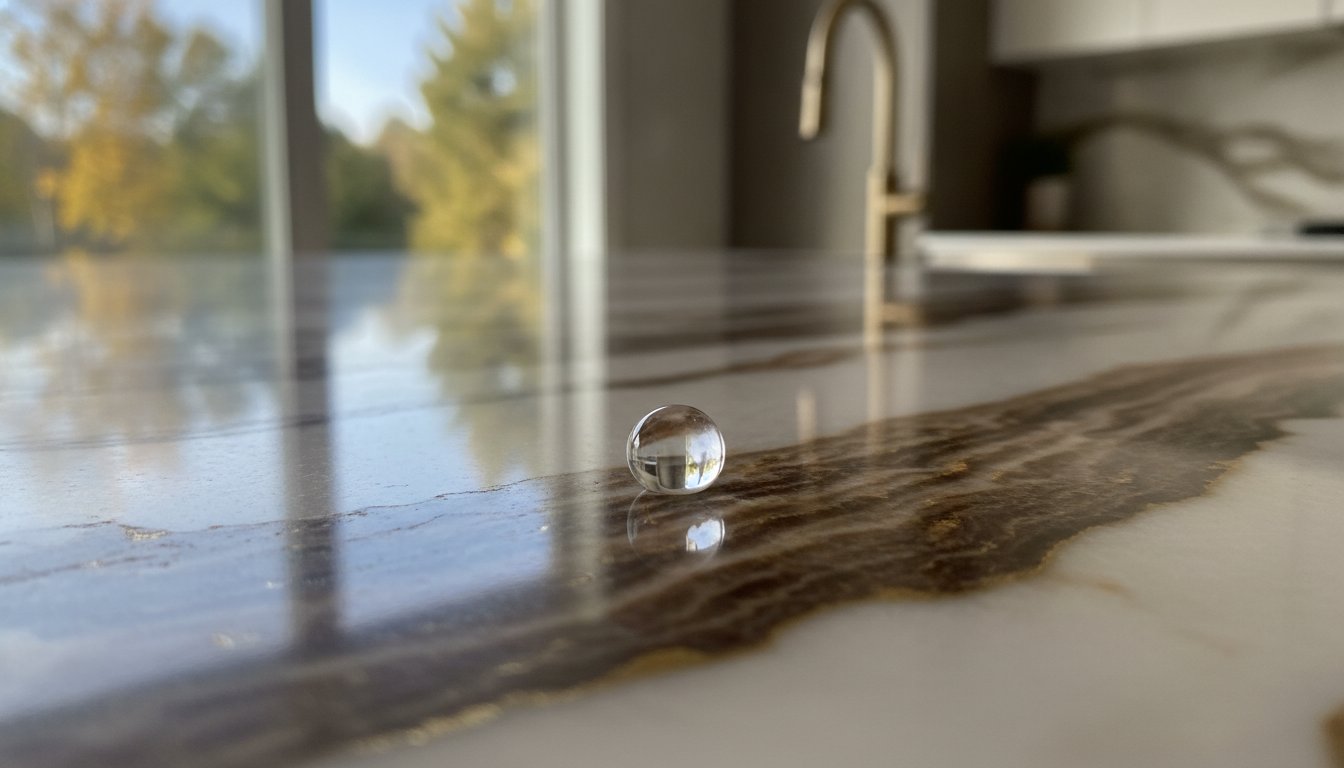
What if the very element that gives life to your home, water, is silently dulling the brilliance of your hand-selected quartzite or marble slabs? For homeowners across Ontario, where municipal water hardness can range from 7 to over 38 grains per gallon, those persistent white rings and cloudy deposits often feel like an inevitable tax on luxury. You've invested in the finest architectural surfaces, and it's natural to feel frustrated when conflicting DIY advice or hard water minerals threaten to ruin that high-gloss finish.
We believe that maintaining the elegance of premium stone requires more than just a damp cloth; it requires a ritual of curated care. This guide shares professional secrets for preventing water stains on natural stone, providing you with the confidence to protect your investment for the long term. We will examine the technical necessity of VOC-compliant sealing, the specific challenges of regional mineral deposits, and the proactive maintenance steps needed to ensure your slabs retain their pristine, sophisticated allure for decades.
Key Takeaways
- Understand the geological science of porosity and how capillary action draws minerals into your luxury stone slabs.
- Implement a professional sealing protocol to create a hydrophobic barrier, making preventing water stains on natural stone a predictable part of your home care.
- Adopt pH-neutral cleaning rituals to avoid the damaging "acid trap" caused by common household cleaners like vinegar or lemon juice.
- Address regional water quality issues by learning to manage the calcium and magnesium deposits characteristic of the Greater Toronto Area.
- Evaluate long-term maintenance needs by comparing the porosity of natural quartzite against the engineered resilience of porcelain or quartz slabs.
The Science of Stone Porosity: Why Water Stains Occur
Natural stone is far from a solid, impenetrable mass. At a microscopic level, every slab contains a network of tiny, interconnected voids known as pores. The Science of Stone Porosity defines this as the ratio of open space within the material relative to its total volume. For the discerning homeowner, understanding this ratio is the first step in preventing water stains on natural stone. When liquid rests on a surface, capillary action acts as a microscopic vacuum. This physical force draws moisture and dissolved minerals deep into the stone's internal architecture, where they can become trapped and visible.
Vulnerability varies significantly across different geological classifications. Marble and limestone possess higher porosity levels, which means they absorb liquids with alarming speed. High-end quartzite slabs are far denser and more resilient, yet they aren't entirely immune to the laws of physics. It's essential to distinguish between a true stain and surface etching. A stain occurs when a liquid is absorbed into the pores. Etching, however, is a chemical reaction or surface corrosion caused by acidic substances; it physically alters the stone's texture and dulls its finish, regardless of the stone's density.
The Difference Between Absorption and Mineral Buildup
In regions like the Greater Toronto Area, what looks like a permanent stain is often a localized buildup of minerals. As tap water evaporates, it leaves behind concentrated traces of calcium and magnesium. These surface rings are distinct from deep-set stains, which appear as darkened, shadowy patches beneath the stone's polish. Porosity is the primary factor that dictates how easily these minerals can anchor themselves to your surfaces. Understanding this distinction helps you choose the correct cleaning methodology without risking further damage to the stone's delicate crystalline structure.
Testing Your Slabs Porosity at Home
The Water Drop Test serves as a definitive diagnostic tool for any homeowner. Place a small bead of water on several areas of your counter and observe the reaction time with precision. If the water vanishes and darkens the stone within ten minutes, the surface is highly porous and lacks adequate protection. A well-sealed stone will cause the water to bead tightly on the surface for thirty minutes or more. This simple ritual reveals exactly when your stone selection requires a fresh application of professional-grade sealant to maintain its essential hydrophobic barrier.
The Professional Sealing Protocol: Your First Line of Defence
While stone density is a critical factor, even the most compact architectural surfaces require a secondary layer of protection. Impregnating sealers represent the gold standard in preventing water stains on natural stone. Unlike topical coatings that sit on the surface and can peel or yellow, an impregnating sealer penetrates the pores to create a hydrophobic barrier. This microscopic shield doesn't make the stone waterproof. Instead, it significantly reduces the rate of absorption. This buys you precious "reaction time" to address spills before they migrate into the crystalline structure of your quartzite slabs or marble features.
Sealing is a recurring necessity rather than a one-time event. Over time, the protective molecules within the stone break down due to environmental stressors. Using the right product is essential; high-end natural materials demand professional-grade, breathable sealers that allow moisture vapour to escape while blocking liquid ingress. For those seeking the ultimate in durability, exploring our inventory of premium natural stone slabs ensures you start with a material foundation that responds best to these protective protocols.
How to Apply a High-End Impregnating Sealer
A flawless application ensures the longevity of your stone's finish. Follow this structured approach to maintain your investment's integrity:
- Step 1: Deep clean the surface with a pH-neutral cleaner to remove all oils and dust. The stone must be thoroughly dry before proceeding.
- Step 2: Apply the sealer evenly across the slab using a clean, lint-free cloth or a specialized applicator. Ensure every square centimetre is saturated.
- Step 3: Allow the solution to penetrate the pores for the duration specified by the manufacturer, typically ten to fifteen minutes.
- Step 4: Buff away any excess residue with a fresh cloth. Leaving puddles can result in a cloudy, unattractive film that is difficult to remove once cured.
Frequency and Timing: When to Reseal
Several factors dictate how often you must replenish the hydrophobic barrier. High-traffic areas like kitchen islands endure heat, friction from cookware, and frequent cleaning, all of which degrade the seal faster than in decorative zones. We recommend an "annual check-up" for these hardworking surfaces. Conversely, bathroom vanities face constant humidity and contact with alkaline soaps, often requiring more frequent attention to prevent dullness. Adhering to professional Daily Maintenance Rituals will extend the life of your sealer, but it will never replace the need for periodic reapplication.
Daily Maintenance Rituals: Avoiding the Acid Trap
The daily ritual of maintenance is where the longevity of your architectural surfaces is truly decided. While the professional sealing protocols discussed previously provide a robust defence, they are not invincible against poor chemistry. Adhering to the "pH neutral" rule is non-negotiable for anyone serious about preventing water stains on natural stone. Many common household cleaners, particularly those marketed as "natural" or "green," contain high levels of acidity that can strip sealants and damage the stone's surface in seconds.
A "wipe-as-you-go" philosophy is the most effective way to prevent mineral bonding. When water is allowed to pool and evaporate, it leaves behind the calcium and magnesium traces common in Ontario's municipal supply. By drying surfaces immediately after use, you eliminate the opportunity for these minerals to anchor themselves to the stone. Incorporating sophisticated protective accessories, such as coasters and trivets, further elevates this preventative strategy. These are not merely aesthetic choices; they are functional barriers that ensure acidic condensation or heat never makes direct contact with your delicate surfaces.
The Chemistry of Etching vs. Staining
Many homeowners mistake etching for a stubborn water stain. This is a critical error that can lead to improper treatment. In materials such as marble slabs, acidic liquids like lemon juice, vinegar, or even certain wines react with the calcium carbonate in the stone. This chemical reaction physically dissolves a thin layer of the surface. Etching is a physical change in the stone texture, not a discolouration. Because the polish itself has been compromised, these dull, matte marks cannot be wiped away like a standard spill.
Curating Your Cleaning Kit
Maintaining a pristine finish requires a specialized arsenal. A high-quality microfibre cloth is your most valuable tool; it lifts dust and moisture without the risk of abrasion. Your cleaning kit should centre on a dedicated, pH-neutral stone soap designed specifically for preventing water stains on natural stone. For more complex issues involving deep-set deposits, the Natural Stone Institute's guide to stain removal provides authoritative recipes for safe poultices. Avoid abrasive scouring pads at all costs. These tools will dull the stone's factory polish over time, creating a hazy appearance that is difficult to reverse. If a specialized cleaner is unavailable, a very small amount of mild dish soap diluted in warm water serves as a safe, temporary alternative.

Ontario Hard Water: Addressing Local Mineral Challenges
Homeowners across the Greater Toronto Area face a specific environmental adversary: municipal water quality. In Mississauga and Toronto, water hardness typically averages 7 to 10 grains per gallon (GPG), classified as "hard." In groundwater-reliant regions like Guelph or Kitchener, these levels can escalate to an "extremely hard" 38 GPG. These minerals, primarily calcium and magnesium, are the architects of the stubborn "white rings" that threaten the clarity of your surfaces. When tap water evaporates on a counter, it leaves behind these inorganic solids, which eventually bond to the stone's surface.
Installing a whole-home water softener is perhaps the most significant investment for long-term stone longevity. By replacing hardening minerals with sodium ions, you fundamentally alter the chemistry of the water before it ever touches your slabs. However, even with a softening system, proactive drying remains the most effective labour-saving habit for preventing water stains on natural stone. Wiping away standing water before it has the opportunity to evaporate is the only way to ensure mineral traces never have the chance to crystallize.
Managing Hard Water in the Kitchen and Bath
The area surrounding faucet bases and soap dispensers is the primary "hot zone" for mineral accumulation. Constant splashing creates a cycle of wetness and evaporation that leads to rapid limescale buildup. Using a microfibre cloth or a small squeegee after every use prevents this cycle from taking hold. This practice is particularly vital for granite slabs. While granite is celebrated for its density, its darker varieties can make white mineral deposits appear much more prominent, detracting from the stone's natural depth and lustre.
Removing Existing Mineral Deposits Safely
If deposits have already formed, removal requires a controlled, delicate touch to avoid surface damage. A plastic scraper or a single-edge razor blade, used at a shallow 15-degree angle with extreme caution, can physically lift the mineral crust without scratching the polish. Specialized "soap scum" removers, specifically formulated for natural stone, can dissolve the bond between minerals and the stone's surface safely. When mineral crusting becomes deep-set or covers significant surface area, a professional stone restorer should be consulted to mechanically polish the slab back to its original state. To find the perfect foundation for your next design project, view our curated selection of premium stone slabs.
Material Selection as Prevention: Choosing the Right Slab
True prevention begins long before the first drop of water touches a surface. While the maintenance rituals and sealing protocols discussed in previous sections are essential for porous materials, the most effective strategy for preventing water stains on natural stone is selecting a slab that aligns with your lifestyle. For high-traffic kitchens or master ensuites where moisture is constant, the geological properties of your chosen material will dictate the level of vigilance required. The Infinity Stone approach centres on providing professional guidance to help you navigate our inventory, ensuring you select a foundational element that offers both timeless elegance and manageable care requirements.
Before finalizing a purchase, it is vital to compare the maintenance profiles of different geological categories. While marble offers an unmatched classical aesthetic, its high calcium carbonate content and porosity make it a high-commitment choice in wet environments. Conversely, denser materials or engineered alternatives can significantly reduce "stain anxiety," allowing you to enjoy your architectural features without constant worry over mineral deposits or capillary absorption.
Quartzite: The Durable Natural Alternative
For those who refuse to compromise on the "soul" of natural stone but require enhanced durability, quartzite is the premier choice. True quartzite is a metamorphic rock that is significantly harder and less porous than marble, yet it still retains the sophisticated veining many designers crave. It's important to realize that while quartzite is more resilient, it still requires professional sealing to maintain its hydrophobic barrier. Sourcing premium stone slabs involves a careful review of these technical specifications to ensure the material can withstand the specific humidity and usage patterns of your home.
Porcelain and Quartz: Engineered for Peace of Mind
Homeowners seeking a nearly maintenance-free experience often gravitate toward the "bulletproof" nature of quartz slabs. Because quartz is an engineered material, it is non-porous and never requires sealing, making it virtually immune to the mineral rings common in the Greater Toronto Area. Similarly, porcelain countertops represent the pinnacle of modern material science. These slabs are fired at extreme temperatures to create a vitrified surface that is completely impervious to water. While natural stone offers unique geological character, these engineered options provide a steady, reliable partner for busy households, effectively eliminating the risk of water stains through superior material density.
Master the Art of Lasting Elegance
Sustaining the brilliance of your luxury surfaces is a deliberate choice that begins with material knowledge and ends with disciplined care. By adhering to a professional sealing protocol and respecting the pH-neutral rule, you effectively mitigate the risks posed by Ontario's challenging mineral content. Understanding that preventing water stains on natural stone is an ongoing ritual rather than a one-time task ensures your investment remains a centrepiece of sophisticated design for decades. Whether you choose the organic soul of quartzite or the engineered resilience of porcelain, your maintenance strategy must be as refined as the stone itself.
As direct importers of rare global stones, we offer the expert guidance necessary to navigate these technical nuances for both designers and homeowners. We invite you to explore our curated collection of premium slabs at our Mississauga showroom, where you will find the largest selection of premium quartzite and porcelain in Ontario. Your home deserves the foundational excellence that only expertly curated materials and a refined maintenance ritual can provide. We look forward to helping you realize your vision for a flawlessly finished interior that stands the test of time.
Frequently Asked Questions
Is it possible to permanently stain natural stone with just water?
Pure water itself won't permanently discolour stone, but the minerals and contaminants dissolved within it can create lasting issues. If water is allowed to sit on an unsealed surface, it carries these minerals deep into the pores via capillary action. Once the moisture evaporates, the minerals remain trapped, creating a darkened shadow or a permanent "watermark" that requires professional poulticing to extract.
Why does my stone look dull even after I wipe away water spots?
Dullness typically indicates that the stone's factory polish has been compromised by either microscopic mineral buildup or chemical etching. In the Greater Toronto Area, the high calcium content in municipal water can leave a thin, tenacious film that masks the stone's natural lustre. If the surface feels slightly rough to the touch, you aren't looking at a stain but rather physical damage to the stone's crystalline structure.
Can I use Windex or other glass cleaners on my granite or marble?
You should never use glass cleaners, as they often contain ammonia or other harsh solvents that strip away protective sealants. These chemicals are far too aggressive for natural surfaces and will eventually lead to a cloudy, unattractive finish. For preventing water stains on natural stone, always stick to pH-neutral cleaners specifically formulated for architectural slabs to maintain the integrity of the hydrophobic barrier.
How often should I realistically reseal my kitchen countertops in Ontario?
High-traffic kitchen surfaces in Ontario should be resealed every 12 to 18 months to account for the mineral load in our local water. While some products claim multi-year protection, the heat and friction of a working kitchen naturally degrade sealants faster. Performing the "water drop test" every six months is the most reliable way to determine if your specific slab requires a fresh application of professional-grade sealer.
What is the best way to remove a dark water stain that has soaked in?
A deep-set water stain requires a poultice to draw the moisture and minerals back out of the stone's internal pores. You can create a simple paste using baking soda and a small amount of water, applying it to the area and covering it with plastic wrap for 24 hours. As the paste dries, it pulls the liquid from the stone, though complex mineral stains may require a specialized professional poultice.
Does quartzite need to be sealed as often as marble?
Quartzite is significantly denser than marble, so it generally requires less frequent sealing, but it isn't entirely maintenance-free. Because quartzite is still a natural, porous material, it can still suffer from mineral anchoring if the surface isn't protected. While you might only need to seal quartzite every two years, you should still monitor the area around sinks more closely for signs of absorption.
Will a water softener help prevent stains on my stone surfaces?
A whole-home water softener is an excellent investment for preventing water stains on natural stone because it removes the calcium and magnesium ions before they reach your taps. By replacing these minerals with sodium, the water becomes less likely to leave behind the stubborn white rings characteristic of hard water. This significantly reduces the labour required for daily maintenance and extends the life of your stone's polish.
How can I tell the difference between a water stain and an acid etch?
The primary difference lies in the texture and how the surface reflects light. A water stain is typically a darkened area beneath the surface that remains smooth to the touch. In contrast, an acid etch is a physical change in the stone's texture; it will look like a dull, matte spot and feel slightly rough or "pitted" when you run your fingernail across the affected area.


