
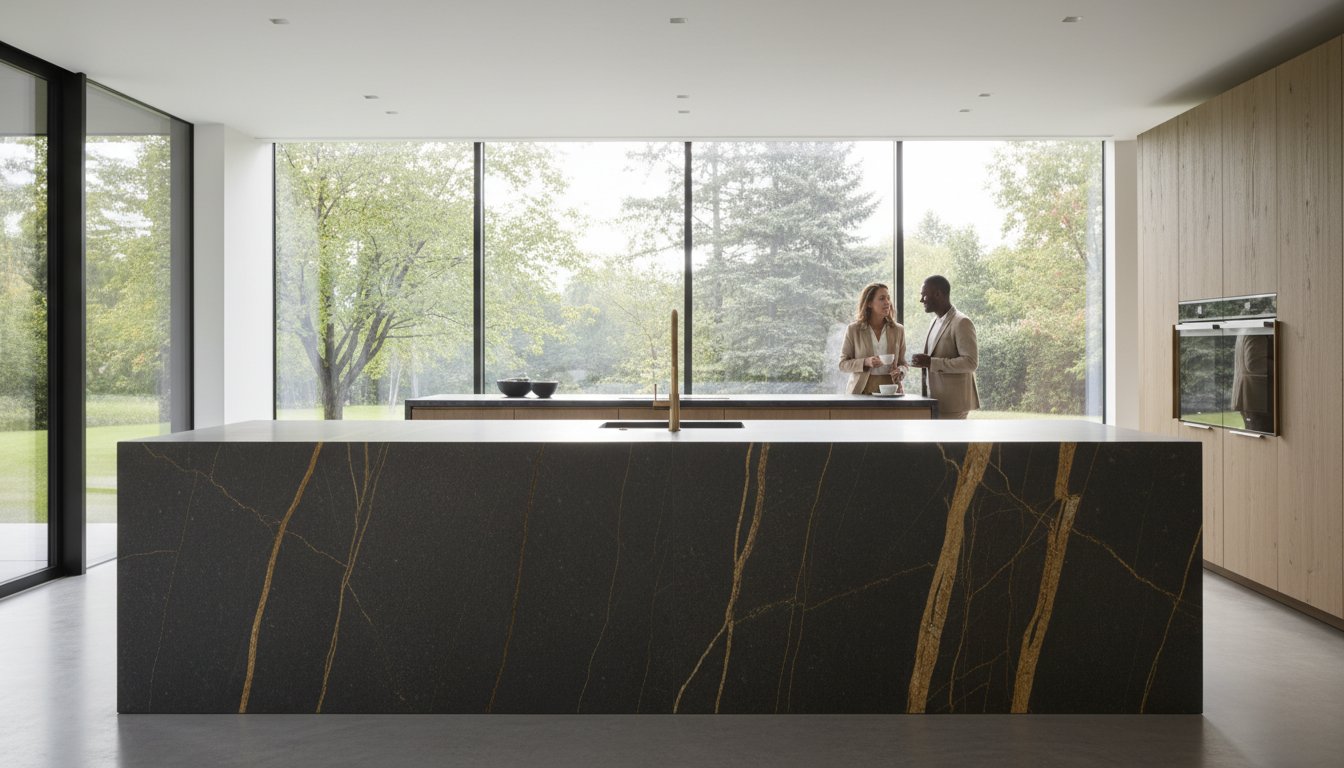
The most exquisite natural marble in a luxury kitchen is often a liability rather than an asset the moment it encounters a lemon wedge or a hot cast-iron skillet. You likely recognize the frustration of protecting a premium surface from the very life that happens around it. As a connoisseur of high-end design, you shouldn't have to compromise the authentic look of stone for the durability your lifestyle demands. This is why neolith has emerged as a sintered evolution, offering the aesthetic soul of natural materials without the fragility that plagues traditional slabs.
In this review, you'll discover why this architectural surface is the preferred choice for sophisticated Ontario interiors and how it compares to quartzite or porcelain. We'll provide a detailed look at the 2026 nature-inspired collection, including the new Colosseo and Toscano designs that debuted in March 2026. You'll learn how to navigate the typical $60 to $110 per square foot price range while securing a material that handles indoor and outdoor transitions with ease. We'll preview the new Matt and Wood finishes, ensuring your next project achieves a maintenance-free result that remains pristine against the unique demands of a modern home.
Key Takeaways
- Learn how the sintering process creates a high-performance surface that mimics the natural formation of stone in a fraction of the time.
- Evaluate the material's resilience against thermal shock and scratches, making it a reliable partner for professional-grade residential kitchens.
- Compare the aesthetic depth of neolith against traditional quartzite to understand its unique advantages in large-format bookmatched applications.
- Discover sophisticated placement ideas for Ontario homes, including seamless fireplace cladding in Toronto and durable outdoor kitchen surfaces in Burlington.
- Understand the necessity of inspecting full-format slabs in person to appreciate the curated excellence required for high-end interior projects.
What is Neolith? Understanding the Sintered Stone Revolution
Neolith represents a paradigm shift in the world of high-end architectural surfaces. While many homeowners initially mistake it for traditional porcelain, this material belongs to a distinct category known as sintered stone. It's a pioneer in the industry, crafted from 100% natural raw materials including granite minerals, glass minerals, and natural oxides. These elements are meticulously selected for their purity before undergoing a transformative manufacturing process. The result is a sophisticated slab that offers the visual depth of natural stone with a level of resilience that was previously unattainable in the luxury market.
The core of this revolution lies in how the material is formed. In nature, metamorphic stone takes thousands of years to develop under tectonic pressure and geothermal heat. Neolith replicates this geological phenomenon in a matter of hours through the process of sintering. This high-tech acceleration creates a product that doesn't just look like stone; it possesses the structural integrity of a material forged by the earth itself. For Ontario designers, this means access to large-format slabs that allow for seamless, expansive kitchen islands without the unsightly grout lines associated with smaller tiles.
The Sintering Technology Explained
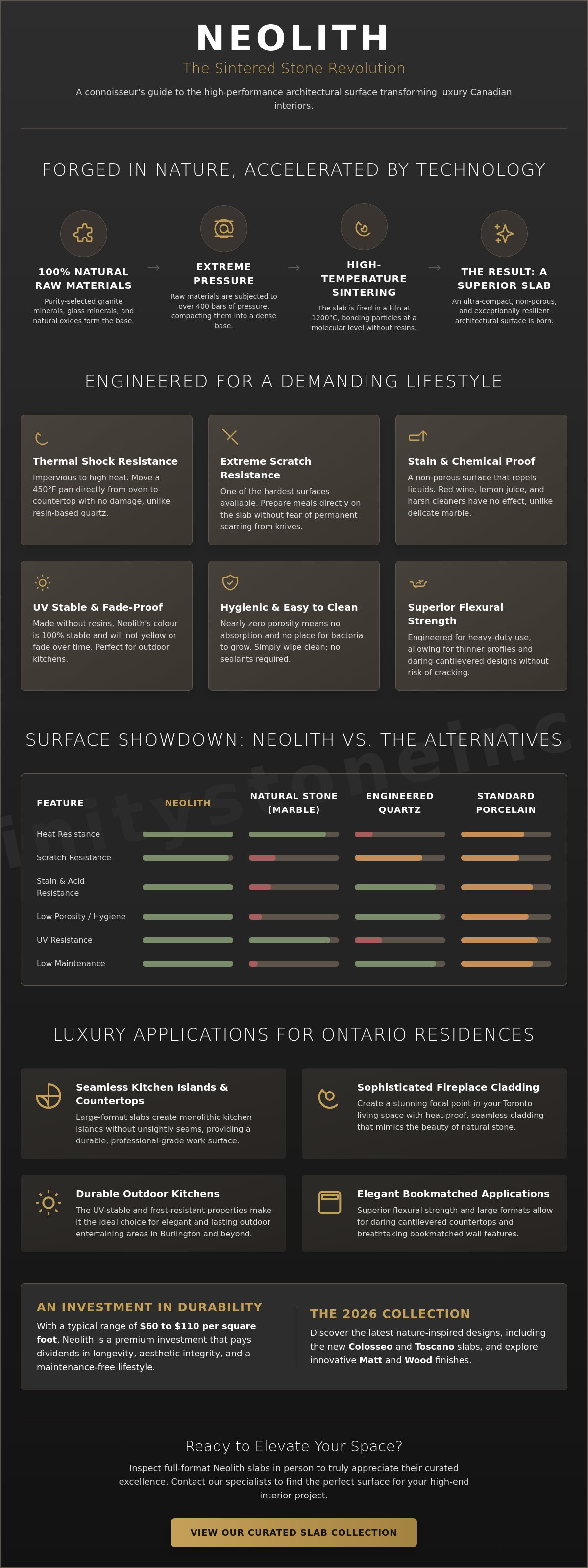
The technical specifications behind these slabs are impressive. During production, the raw materials are subjected to a massive 400 bars of pressure. Once compressed, the slabs enter a kiln where temperatures reach 1200 degrees Celsius. This intense heat bonds the particles together at a molecular level. Unlike engineered quartz slabs, which rely on petroleum-based resins to hold minerals together, this material is entirely inorganic. The absence of resins ensures that the surface won't scorch or yellow when exposed to high heat or UV rays. This process also results in a nearly zero-porosity surface, making it essentially immune to liquid absorption and bacterial growth.
Neolith vs. Standard Porcelain Slabs
Distinguishing between architectural-grade sintered stone and standard porcelain is vital for any connoisseur of fine interiors. While they share some ingredients, the density and purity of the minerals used in neolith are significantly higher. Standard porcelain is often designed for light-duty wall or floor applications; however, sintered stone is engineered for the rigours of heavy-duty use. It possesses superior flexural strength, which is a critical factor for the daring cantilevered countertops often found in modern Toronto penthouses. This structural advantage allows architects to specify thinner profiles without risking the cracks or brittleness common in lower-grade ceramic materials.
Performance Review: Why Designers Across Ontario Favour Neolith
Designers in the Greater Toronto Area frequently transition from natural stone to neolith because it eliminates the anxiety of high-maintenance living. While a marble countertop requires constant vigilance against spills, this sintered surface offers a nearly impenetrable barrier. Its extreme scratch resistance is a primary draw for professional-grade home kitchens where heavy cookware and sharp cutlery are in constant use. You can prepare meals directly on the surface without the fear of permanent scarring that often occurs with softer materials. This reliability makes it an essential partner for those who prioritize both aesthetic elegance and daily functionality.
Chemical resilience is another hallmark of its performance. Common household acids like lemon juice, vinegar, or red wine, which would instantly etch a delicate marble slab, have no effect on this non-porous material. This creates a hygienic environment where bacteria cannot find a foothold in microscopic crevices. Cleanup involves a simple wipe with a damp cloth; there's no need for specialized sealants or aggressive chemical cleaners to maintain the original lustre. If you are looking to explore these resilient options, you can view our curated slab collection to find the perfect fit for your next interior project.
Heat and Cold Resistance for the Canadian Home
Thermal shock resistance is perhaps the most impressive feat of engineering within these slabs. You can move a hot pan directly from a 450-degree Fahrenheit oven to the countertop without causing cracks or surface damage. Unlike quartz, which contains approximately 7% to 10% resin, this material doesn't burn or emit toxic fumes when exposed to high heat. It remains perfectly stable despite Ontario's varying indoor humidity levels. Thermal expansion remains negligible across the surface, ensuring that the integrity of large-format installations is preserved even during drastic seasonal temperature shifts.
UV Stability and Colour Longevity
Many homeowners realize too late that resin-based engineered stones can yellow or fade when placed near large windows or in outdoor settings. neolith solves this through its inorganic mineral composition, ensuring that colours never fade regardless of UV exposure. This stability allows for a seamless visual flow between an indoor kitchen and an Oakville patio or Burlington terrace. For those concerned about aesthetics on exposed edges, choosing "Full Body" patterns ensures the design remains consistent through the entire thickness of the slab. This attention to detail is why it remains a staple in luxury Ontario residences that demand long-term durability.
Neolith vs. Natural Stone: Comparing Aesthetics and Utility
While natural stone holds an undeniable organic charm, neolith offers a level of precision that nature cannot always provide. For a connoisseur, the choice between sintered stone and quartzite slabs often comes down to the specific requirements of the architectural design. Quartzite provides unparalleled depth and unique crystalline structures; however, sintered stone allows for absolute control over pattern continuity. This predictability is a significant asset for large-scale projects where visual cohesion is paramount and surprises in veining aren't welcome.
This control is most evident in "Bookmatch" and "Endmatch" capabilities. In natural stone, finding two perfectly mirrored blocks is rare and expensive. Sintered stone allows designers to create expansive, symmetrical focal points with ease, ensuring that veins align perfectly across a kitchen island or feature wall. Beyond aesthetics, the weight advantage is significant. A standard 3cm natural stone slab is immensely heavy, often requiring structural reinforcement for floors or cabinetry. In contrast, 6mm or 12mm slabs provide high strength with a fraction of the mass, making them ideal for vertical cladding or integrated furniture applications.
The Marble Aesthetic Without the Maintenance
Many Ontario homeowners desire the prestige of marble slabs but fear the inevitable etching. Natural marble is susceptible to "etch" marks, which are dull spots caused by acidic reactions from common kitchen items. Neolith's Statuario and Calacatta patterns replicate iconic grey veining without this vulnerability. Over a ten-year period, the cost-benefit analysis favours sintered stone due to the absence of professional restoration and annual sealing fees required for natural alternatives.
Texture and Feel: Realizing the Natural Look
The tactile experience is no longer a compromise for high-end interiors. Using advanced digital textures, the material achieves a "honed" or "leathered" feel that's synchronized with the printed pattern. The Silk finish offers a matte elegance, while the Riverwashed texture provides a rugged, organic touch for rustic designs. For contemporary design centres, the "Ultrasoft" finish delivers a velvet-like sensation that rivals the most exclusive natural finishes, ensuring the surface feels as premium as it looks. Each texture is precisely applied to match the visual grain of the pattern, creating a realistic sensory experience.
Luxury Applications for Neolith in Ontario Residences
Ontario's high-end residential market demands materials that bridge the gap between interior elegance and exterior endurance. Architects across the GTA are increasingly specifying neolith for grand, floor-to-ceiling fireplace surrounds. Because these slabs are available in ultra-thin 6mm profiles, they can be applied to vertical surfaces without the structural reinforcement required for traditional 3cm stone slabs. This versatility extends into the master suite, where the material's non-porous nature provides a hygienic, waterproof solution for steam showers and expansive vanity tops. It's a sophisticated choice for those who want a cohesive design language throughout the home.
Selecting the correct thickness is critical for the success of your project. The 3mm and 6mm profiles are engineered for furniture cladding, cabinetry fronts, and wall panelling. Conversely, the 12mm and 20mm options are the industry standard for horizontal surfaces that require higher impact resistance. Using the appropriate thickness ensures that the material performs as intended while maintaining the sleek, modern lines favoured in contemporary Ontario architecture.
Gourmet Kitchens and Statement Backsplashes
Modern gourmet kitchens in Toronto and Mississauga are trending toward substantial, 20mm island centres that serve as the home's primary social hub. Integrating a matching 6mm backsplash creates a seamless, minimalist aesthetic that complements the walnut or matte-black cabinetry currently favoured by local decorators. This continuity of colour and texture eliminates visual clutter, allowing the sophisticated veining of the slab to remain the focal point. If you're ready to select a material for your next project, you can browse our premium slab inventory to see these finishes in person.
Outdoor Living and Ontario Weather
Ontario's climate presents unique challenges that often lead to the failure of traditional ceramics or porous natural stones. The intense freeze-thaw cycles in regions like Oakville and Burlington can cause water-trapped materials to crack as they expand in the winter. Sintered stone eliminates this risk due to its near-zero water absorption rate. It remains perfectly stable despite the extreme temperature swings common in the Canadian climate. For south-facing patios, the material's UV resistance ensures that the deep, rich colours won't fade or yellow under the summer sun. Cleaning seasonal debris, pollen, or spills from an outdoor dinner party is effortless, making it the ultimate low-maintenance solution for luxury outdoor kitchens.
Sourcing Neolith: The Importance of a Premium Slab Supplier
Selecting a surface for a high-end residence requires more than a technical approval; it requires a visual confirmation of the material's artistry. Relying on small samples often leads to a disconnect between the design intent and the final installation. This is why viewing full-sized stone slabs is a non-negotiable step for discerning homeowners and architects. A large-format material like neolith reveals its true character—the sweep of its veins and the subtlety of its texture—only when seen at its full three-metre scale. A premium supplier acts as a curator, ensuring that every slab in the inventory meets the high standards expected by the Ontario design community.
Logistically, sourcing from a local Ontario distributor provides significant advantages for project timelines. It eliminates the uncertainties of international shipping and allows for immediate physical inspection. While Infinity Stone Inc. provides the premium material, we work in tandem with your chosen professional fabricator to ensure a seamless transition from our warehouse to your home. This coordination is essential, as the dense nature of sintered stone requires specialized handling and precision cutting tools. By choosing a local partner, you ensure that your project remains on schedule while maintaining access to the most exclusive collections available in the province.
The Designer-Supplier Partnership
Infinity Stone Inc. positions itself as a professional ally for the design community, offering a level of service that goes beyond simple transactions. We understand that consistency is paramount for expansive projects. Our team assists in reserving specific lots to ensure that every slab used in a multi-room renovation maintains a perfect colour match. Trusted by interior designers and decorators across Canada, we maintain an inventory that includes rare patterns and the latest 2026 nature-inspired releases. This curated approach allows professionals to realize their creative visions without compromising on material availability or aesthetic uniformity.
Finalizing Your Selection in Ontario
Visiting a showroom is the only way to truly appreciate the scale and nuanced colour palettes of these architectural surfaces. Handpicking your slabs ensures that the specific veining patterns align with your project’s focal points, such as a waterfall island or a feature fireplace. To make the most of your viewing, we recommend arriving prepared to see how the stone interacts with your other design elements. This tactile and visual verification is the final step in securing a surface that will define your interior for decades.
When visiting our facility to finalize your selection, please consider bringing the following items:
- Cabinet Samples: To verify how the slab's base colour complements your millwork.
- Paint Chips: To ensure the veining tones harmonize with your wall colours.
- Flooring Offcuts: To check the transition between horizontal surfaces.
- Lighting Specifications: To understand how different colour temperatures might affect the slab's appearance.
Elevating Your Ontario Interior with Sintered Innovation
Choosing a surface for a luxury residence is a long-term investment in both lifestyle and architectural integrity. This review demonstrates that neolith provides a definitive solution by merging the aesthetic soul of natural stone with the technical resilience of a high-performance material. Whether you're designing a high-traffic kitchen island in Toronto or a weather-resistant outdoor terrace in Oakville, this surface delivers a maintenance-free experience that natural marble simply can't match. Its zero-porosity and UV stability ensure your design remains pristine despite the rigorous Ontario climate.
The success of your renovation depends on selecting the ideal lot and thickness for your specific application. Trusted by top Ontario interior designers, Infinity Stone Inc. offers an exclusive handpicked inventory and a premium showroom experience in the GTA. Seeing the full scale of these slabs is the only way to realize the impact they'll have on your space. We invite you to Explore our curated collection of Neolith and premium stone slabs in Ontario today. Your journey toward a more sophisticated and durable home begins with the right material partner.
Frequently Asked Questions
Is Neolith more expensive than granite or quartz in Ontario?
Neolith typically ranges from $60 to $110 per square foot, placing it in a similar price bracket as premium quartz or exotic granite. The final investment depends on the slab's thickness and the complexity of the chosen finish. While it's a luxury material, the long-term value is higher because it eliminates the recurring restoration and sealing costs associated with softer natural stones.
Can Neolith slabs be used for outdoor kitchens in the GTA?
These slabs are perfectly suited for outdoor kitchens in the Greater Toronto Area because they're immune to UV degradation and moisture. Unlike resin-based materials, neolith won't yellow or fade when exposed to the intense summer sun. Its near-zero water absorption rate also protects the material from cracking during Ontario's frequent freeze-thaw cycles, ensuring the surface remains structurally sound year-round.
How do I clean and maintain my Neolith countertops?
Maintaining these surfaces requires nothing more than a damp cloth and mild dish soap for daily spills. Since the material is non-porous, bacteria and mould cannot penetrate the surface; this makes it one of the most hygienic options for modern kitchens. You don't need to purchase specialized stone cleaners or aggressive chemicals to keep the finish looking as pristine as the day it was delivered.
Does Neolith chip easily compared to natural stone?
Sintered stone is incredibly hard; however, like any premium material, the edges can chip if struck with significant force by a heavy object. This risk is comparable to natural granite or quartzite. To minimize this, we recommend working with a certified fabricator who can provide rounded edge profiles that better distribute impact and enhance the slab's long-term durability in high-traffic areas.
Can I place hot pans directly on a Neolith surface?
You can place hot pans directly on the surface without fear of scorching or thermal shock. The material is manufactured at temperatures reaching 1200 degrees Celsius, which is far higher than any residential oven or stovetop can produce. This heat resistance is a significant advantage over engineered quartz, which contains resins that can melt or discolour when exposed to high temperatures.
What is the difference between Neolith and Dekton?
Neolith and Dekton are both high-performance sintered stones, but they differ in their specific mineral blends and aesthetic collections. While both offer similar technical benefits like heat and scratch resistance, neolith is often favoured for its unique nature-inspired patterns and specific finishes like the 2026 Wood and Matt releases. Choosing between them usually comes down to the specific visual requirements of your interior design project.
Do I need to seal my Neolith slabs periodically?
You never need to seal these slabs because they're naturally non-porous. Unlike marble or granite, which require periodic chemical treatments to prevent staining, this material's molecular structure is too dense for liquids to penetrate. This quality is a primary reason why busy homeowners across Canada choose it for high-use areas like kitchen islands and bathroom vanities.
Is Neolith an environmentally friendly choice for Canadian homes?
Sintered stone is an exceptionally eco-conscious choice because it's composed of 100% natural minerals and contains no petroleum-based resins. The manufacturing process uses up to 48% recycled content in certain slabs, and the material itself is fully recyclable at the end of its life. This aligns with the growing demand for sustainable building materials in the luxury Canadian housing market.


