

Could a millions-of-years-old geological masterpiece actually be a structural liability waiting to shatter on the fabricator's saw? When you're investing in premium quartzite or marble, the distinction between breathtaking natural character and a terminal flaw is often razor thin. You likely feel the pressure of selecting a piece that defines your home, yet the anxiety over a hidden defect causing a failure during processing is a common concern for even the most seasoned designers. Mastering how to inspect a stone slab for defects is the essential step to transform that uncertainty into the quiet confidence of a true curator.
We realize that your architectural vision requires a material that's both aesthetically superior and structurally sound, adhering to the durability standards outlined in the 2024 Ontario Building Code. This guide promises to equip you with the technical vocabulary and professional techniques needed to distinguish between benign geological history and genuine structural instability. We'll preview tactile inspection methods, the critical differences between fissures and cracks, and the specific quality markers that ensure your luxury installation in a kitchen or bath remains a permanent fixture of elegance.
Key Takeaways
- Differentiate between unique geological character and genuine structural flaws to protect the long-term integrity of your architectural installation.
- Utilize professional lighting techniques and the "water test" to reveal surface imperfections and visualize the final polished colour of the material.
- Apply the tactile "fingernail test" to master how to inspect a stone slab for defects, distinguishing benign natural fissures from critical, surface-reaching cracks.
- Identify material-specific vulnerabilities, such as "sugar" spots in quartzite or acid-sensitive mineral inclusions often found in high-end marble.
- Recognize the value of professional sourcing standards that prioritize rigorous global selection to minimize defects before the slab reaches the showroom.
The Importance of Professional Slab Inspection in Ontario Showrooms
In the luxury stone market, the showroom floor is where architectural visions are either solidified or compromised. Selecting a premium material like quartzite or marble requires more than an appreciation for its visual depth; it demands a rigorous technical evaluation. Understanding how to inspect a stone slab for defects is the primary safeguard for any high-end project in the Greater Toronto Area. While the 2024 Ontario Building Code stipulates in Section 9.20.2.5 (1) that stone must be sound and durable, these regulations represent a minimum threshold. For a bespoke kitchen or a grand foyer, the standard for excellence is considerably higher.
Local environmental factors play a subtle but significant role in slab stability. Ontario's dramatic seasonal temperature shifts can impact materials stored in unheated or semi-conditioned warehouses. Traditional stonemasonry techniques emphasize that stone is a "living" material that reacts to its environment. Expansion and contraction during a Mississauga winter can occasionally aggravate pre-existing hairline fissures. A professional inspection ensures that the slab you approve in the showroom remains stable throughout the journey from the supplier's rack to your interior space.
The quality assurance process involves a delicate handoff between the supplier and the fabricator. The supplier acts as the curator, sourcing and housing the raw material, while the fabricator is responsible for the precision cutting and finishing. By conducting a thorough audit before the purchase is finalized, you eliminate the ambiguity of responsibility. This clarity ensures that any concerns regarding structural integrity are addressed before the material reaches the fabrication shop, where the stakes—and the costs of failure—escalate rapidly.
Defining Acceptable Geological Variation
Natural stone is defined by its history, recorded through intricate veining, mineral clusters, and colour movement. In materials like quartzite, these features are hallmarks of authenticity rather than flaws. Perfection is a misnomer in this context. A unique swirl of iron oxide or a dense cluster of quartz crystals often enhances the architectural value of a piece. Distinguishing these character marks from actual damage is the first step in mastering how to inspect a stone slab for defects. You're looking for continuity in the stone's story, ensuring that every "imperfection" is a natural occurrence rather than a result of mishandling.
The Financial Risk of Overlooking Defects
The financial implications of a missed defect are substantial. A single structural crack can lead to catastrophic failure during the high-pressure waterjet cutting process. In the GTA, where skilled labour for senior specialists can exceed $53 per hour, the cost of project delays and material replacement can devastate a construction timeline. Realizing the value of a pre-purchase audit protects your investment. It prevents the logistical nightmare of sourcing a matching slab from a different lot when the original fails, ensuring your luxury installation proceeds without the burden of unforeseen expenses.
The Visual Assessment: Spotting Aesthetic Flaws and Colour Inconsistencies
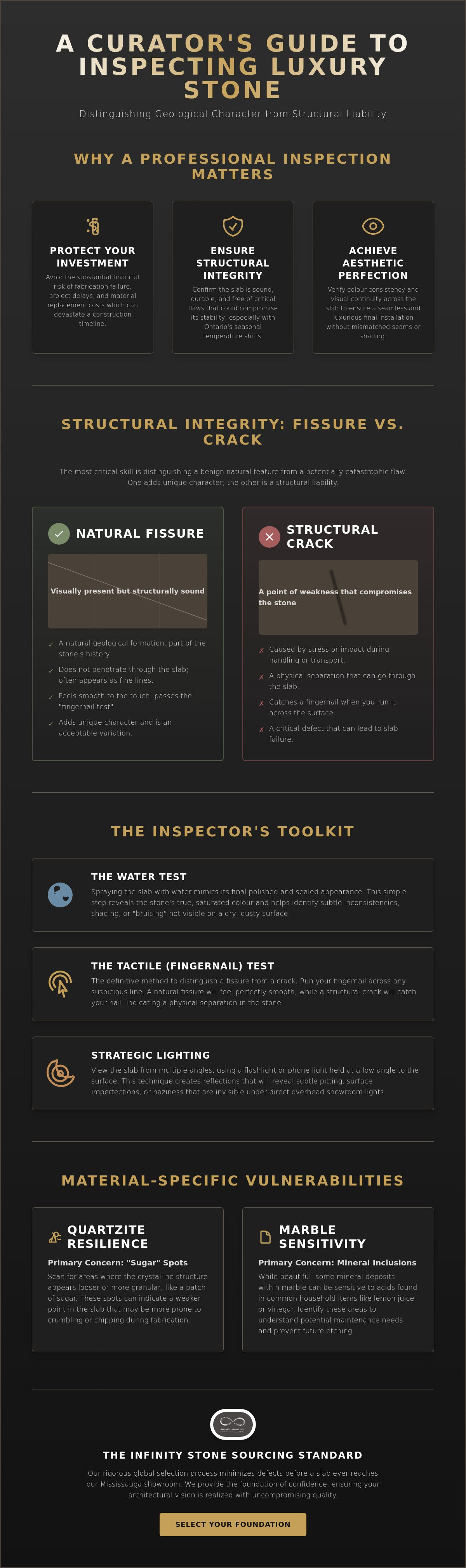
While the structural soundess of a material is paramount, the aesthetic success of a luxury interior depends on the visual continuity of the stone. A showroom environment can be deceptive; high-ceilinged galleries often use specific lighting temperatures that mask subtle variations. When learning how to inspect a stone slab for defects, your first tool is a simple bottle of water. Spraying the surface allows you to visualize the final polished appearance, as the "wet look" mimics the depth and colour saturation the stone will exhibit once it's sealed and installed in your home. This technique is particularly effective for identifying inconsistent pigmentation or "shading" across the length of the slab, which could lead to mismatched seams during fabrication.
Translucent materials, such as high-end quartzite, require an even more discerning eye. You should scan for "clouding" or "bruising," which are internal discolourations that often occur during the quarrying or transport process. These anomalies aren't always surface-level; they can exist deep within the crystalline structure. Following the Natural Stone Institute's best practices for material evaluation helps ensure you aren't selecting a piece with mineral inclusions that might react poorly to daily use. Beyond the face of the stone, inspect the edges for micro-chipping. Excessive chipping along the perimeter often indicates a brittle composition, suggesting the material may be prone to cracking during the intricate cutting required for mitred edges or undermount sinks. To ensure you're starting with the highest quality material, consider browsing a collection of hand-selected quartzite slabs that have already undergone rigorous preliminary screening.
Lighting and Viewing Angles
Correct illumination is non-negotiable. You must view the slab from multiple perspectives, ideally seeing it both vertically on the rack and horizontally if the showroom allows. Showroom LED lighting can sometimes create a "glare" that hides surface imperfections. We recommend using a high-powered, handheld flashlight held at an acute angle to the surface. This raking light will catch small surface scratches, resin fills, or "pitting" that would otherwise remain invisible under standard overhead lights. If possible, request to see the slab near a loading bay or window to evaluate how natural Ontario sunlight affects the stone's tonality.
Surface Finish Uniformity
A premium finish should be consistent from edge to edge. Scan the surface for "dull spots," which are areas where the factory polishing heads didn't apply uniform pressure. These patches will lack the reflective clarity of the rest of the slab and are notoriously difficult to correct after installation. Additionally, evaluate the factory-applied mesh backing on more fragile varieties like marble or exotic granite. While the mesh provides necessary support, any areas where the mesh is peeling or where excessive resin has pooled may indicate a slab that requires extra care during the handling phase to avoid structural failure.
Structural Integrity: Distinguishing Natural Fissures from Critical Cracks
The structural soundness of a luxury slab is the bedrock of its long-term performance. A connoisseur's mastery of how to inspect a stone slab for defects begins with the ability to distinguish between a natural fissure and a structural crack. While both may appear as linear markings on the stone's surface, their implications for fabrication and durability are vastly different. A fissure is a naturally occurring separation along crystalline boundaries, often filled with mineral deposits during the stone's formation. These are considered part of the stone's geological DNA and rarely compromise the slab's strength. Conversely, a crack is a legitimate break resulting from external stress, quarrying accidents, or improper handling. Identifying these early is essential to prevent catastrophic failure during the cutting phase.
Beyond linear breaks, you must also evaluate the presence of pits and pinholes. These are small voids where mineral crystals have dislodged or failed to form. While common in certain granite and marble varieties, excessive pitting may require extensive resin filling, which can affect the tactile quality of the finished surface. The Natural Stone Institute's Dimension Stone Design Manual provides the industry standard for these tolerances, defining the acceptable limits for natural variations versus actual damage. Any crack that runs entirely through the thickness of the slab, visible on both the face and the back, is a primary warning sign that the material's integrity is compromised.
The Fingernail Test for Surface Breaks
The most reliable tactile method for evaluating a suspect line is the fingernail test. Simply run your nail across the surface perpendicular to the vein or marking. If your nail "catches" or drops into a groove, the break is open at the surface. A catch suggests a structural crack or an unfilled fissure that may be vulnerable to moisture penetration or further expansion. Industry standards generally consider a fissure stable if it remains closed to the touch and does not extend through the full depth of the material. Mastering this simple check is a fundamental part of learning how to inspect a stone slab for defects before it leaves the showroom floor.
Evaluating Resin Repairs and Fills
Many premium slabs, particularly exotic quartzites, undergo a vacuum-sealed resin treatment at the source to stabilize natural fissures and enhance the stone's clarity. This professional enhancement is standard practice and should not be viewed as a defect. However, you must inspect the quality of these repairs. Look for "popped" fills where the resin has shrunk or dislodged, leaving a noticeable void. For high-visibility areas like a centre island, ensure the resin colour matches the surrounding matrix perfectly. A poorly executed repair can become an eyesore under the focused task lighting of a modern kitchen, detracting from the curated excellence of your project.
Material-Specific Inspection: From Quartzite Resilience to Marble Sensitivity
A sophisticated approach to quality control recognizes that each material category possesses a unique geological signature. You cannot apply a universal standard to every stone; the criteria for a dense granite differ significantly from those used for a delicate marble. Mastering how to inspect a stone slab for defects requires you to understand these material-specific nuances. Whether you are selecting a surface for a high-traffic kitchen or a statement feature wall, your inspection must be tailored to the specific vulnerabilities of the material in question.
Quartzite and Granite: Hardness and Internal Stress
Quartzite is prized for its resilience and crystalline depth. However, its extreme hardness can harbour internal stress. When sourcing Premium Quartzite Slabs in Ontario, you must watch for "sugar" spots. These are granular areas where the stone's bond is weaker, potentially leading to crumbling during the fabrication process. Internal shadow cracks, which appear as faint, dark lines beneath the surface, are also critical to identify. These represent deep-seated tension that may cause the slab to split when subjected to the heat of a CNC saw.
Granite requires a similar level of scrutiny regarding "knots" or large mineral clusters. While these often add character, an excessively large cluster can disrupt the structural uniformity of the slab. You should also scan for "rust" spots. These are typically caused by iron oxidation within the stone. While some designers value this as a natural patina, others may view it as an aesthetic flaw that clashes with a modern colour palette. Identifying these features early allows you to make an informed decision on whether they enhance or detract from your architectural vision.
Marble and Porcelain: Surface Fragility
Marble is celebrated for its soft, elegant veining, but this beauty comes with inherent sensitivities. You must check marble slabs for "dry veins." These are unfilled natural fissures that lack the stabilizing mineral deposits found in healthy veins. If left unaddressed, these veins can open up during the cutting or installation phase. Additionally, scan for acid-sensitive mineral inclusions like pyrite. These can react with household cleaners or even moisture, leading to localized staining that is difficult to remediate once the stone is in place.
Porcelain slabs represent the pinnacle of engineered surface technology, yet they are not immune to defects. For those considering Luxury Porcelain Countertops in Ontario, bowing is a critical metric. Large-format porcelain must be perfectly flat; even a slight curve can make a seamless installation impossible. You should also inspect the digital print quality. On lower-quality slabs, you may notice pixelation or "ghosting" in the pattern, which undermines the illusion of natural stone. Verifying pattern continuity is essential if your project requires bookmatching, ensuring the veins align with mathematical precision across multiple panels.
Selecting the right material is a significant investment in your home's longevity. To ensure your project begins with a foundation of excellence, we invite you to browse our inventory of premium natural and engineered slabs, each curated to meet the highest standards of the design community.
Selecting Your Foundation: The Infinity Stone Sourcing Standard in Mississauga
The final stage of procurement is the selection of a partner who understands the stakes of high-end design. In the Greater Toronto Area, Infinity Stone Inc. serves as a critical filter between the quarry and your home. Our experts understand how to inspect a stone slab for defects long before a material reaches our Mississauga inventory. By handpicking each lot from global quarries, we minimize the presence of structural flaws that typically plague mass-market inventory. This specialized focus on material quality ensures that the quartzite, marble, or porcelain you view in our gallery has already passed a rigorous preliminary audit.
Transparency is the cornerstone of our showroom philosophy. We've designed our Mississauga facility to allow for comprehensive, 360-degree viewing under optimal conditions. This environment empowers you and your fabricator to perform a final, definitive inspection. While we don't handle fabrication or installation ourselves, we actively facilitate the collaboration between you and your chosen professionals. Providing the space and lighting necessary for a detailed assessment is part of our commitment to a defect-free luxury installation; it's the standard our clients expect from a premier supplier.
Sourcing from a specialized supplier means you aren't just buying a product; you're gaining access to a curated collection of the world's finest surfaces. We realize that the pressure of selecting the perfect slab can be daunting. By providing a transparent viewing experience, we remove the anxiety of "hidden" defects. This clarity allows you to focus on the aesthetic potential of the stone, knowing that the technical foundations have already been verified by industry experts who value quality over quantity.
Our Handpicked Selection Process
Curation at Infinity Stone Inc. is a technical discipline. Our curators apply rigorous criteria to every quartzite and marble slab, evaluating mineral stability and aesthetic continuity. We organize our inventory to ensure that every face is accessible, allowing you to apply the professional techniques discussed in this guide. This commitment to excellence makes us a preferred source for premium stone slabs in the GTA. We realize that your project's success depends on the foundational integrity of the material, and our sourcing standards reflect that responsibility.
Next Steps: Visit Our Mississauga Gallery
Preparing for a slab viewing is a vital step for any connoisseur. We recommend bringing your cabinet door samples and paint swatches to evaluate colour tonality under our professional lighting. Our experts are on hand to assist you in identifying the best material for your specific architectural application, providing technical insights into the characteristics of each lot. When you're ready to secure the centrepiece of your next project, Book an appointment at Infinity Stone Inc. and experience a standard of quality that protects your investment from the first glance to the final polish.
Securing Your Architectural Legacy
Mastering the nuances of natural stone transforms a simple purchase into a strategic investment. You now possess the specialized knowledge required to differentiate between a slab's unique geological history and a compromise in its structural integrity. From utilizing the tactile fingernail test to recognizing the specific stress markers in quartzite, understanding how to inspect a stone slab for defects ensures your project proceeds with absolute certainty. This technical discernment is the final safeguard for any luxury installation, protecting both your aesthetic vision and your financial commitment.
At Infinity Stone Inc., we uphold these rigorous standards through a handpicked global inventory curated by specialized quartzite and marble experts. We're a trusted partner for GTA designers and architects who prioritize material excellence and professional transparency above all else. When you're ready to select the foundation for your next high-end interior, we invite you to View our curated collection of premium slabs in Mississauga. Your vision deserves a material that's as resilient as it is breathtaking, and we're here to ensure you find it.
Frequently Asked Questions
Is a fissure in a quartzite slab considered a defect?
No, a fissure is generally classified as a natural geological characteristic rather than a structural defect. These separations occur along crystalline boundaries during the stone's formation and are often filled with stable mineral deposits. While they add to the material's unique character, you should still perform a tactile check to ensure the fissure is stable and hasn't developed into an open, surface-reaching break that could compromise the slab.
Can a stone slab with a crack be repaired during fabrication?
While minor surface imperfections can be stabilized with professional-grade epoxy resins, a full-depth structural crack is typically irreparable for high-end installations. Fabricators may attempt to "work around" a flaw by strategically templating the layout to avoid the compromised area. However, if a crack is located in a high-stress zone like a sink cutout or a long overhang, the material should be rejected to prevent future failure.
How do I distinguish between a natural vein and a structural crack?
You distinguish a crack from a vein by evaluating the depth, texture, and continuity of the mark. A natural vein is a flush, mineralized feature that is perfectly integrated into the stone's matrix. Conversely, a structural crack often feels rough to the touch and may be visible on both the face and the back of the material. Mastering this distinction is a vital part of learning how to inspect a stone slab for defects.
Should I inspect the back of the stone slab as well?
Yes, inspecting the reverse side of a slab is a non-negotiable step for identifying through-body structural damage. Many defects that appear as benign surface markings on the polished face are revealed as significant breaks on the unpolished back. A crack visible on both sides indicates a total breach of the stone's integrity, which will likely fail under the intense pressure of professional fabrication equipment.
What is the "water test" for inspecting natural stone surfaces?
The "water test" involves applying a light mist of water across an unsealed slab to visualize its final polished appearance and colour depth. This technique is highly effective for revealing subtle surface imperfections, such as dull spots or inconsistent pigmentation, that are often masked by the dry, dusty conditions of a warehouse. It allows you to identify "shading" issues before the material is delivered to your project site.
Does a mesh backing on a slab mean the stone is poor quality?
No, a fiberglass mesh backing is a standard industry reinforcement used to stabilize exotic or naturally fragile stone varieties. It's a professional safeguard that allows for the safe transport and handling of premium materials like marble or certain granites. The presence of mesh doesn't indicate inferior quality; it simply signals that the stone's intricate veining requires additional support during the movement and fabrication phases.
How does lighting affect how I see defects in marble or granite?
Lighting is the primary factor in revealing surface-level flaws like pitting, scratches, or poorly executed resin fills. Standard showroom LED lighting can create a glare that hides these imperfections, whereas a raking light source held at an acute angle will highlight them. Correct illumination is essential for a thorough assessment of how to inspect a stone slab for defects to ensure the material meets your aesthetic standards.
What should I do if I find a defect in a slab I already purchased?
You should contact your stone supplier immediately and document the flaw with high-resolution photographs before the material is moved for fabrication. Once the cutting process begins, the responsibility for defects becomes significantly more difficult to resolve. Request a professional joint inspection with your contractor to determine if the issue can be mitigated through strategic templating or if a full replacement of the slab is necessary.


