
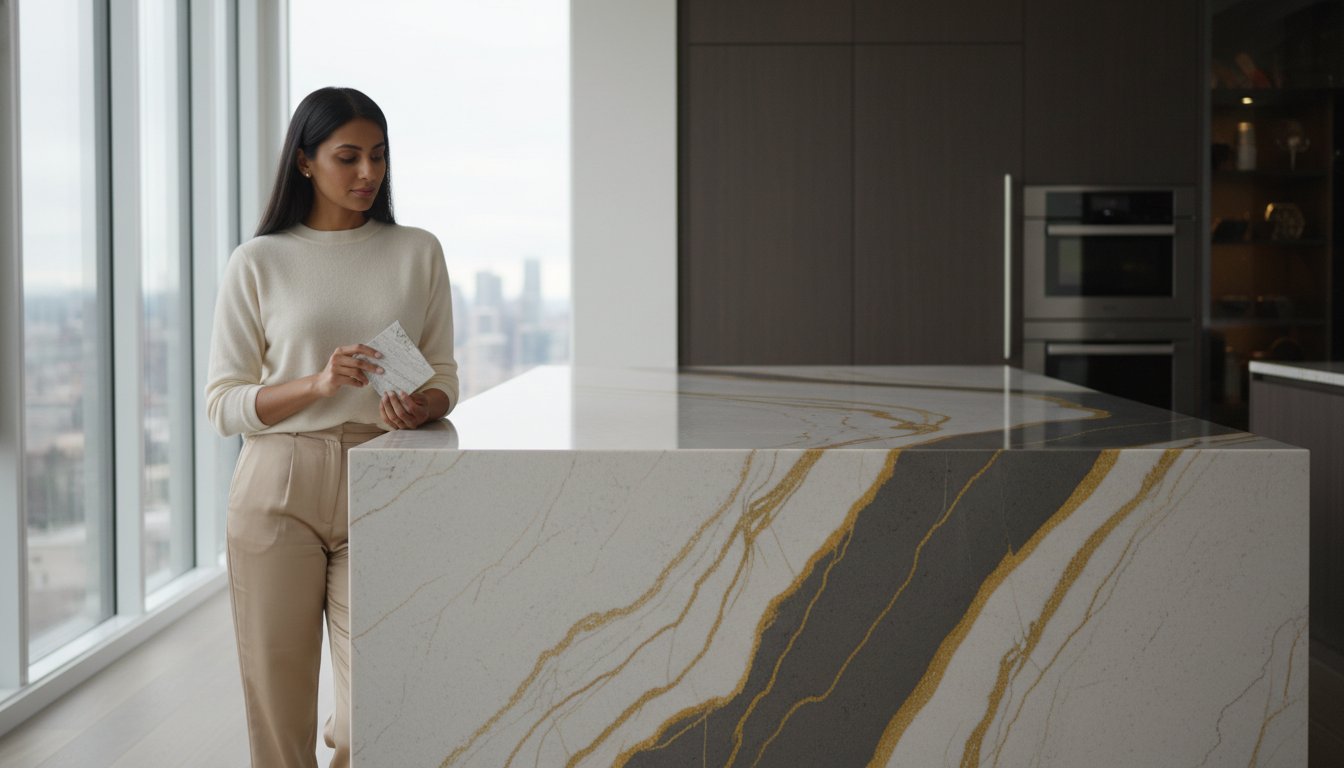
Your choice of a natural or engineered surface is a permanent architectural commitment, not a fleeting design trend. Many homeowners and design professionals inadvertently treat a slab gallery like a simple paint shop; this mindset often leads to common mistakes when buying stone slabs that can compromise the integrity of an entire luxury renovation. Whether you are selecting a rare quartzite or a high-performance porcelain, the technical nuances of each material require a discerning eye and a sophisticated approach.
It's natural to feel a sense of trepidation when faced with the risk of etching a pristine marble surface or the persistent confusion between quartzite and quartz. You deserve a result that balances aesthetic elegance with reliable, long-term durability. This guide provides the curated expertise needed to navigate these premium selections, ensuring your material investment remains a flawless centrepiece for years to come. We'll examine how to identify hidden geological defects, distinguish between complex material properties, and prepare for a professional hand-off to your fabricator.
Key Takeaways
- Recognize why relying on small swatches is one of the most common mistakes when buying stone slabs, as samples often mask the dramatic veining and natural colour variation of the full material.
- Distinguish between the functional properties of marble and quartzite to ensure your selected stone suits the chemical and physical demands of its intended environment.
- Account for technical variables like slab thickness and total yield to prevent unexpected adjustments during the final installation phase.
- Coordinate with your preferred fabricator before finalizing a purchase to manage reserve policies and ensure a seamless transition from the gallery to the home.
- Leverage a curated inventory of globally sourced porcelain and granite to secure foundational elements that define high-end residential design.
The Visual Pitfall: Why Buying from a Sample Is a Critical Error
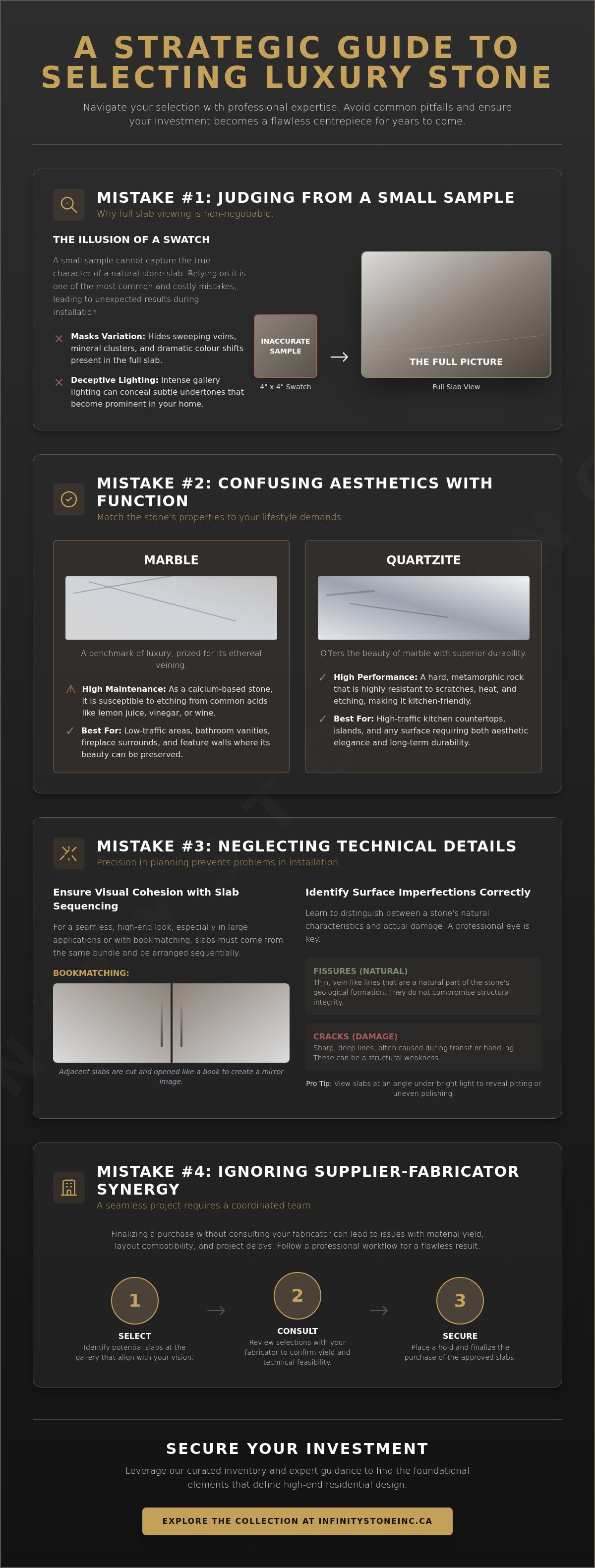
Relying on a handheld swatch is one of the most frequent and costly common mistakes when buying stone slabs. A four-inch square cannot possibly convey the sweeping movement, dramatic veining, or complex mineral clusters present in full-sized stone slabs. While a sample provides a general colour reference, it lacks the geological context of the entire piece. Every Stone slab is a unique snapshot of Earth's history; natural variations such as concentrated quartz deposits or sudden shifts in background hue are often absent in small swatches. These surprises can disrupt a carefully planned aesthetic once the material is installed across a large kitchen island or feature wall. Showroom lighting also plays a deceptive role. High-intensity gallery lights often mask subtle undertones that will become glaringly obvious under the softer, warmer temperatures of a residential kitchen.
A thorough visual inspection at the gallery level is the only way to ensure the material aligns with your vision. Viewing the entire surface allows you to identify the difference between natural fissures and structural cracks that might have occurred during transit. This level of scrutiny is standard practice for industry professionals who prioritize geological integrity. Avoiding common mistakes when buying stone slabs starts with seeing the exact material that will eventually reside in your home, ensuring the final installation mirrors your high-end expectations.
The Importance of Slab Sequencing
Achieving a cohesive architectural look requires meticulous attention to slab sequencing. If your project involves bookmatching, where two mirror-image slabs meet at a central seam, you must inspect adjacent slabs from the same bundle. This ensures that the veining flows logically across the surface without awkward interruptions. Even for non-mirrored applications, checking batch numbers is essential to avoid tonal shifts between different shipments. Using slabs from disparate bundles often results in a disjointed appearance that compromises the luxury feel of the space. Professional designers always verify that their selected inventory comes from a single, sequential lot to maintain visual continuity.
Identifying Surface Imperfections
Discerning professionals always view material at an angle under bright light to evaluate the surface finish. This technique reveals "pitting" or uneven polishing that a direct gaze might miss. It's vital to distinguish between natural beauty marks and actual damage sustained during transport. Fissures are natural geological features; they appear as thin, vein-like lines that do not compromise slab integrity or structural strength. Unlike cracks, which are typically sharp and deep, fissures are a testament to the stone's organic origin. Identifying these nuances at the gallery ensures a smooth hand-off to your fabricator and a final result that meets elite craftsmanship standards.
Material Misalignment: Confusing Aesthetics with Functional Reality
Selecting a surface based solely on visual appeal is a frequent error. While the ethereal veining of marble slabs remains a hallmark of luxury, placing this calcium-based stone in a high-traffic family kitchen often leads to disappointment. Acidic substances like lemon juice, wine, or vinegar cause etching on marble, a chemical reaction that dulls the surface regardless of the sealant used. Matching the geological profile of a material to the functional demands of your space is a prerequisite for a successful project.
Heat resistance is another critical factor frequently overlooked. Natural stones generally handle high temperatures well, but placing engineered materials near cooktops or fireplaces can lead to thermal shock or resin scorching. The Dimension Stone Design Manual provides technical benchmarks for these specific applications, highlighting the limits of various minerals. Choosing a honed finish over a polished one can also hide minor scratches and wear, making it a pragmatic choice for active households that still value a prestigious atmosphere.
Quartzite vs. Quartz: The Durability Debate
One of the most frequent common mistakes when buying stone slabs is the failure to distinguish between natural quartzite slabs and engineered quartz. Quartzite is a metamorphic rock formed under intense heat and pressure, while quartz is a man-made product composed of crushed stone and resin. This distinction is vital for architectural applications requiring UV stability, such as Ontario sunrooms or outdoor kitchens, where resins in engineered products may discolour over time.
| Feature | Natural Quartzite | Engineered Quartz |
|---|---|---|
| Porosity | Low to Moderate | Non-porous |
| Heat Resistance | High | Low (Resin-based) |
| UV Stability | Excellent | Poor (May yellow) |
| Maintenance | Requires Sealing | Minimal |
Porosity and the Acid Sensitivity Test
Natural stone varies in its liquid absorption rate. High porosity means a slab is more susceptible to staining from oils or dark liquids. To avoid common mistakes when buying stone slabs, ask for a small scrap piece of your specific material for home testing. Applying a professional-grade sealant creates a barrier, but it doesn't make natural stone indestructible. Understanding these limits before purchase ensures your investment maintains its integrity. For those seeking a balance of aesthetics and resilience, exploring a curated inventory of premium surfaces is the best first step.
Technical Oversights: Thickness, Origin, and Edge Profiles
Technical precision is the hallmark of a successful architectural installation. Avoiding common mistakes when buying stone slabs requires a deep understanding of material dimensions and geological grading. Many buyers assume that a generic name like "Carrara" or "Calacatta" guarantees a specific level of quality. In reality, these names represent broad categories with significant variations in background clarity, veining precision, and structural integrity. Selecting a slab based on name alone, without verifying its specific origin and grade, often leads to inconsistencies that become apparent only after the stone is installed in a high-end space.
The choice of an edge profile is another technical detail that influences long-term durability. While sharp, mitered edges offer a sleek, modern aesthetic, they're also more susceptible to chipping in high-traffic areas. Choosing a slightly rounded or eased edge can mitigate this risk, preserving the stone's pristine condition. Failing to account for the "yield" of a slab is a frequent logistical error. If a kitchen layout requires one and a half slabs, you'll likely need to purchase two full pieces to ensure a perfect colour match. Buying slabs from different lots later is a risk that rarely pays off, as tonal shifts can disrupt the visual continuity of your surfaces.
The 2cm vs. 3cm Decision
Material thickness is a primary consideration for both aesthetics and structural support. In the Canadian luxury market, 3cm slabs are the standard for kitchen countertops. This thickness provides the necessary strength for large spans and overhanging breakfast bars without requiring extensive plywood decking. Conversely, 2cm slabs are an excellent choice for vertical applications such as full-height backsplashes or bathroom vanities where weight is a concern. Using a 2cm slab for a heavy-use kitchen island without proper sub-top support is a structural oversight that can lead to stress fractures over time.
Slab Dimensions and Seam Placement
Standard slab sizes vary by material, and overlooking these dimensions can lead to unplanned seams. When designing an oversized kitchen island, it's vital to compare the island's length against the maximum length of your chosen stone. If a seam is unavoidable, its placement must be planned during the selection process to align with the stone's natural veining. For those seeking a truly seamless look across expansive surfaces, porcelain countertops often come in larger formats than traditional natural stone. This allows for grander architectural statements with fewer interruptions, provided the format aligns with the project's technical requirements.
The Professional Gap: Ignoring the Supplier-Fabricator Synergy
A seamless stone installation requires precise collaboration between the material specialist and the fabricator. One of the most significant common mistakes when buying stone slabs is selecting a premium surface without having a designated fabricator already in place. This lack of coordination often leads to logistical delays or material mismanagement. It's vital to understand that a specialist supplier focuses on the curation and provision of elite materials like marble or granite; they don't perform on-site measurements or installation. Assuming the supplier handles the final cutting and placement is a frequent error that can disrupt your project timeline.
Failing to confirm reserve policies is another oversight that can jeopardize an entire design. High-end slabs move quickly. If a specific bundle isn't officially "tagged" or reserved through a clear agreement, you risk losing your preferred material to another project. Professional designers always ensure the communication loop between the gallery and the fabrication shop remains closed. Avoiding common mistakes when buying stone slabs starts with acknowledging that the supplier and the fabricator occupy two distinct but equally important roles in the architectural process.
Coordinating the Hand-off
The transition from the gallery to the fabrication shop is a technical process. Your fabricator must perform the final "templating" at your residence after the cabinets are installed but before any stone is cut. This ensures the material is tailored to the exact dimensions of your space. A reputable supplier will communicate directly with your fabrication partner to manage transport logistics, ensuring the slabs arrive in pristine condition. This professional synergy prevents the damage or miscommunication that often occurs when homeowners try to manage these complex movements independently.
The Layout Review
Bringing a detailed cabinet plan to the slab gallery is the mark of a prepared connoisseur. This document allows you to visualize how the veining of a quartzite or porcelain slab will travel across your specific island or perimeter counters. It also enables a more accurate yield calculation. You'll know immediately if you need additional material for a matching backsplash or if a single slab is sufficient for the entire perimeter. Reviewing the layout with the supplier ensures that the natural movement of the stone is highlighted rather than hidden. To begin your selection with professional guidance, contact our team of material specialists today.
Securing Your Investment: The Infinity Stone Selection Process
Securing a premium surface requires more than a simple transaction; it demands a partnership with a material specialist who understands the gravity of your architectural vision. Avoiding the common mistakes when buying stone slabs mentioned throughout this guide is significantly easier when you have access to a curated inventory of handpicked, globally sourced materials. Our collection includes rare quartzite and marble varieties that standard fabricators rarely stock, providing a level of exclusivity that distinguishes high-tier Mississauga and GTA residences. By focusing on material integrity and aesthetic excellence, we ensure your investment stands the test of time.
The selection process at our Mississauga showroom is designed to eliminate the ambiguity often found in mass-market retail environments. We provide expert guidance on material suitability, helping you match specific geological profiles to the unique architectural styles found across Ontario. Whether you're seeking the resilience of granite or the modern versatility of porcelain, our goal is to provide the foundational elements for high-end living. Navigating the complexities of stone selection becomes a structured, logical progression when you're supported by industry experts who value quality over quantity.
The Designer Advantage
We prioritize the needs of the design community, offering a sophisticated environment where decorators and architects can specify foundational elements for their most ambitious projects. Our staff provides technical stone classification for builders, ensuring that every selection meets the rigorous requirements of modern construction. We invite you to explore our extensive inventory in person, as this is the only way to achieve an accurate colour representation and appreciate the tactile quality of the stone. This professional partnership ensures that the materials selected are not only beautiful but also technically sound for their intended application.
Next Steps for Your Project
Once you've identified the perfect material, our process focuses on professional efficiency and logistical precision. We assist with the following steps to secure your investment:
- Selection and Tagging: We identify and "tag" your specific slabs, ensuring they're reserved exclusively for your project.
- Technical Review: We verify batch numbers and slab sequencing to maintain visual continuity across your surfaces.
- Fabricator Release: We coordinate the professional release of your material to your chosen fabricator for final templating and cutting.
By following this structured approach, you bypass the common mistakes when buying stone slabs that often lead to project delays or material inconsistencies. High-end renovations depend on the integrity of the raw material, and our role is to ensure that integrity is preserved from the gallery to the final hand-off. To realize your design vision with confidence, Visit Infinity Stone Inc. in Mississauga to view our premium slab collection.
Elevate Your Architectural Standards
Selecting the foundational elements for your home requires a shift from viewing material as a simple product to seeing it as a significant geological investment. By prioritizing full slab inspections over small swatches and aligning material porosity with your specific lifestyle, you ensure a result that's both beautiful and resilient. Coordinating with your fabricator early in the process prevents the logistical gaps that often compromise high-end projects. Avoiding these common mistakes when buying stone slabs transforms a complex procurement into a structured, successful realization of your design vision.
Since 2017, we've operated as a specialized supplier for the design community, offering a premium handpicked inventory sourced from the world's most prestigious quarries. Our team provides the expert technical guidance needed to navigate geological classifications and engineered specifications with absolute clarity. View our curated collection of premium stone slabs in Mississauga and secure the ideal material for your next architectural statement. Your pursuit of excellence deserves a partner that values durability and elegance in equal measure.
Frequently Asked Questions
What is the most common mistake when buying natural stone slabs?
The most frequent error is selecting a material based solely on a handheld sample rather than inspecting the full-sized slab. Small swatches cannot represent the dramatic veining, mineral clusters, or natural colour shifts that define a large-format surface. Viewing the entire piece in person ensures the movement aligns with your architectural vision and prevents unexpected visual "surprises" during installation.
Can I buy a stone slab directly from a supplier without a fabricator?
You can select and reserve your material at a gallery, but the final transaction and logistics are typically coordinated through your designated fabricator. As a material specialist, we provide the raw slabs, while the fabricator handles the precise templating, cutting, and installation. Establishing this partnership early ensures a professional hand-off and protects the integrity of your stone during transport.
Why does the same type of marble have different price points?
Pricing for marble is determined by grading, background clarity, and the rarity of the veining pattern. A slab with a crisp, white background and balanced veining is graded higher than one with greyish undertones or inconsistent mineral deposits. Rarity also plays a role; certain quarries produce limited quantities of elite-tier stone, which naturally increases the market value for those specific blocks.
How do I know if a slab has a structural crack or just a natural fissure?
Fissures are naturally occurring geological features that follow the stone's crystalline structure and don't compromise its strength. You can distinguish them from cracks by their smooth surface and alignment with the stone's natural pattern. Structural cracks are typically jagged, cross over mineral lines, and often feel rough to the touch, indicating potential instability that requires professional evaluation.
Is it better to choose a 2cm or 3cm thick slab for my kitchen?
A 3cm thickness is the preferred standard for luxury Canadian kitchen countertops due to its superior structural strength and substantial aesthetic profile. This thickness allows for larger spans and overhangs without the need for extensive sub-top support. 2cm slabs are better suited for vertical applications like full-height backsplashes or bathroom vanities where reducing weight is a primary technical requirement.
What happens if the slab I tagged is sold to someone else?
This situation typically occurs when the "reserve" or "tagging" policy isn't officially confirmed between the buyer, the supplier, and the fabricator. To avoid this and other common mistakes when buying stone slabs, ensure your fabricator provides a formal commitment within the gallery's specified holding period. Clear communication between all parties is the only way to secure a specific bundle in a high-demand market.
Do I need to see the actual slab, or is a photo sufficient?
Seeing the actual slab in person is essential for accurately judging colour temperature and surface texture. Digital photography often distorts subtle undertones and fails to capture how the stone reacts to different lighting angles. A physical inspection allows you to identify minor surface pitting or polishing inconsistencies that aren't visible in high-resolution images, ensuring the material meets your quality standards.
How can I tell if a quartzite slab is "true" quartzite or just hard marble?
True quartzite is a metamorphic rock that's significantly harder than marble and will not etch when exposed to acidic substances like lemon juice. You can verify its authenticity by performing a scratch test on a scrap piece; quartzite will easily scratch glass, whereas marble will not. Identifying these mineral properties is a critical step in avoiding common mistakes when buying stone slabs for high-use environments.


