
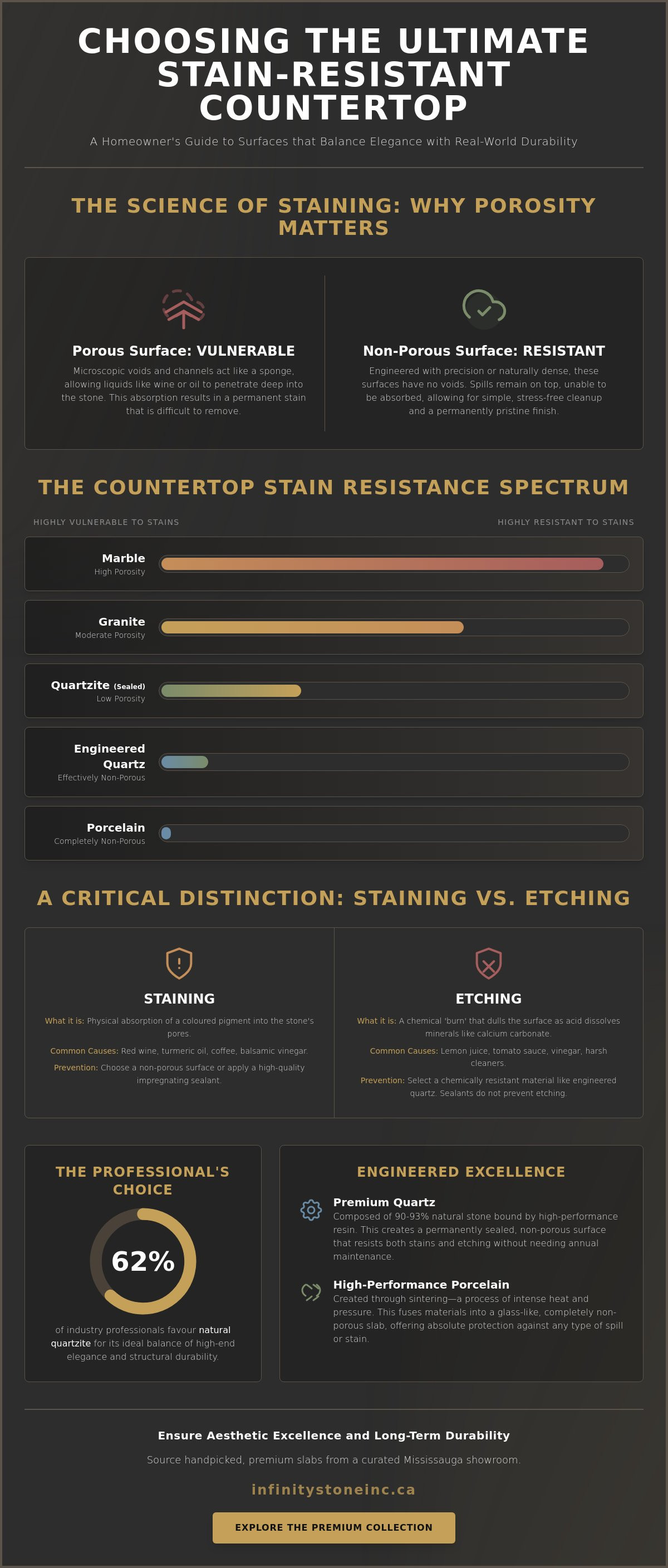
It's understandable to feel frustrated by the maintenance requirements of traditional stones that demand constant sealing and specialized care. You deserve a pristine sanctuary. This selection guide explores the most sophisticated, non-porous surfaces for 2026, including low-silica engineered quartz and high-performance porcelain slabs. We will detail which materials offer absolute stain resistance and why 62% of industry professionals now favour natural quartzite for its balance of high-end elegance and structural durability. By the end of this guide, you will have the confidence to select a surface that matches both your lifestyle and your aesthetic standards.
Key Takeaways
- Understand how microscopic porosity dictates surface vulnerability and the critical distinction between temporary surface spills and permanent molecular staining.
- Identify why non-porous engineered surfaces like quartz and porcelain represent the best countertop material that doesn't stain for high-traffic luxury environments.
- Discover the geological density of natural quartzite and how modern impregnating sealants allow authentic stone to rival the performance of engineered alternatives.
- Learn the professional Water Drop Test to diagnostic stone integrity and establish maintenance protocols that preserve a pristine finish for decades.
- Realize the value of sourcing handpicked, premium slabs from a curated Mississauga showroom to ensure both aesthetic excellence and long-term durability.
The Science of Surface Porosity: Why Some Countertops Stain
Porosity is the primary indicator of a material’s maintenance profile. This geological characteristic refers to the microscopic voids and interconnected capillary channels within a slab that allow liquids to penetrate beneath the visible surface. When homeowners search for the best countertop material that doesn't stain, they're essentially looking for a surface with the lowest possible porosity. In natural stone, these voids are a byproduct of the earth's cooling and compression processes over millennia. In engineered materials, manufacturers use vacuum-pressing and resins to eliminate these gaps entirely.
Understanding the distinction between a surface spill and a deep-seated stain is vital for long-term stone preservation. A spill sits on top of the material; a stain occurs when pigments migrate into the stone's molecular structure. Once a liquid like balsamic vinegar or turmeric oil enters these pores, it becomes part of the slab. Removing it requires chemical poultices rather than simple detergents. The mineral composition of your chosen slab dictates its natural resistance. Slabs rich in quartz tend to be denser and less absorbent, while those with high calcium content remain vulnerable to both pigment absorption and chemical reactions.
The Porosity Scale: From Marble to Porcelain
The hierarchy of stain resistance begins with geological density. Marble sits at the high-porosity end of the spectrum. Its calcium carbonate base is naturally soft, featuring a network of open pores that act like a sponge for dark liquids. If you don't seal it regularly, even clear oils can leave permanent shadows. Granite and quartzite offer significantly higher density, but they still possess microscopic pathways. For those seeking absolute protection, porcelain slabs represent the pinnacle of engineering. These surfaces undergo a process called sintering, where intense heat and pressure fuse raw materials into a glass-like, non-porous mass. This manufacturing precision effectively deletes the voids found in natural stone.
Acid Sensitivity vs. Pigment Absorption
It's a common mistake to conflate "etching" with "staining," yet they are entirely different issues. Staining is the physical absorption of a pigment into the stone's pores. Etching is a chemical "burn" that occurs when acidic substances like lemon juice or wine dissolve the minerals on the surface. While a high-quality sealer can block pigments, it rarely protects against the chemical reaction of acid on a soft stone. This is why a comprehensive Countertop materials overview often highlights engineered quartz as a superior choice for active kitchens. Because quartz slabs are bound with non-porous resins, they provide a barrier against both physical stains and acidic etching. Selecting the best countertop material that doesn't stain requires balancing these two distinct types of surface vulnerability to ensure your kitchen remains pristine for decades.
Engineered Excellence: Why Quartz and Porcelain Lead in Stain Resistance
Transitioning from natural porosity to manufactured precision reveals why engineered slabs are the industry's answer to high-maintenance surfaces. Quartz and porcelain represent the pinnacle of modern surfacing technology. These materials consistently outperform natural alternatives in rigorous "turmeric and red wine tests" where pigments are left to sit for 24 hours. While natural stone relies on geological luck, engineered slabs are designed to be the best countertop material that doesn't stain through controlled industrial processes. They offer a level of reliability that matches the high standards of luxury interior design.
The Non-Porous Nature of Premium Quartz Slabs
Quartz slabs typically comprise 90 to 93 percent crushed natural stone bound together by high-performance polyester resins. This resin binder acts as a permanent, internal sealant that saturates every microscopic void. It creates a surface that requires no annual sealing or specialized stone soaps. This structural integrity has allowed for an aesthetic evolution where designers can now achieve the authentic "marble look" without the associated maintenance anxiety. For those exploring specific inventory options, our Quartz Countertops Mississauga: A Connoisseur’s Guide to Premium Slabs provides deeper insight into selecting the right grade for your project.
Citing a Best Types Of Kitchen Countertops report confirms that quartz is a premier non-porous choice that resists both bacteria and staining agents. This makes it an ideal foundational element for a busy kitchen where hygiene and aesthetics are equally weighted. Because the pigments are locked within the resin matrix, even stubborn substances like beet juice or permanent markers can be removed with standard cleaning protocols.
Porcelain: The Only Truly Stain-Proof Surface
If quartz is stain-resistant, premium porcelain is arguably the only material that qualifies as truly stain-proof. Porcelain slabs are the result of sintering, a process involving extreme heat and pressure that fuses minerals into a glass-like density. This zero-porosity finish makes porcelain impervious to almost all household chemicals, including harsh degreasers and acidic cleaners. Unlike quartz, porcelain also exhibits exceptional resistance to UV rays and thermal shock. This makes it a superior choice for sun-drenched kitchens or outdoor dining centres where temperature fluctuations are common.
Professional designers often select these slabs for their technical resilience and architectural versatility. To understand the full scope of these materials, consult our Luxury Porcelain Countertops in Ontario: The Sophisticated Homeowner’s Guide. If you're ready to view these high-performance surfaces in person, you can explore our curated slab inventory to find the perfect match for your interior vision.
Natural Stone Realities: Can Quartzite and Granite Be Stain-Proof?
While engineered slabs offer absolute predictability, natural stone provides a unique character that remains unmatched in luxury interiors. Many homeowners assume that choosing an organic surface means sacrificing durability, yet specific geological classifications offer remarkable resistance to absorption. When evaluating the best countertop material that doesn't stain within the natural category, the conversation begins with density. Granite has long been the standard for Canadian kitchens because of its resilient mineral structure, but quartzite has emerged as the superior choice for those demanding both marble-like aesthetics and granite-level performance. These stones don't rely on resins for their integrity; their resistance is a direct result of intense heat and pressure within the earth's crust.
According to a detailed review of the best types of kitchen countertops, granite remains a top contender for its ability to withstand heat and scratches, though its porosity varies significantly by colour and quarry source. Darker granites, such as those in deep blacks or charcoal greys, often possess tighter crystalline structures. This makes them naturally more resistant to oils and pigments than lighter, more granular varieties. For a busy Canadian household, selecting a low-porosity granite slab ensures the kitchen remains a functional centrepiece without the constant fear of permanent marks from daily spills.
Quartzite: The Designer’s Compromise
Quartzite represents a metamorphic evolution from sandstone, resulting in a material that ranks a 7 on the Mohs scale of hardness. This crystalline structure makes it harder than steel and significantly more dense than traditional granite. For those seeking the pinnacle of natural performance, our Premium Quartzite Slabs in Ontario: The Connoisseur’s Guide to Luxury Surfaces details the specific varieties that balance visual drama with structural integrity. It's essential to distinguish between "hard" quartzites, which are nearly impervious, and "soft" quartzites, which may contain traces of calcium and require more diligent care. The highest quality quartzites provide the sophisticated veining of marble while resisting the deep-seated molecular staining that plagues softer stones.
The Necessity of High-Performance Sealing
Modern chemical engineering has transformed the maintenance profile of natural stone. High-end nano-sealants now penetrate the stone's surface to create a hydrophobic barrier at the molecular level. These impregnators don't sit on top of the slab like a plastic film; instead, they fill the microscopic voids to repel liquids while allowing the stone to breathe. A premium slab treated with these advanced solutions typically only requires re-sealing every few years, depending on the intensity of kitchen use. This proactive protection ensures that even if a spill occurs, the liquid remains on the surface for easy removal. Quartzite offers the highest stain resistance among all natural stones.
Testing and Maintenance: How to Ensure Your Slabs Stay Pristine
Determining the best countertop material that doesn't stain requires more than just reviewing technical specifications; it involves active verification of a slab's physical integrity. While manufacturing standards for porcelain and quartz remain remarkably consistent, natural stones like quartzite and granite exhibit geological variations that influence their absorption rates. Before finalizing an investment, performing a 30-minute Water Drop Test serves as a reliable diagnostic for porosity. Simply place a tablespoon of water on the surface. If the stone darkens or the water disappears within the half-hour, the material requires a high-performance impregnating sealer to prevent permanent blemishes. This simple diagnostic provides the confidence needed to ensure a kitchen remains a pristine architectural feature for decades.
The "Lemon Test" is equally vital for identifying acid-sensitive minerals that lead to etching. Placing a drop of citrus juice on a sample piece reveals whether the stone contains calcium carbonate, which reacts chemically with acids. This is particularly useful for distinguishing between true "hard" quartzites and softer varieties that may behave more like marble under daily use. Understanding these reactions before purchase prevents the frustration of ruining an expensive stone investment with common household ingredients like vinegar or citrus.
The Professional Slab Inspection Process
A thorough visual inspection at the showroom is the first step in quality control. You should examine the slab under high-intensity lighting to identify micro-fissures, which are tiny structural cracks that can harbour bacteria or collect pigments. The choice of finish also impacts stain visibility. While a polished surface provides a reflective lustre that is easier to wipe clean, a honed finish offers a sophisticated matte aesthetic that can occasionally highlight oil-based fingerprints. Viewing a full slab in person allows you to realize the true scale of the veining and ensure there are no natural pits that could compromise the surface's non-porous performance.
Long-Term Care for Luxury Surfaces
Daily maintenance routines should focus on preservation rather than aggressive cleaning. For non-porous engineered surfaces like quartz and porcelain, a soft cloth and mild dish soap are sufficient. You must avoid abrasive cleaners or scouring pads; these can dull the factory finish and create microscopic scratches where stains might eventually take hold. For natural stones, the protocol is more specific:
- Use pH-neutral cleaners: Avoid bleach, ammonia, or acidic "all-purpose" sprays that can degrade sealants.
- Monitor sealant integrity: Perform the water drop test annually to check if the hydrophobic barrier is still active.
- Blot, don't wipe: When spills occur on natural stone, blotting prevents the liquid from being pushed deeper into the pores.
Identifying when it's time to re-seal your granite or quartzite surfaces is simple: if water no longer beads on the surface, the protective barrier has worn thin. To see how these maintenance protocols apply to specific materials, you can explore our hand-selected slab inventory and consult with our experts on the best care for your chosen stone.
Sourcing High-Performance Slabs in Mississauga: The Infinity Stone Selection
Securing the best countertop material that doesn't stain begins with a discerning sourcing process. While mass-market retailers often prioritize volume, Infinity Stone Inc. focuses on the geological integrity and aesthetic rarity of every individual slab. Our inventory is the result of direct partnerships with premier global quarries, ensuring that each piece of quartzite, quartz, and porcelain meets the rigorous standards of the 2026 luxury market. By operating exclusively as a material supplier, we provide a neutral, expert environment where the focus remains entirely on the quality and performance of the stone. This specialization allows us to curate a collection that balances visual drama with the technical necessity of a non-porous finish.
Our Mississauga showroom serves as a professional hub for those seeking the foundational elements of high-end living. We understand that a kitchen island is an architectural focal point that must withstand the realities of a social household. By selecting materials with superior density and mineral purity, we eliminate the maintenance anxiety that often accompanies traditional stone investments. Whether you're an architect specifying a commercial project or a homeowner designing a dream kitchen, our team provides the geological data and technical validation required to make an informed selection.
Why Designers Choose Our Mississauga Slab Gallery
Professional designers and architects require more than just a surface; they need a reliable industry partner. Our Mississauga slab gallery provides access to rare, high-density quartzites that possess the crystalline structure needed to resist deep-seated molecular staining. These premium varieties are often unavailable in big-box retail environments. We offer professional consultation on the specific geological properties of our inventory, helping you distinguish between materials that require periodic sealing and those that are naturally impervious. Our strategic location in Ontario ensures easy project viewing, allowing stakeholders to inspect full-scale slabs under professional lighting to ensure absolute quality control before fabrication begins.
Foundations for High-End Living
Our commitment to excellence is reflected in our strict distribution of only the most reliable and aesthetic surfaces. We prioritize materials that satisfy both the aesthetic sensibilities of decorators and the technical requirements of builders. While we don't handle on-site installation or fabrication, we partner closely with the region's top fabricators to ensure your vision is realized with the highest quality material. This ensures the technical specifications of the best countertop material that doesn't stain are preserved from our warehouse to your home. Selecting a slab from our curated collection is a proactive step toward a pristine, maintenance-free interior that remains flawless for decades.
Explore our curated collection of premium slabs in Mississauga and discover the perfect balance of luxury and durability for your next design project.
Elevating Your Interior with Enduring Surface Performance
Selecting a surface that balances aesthetic grandeur with absolute resilience requires a deep understanding of geological density. Whether you opt for the zero-porosity precision of porcelain or the crystalline hardness of premium quartzite, your choice should reflect a commitment to long-term quality. Identifying the best countertop material that doesn't stain is the definitive step toward a maintenance-free luxury kitchen that survives the rigours of daily life without losing its lustre. By utilizing professional diagnostics like the Water Drop Test, you can ensure your investment remains a pristine architectural feature for decades.
Infinity Stone Inc. remains a dedicated partner for the design community, offering a handpicked global inventory and specialized expertise in high-density quartzite. Our collection is trusted by Ontario's leading designers and architects for its uncompromising standards and curated excellence. We invite you to View Our Curated Mississauga Slab Inventory to find the foundational elements for your next high-end project. Your vision of a sophisticated, worry-free sanctuary is well within reach.
Frequently Asked Questions
Is porcelain really better than quartz for preventing stains?
Yes, porcelain is technically superior because its zero-porosity surface is achieved through sintering at extreme temperatures. While quartz is highly resistant due to resin binders, porcelain is impervious to a wider range of chemicals and UV rays. This makes it the absolute best countertop material that doesn't stain for those seeking a truly maintenance-free surface that can withstand harsh environments without discolouration.
Does quartzite need to be sealed to prevent staining?
Yes, all natural quartzite requires a high-quality impregnating sealer to maintain its resistance. Although it is significantly denser than marble, it still possesses microscopic voids that can absorb pigments over time. Applying a premium nano-sealant creates a hydrophobic barrier that prevents liquids from migrating into the stone's crystalline structure, ensuring the slab remains pristine through years of heavy use.
What is the most stain-resistant natural stone for a kitchen?
High-density quartzite is widely considered the most stain-resistant natural stone available. Its mineral composition provides a hardness and density that outperforms granite and marble. For those who prefer organic surfaces, it is often cited as the best countertop material that doesn't stain when properly sealed. It remains the premier choice for those desiring marble aesthetics without the associated maintenance anxiety.
Can red wine stain a quartz countertop?
Red wine rarely stains quartz if it is wiped away promptly, but prolonged exposure can lead to surface discolouration. The resin binders in quartz are non-porous, yet certain intense pigments can occasionally interact with the surface if left to dry indefinitely. Using a pH-neutral cleaner usually resolves these issues without compromising the factory finish or the structural integrity of the slab.
How do I know if my stone countertop needs to be re-sealed?
The Water Drop Test is the professional standard for checking sealant integrity on natural stone. Place a small amount of water on the slab and wait 15 to 30 minutes. If the water beads on the surface, the sealer is intact. If the stone darkens or absorbs the liquid, the protective barrier has worn thin and it is time to re-apply a professional-grade impregnator.
Are honed finishes more likely to stain than polished finishes?
Honed finishes are not necessarily more porous, but they are more susceptible to showing oil-based marks and fingerprints. A polished finish provides a smoother, more reflective barrier that makes it easier to identify and remove spills before they settle. For active kitchens, a polished surface often remains the most practical choice for long-term stain prevention and ease of daily maintenance.
Can I use bleach to remove a stain from my stone slab?
You should avoid using bleach, as it can strip away protective sealants on natural stone and potentially discolour the resins in engineered quartz. Harsh chemicals often cause more damage than the original spill by creating dull spots or etching the surface finish. Stick to pH-neutral stone cleaners or mild dish soap to preserve the material's factory lustre and long-term durability.
What is the "lemon juice test" for stone slabs?
The lemon juice test is a diagnostic tool used to identify acid-sensitive minerals within a slab before purchase. By placing a drop of citrus juice on a stone sample, you can see if the material "etches" or loses its lustre. This test is essential for confirming that a material is a true quartzite rather than a mislabelled marble or dolomite that would react poorly to acidic kitchen ingredients.


