
What if the most striking feature of your kitchen island isn't the stone itself, but the invisible line where the horizontal surface meets the floor? For many homeowners in the Greater Toronto Area, the dream of a luxury kitchen often centres on the waterfall edge, yet the fear of a mismatched pattern can turn a high-end project into a source of anxiety. Achieving a truly monolithic look requires access to the bookmatched stone slabs Ontario connoisseurs demand for pattern continuity. You want a kitchen that feels like a singular piece of architectural art, not a collection of disjointed parts. Finding the right material is the foundation of ensuring your investment delivers the prestige you expect.
This guide provides the technical clarity you need to select the perfect material for a seamless result. We will examine the specific characteristics of quartzite, quartz, and porcelain, providing a structured approach to slab dimensions, vein alignment, and vertical transitions. From the natural allure of exotic quartzite to the precision of large-format porcelain, you'll gain the confidence to choose a surface that handles the vertical drop with absolute elegance. By focusing on material selection early in the design phase, you ensure your fabricator has the necessary canvas to create a flawless, high-end finish.
Key Takeaways
- Learn how to achieve a monolithic, carved-from-a-single-block aesthetic by prioritizing material continuity at the warehouse stage.
- Understand the structural and aesthetic differences between quartzite, quartz, and porcelain when planning precise mitred corners for vertical transitions.
- Discover how to identify and utilize bookmatched stone slabs Ontario designers prefer for creating mirror-image symmetry across waterfall edges.
- Master the calculations required for slab dimensions to ensure your chosen material covers both the horizontal surface and the vertical legs without unnecessary seams.
- Realize the advantage of viewing handpicked, large-format slabs in person at a Mississauga showroom to guarantee the veining matches your architectural vision.
The Art of the Waterfall Edge: Why Slab Selection Is Paramount
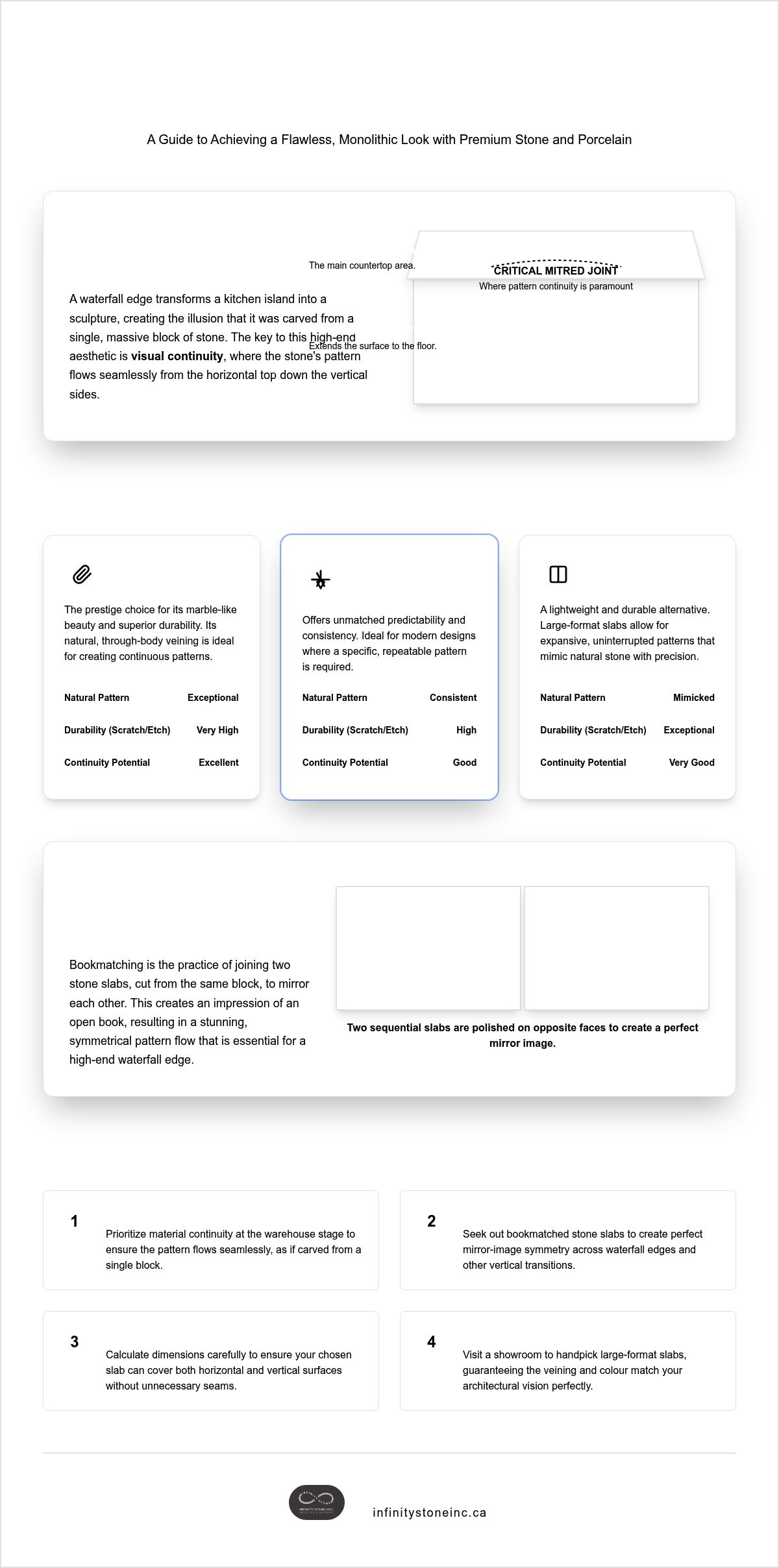
A waterfall countertop is defined by its vertical drop, where the stone surface extends from the horizontal plane directly to the floor. This architectural feature creates a striking profile that emphasizes the material's thickness and natural pattern. In modern Canadian luxury design, the primary aesthetic objective is a monolithic appearance. The island should feel as though it was carved from a single, massive block of stone rather than assembled from separate pieces. This design choice remains a staple in Ontario homes because it transforms a functional kitchen element into a bold, permanent sculpture.
Successful execution begins at the slab warehouse. While fabricators execute the final mitre, the material supplier provides the necessary canvas. Infinity Stone Inc. curates an inventory specifically for these high-stakes transitions. We ensure the veining and structural integrity of our slabs meet the rigorous demands of a vertical layout. Sourcing the right material is the foundation for a fabricator's success; without the correct pattern flow, the illusion of a single block is lost.
Visual Continuity and the Monolithic Aesthetic
The transition from a horizontal countertop to a vertical gable end is where the quality of the slab selection is truly tested. Achieving a continuous flow of pattern elevates a kitchen island into a piece of bespoke furniture. High-end interior architecture relies on the psychological impact of visual weight. A seamless stone transition suggests permanence and exclusivity. The quality of the mitered joint depends entirely on the slab's unique characteristics. This is why designers prioritize The Art of Bookmatching when selecting surfaces. By utilizing bookmatched stone slabs Ontario professionals can create a mirror-image effect that wraps perfectly around the corner. This maintains the narrative of the stone's natural veining without interruption.
Waterfall Edges Beyond the Kitchen Island
The waterfall application is no longer restricted to the kitchen. There is an increasing demand for vertical stone transitions in luxury bathroom vanities and integrated feature seating. In commercial spaces across the GTA, reception desks utilize these stone gables to project a sense of established authority. There is also a notable trend toward large-format porcelain waterfall ends in modern Ontario residences. Porcelain offers a lightweight yet durable alternative for vertical surfaces, allowing for expansive, uninterrupted patterns that mimic natural marble or quartzite. Whether it's a bathroom retreat or a corporate lobby, sourcing the bookmatched stone slabs Ontario experts recommend is the first step in a successful architectural statement. The slab must be chosen for its ability to perform across two planes with absolute precision.
Evaluating Materials: Quartzite, Quartz, and Porcelain for Vertical Transitions
Choosing between natural and engineered surfaces involves balancing organic artistry with structural predictability. While any premium slab can be cut for a waterfall edge, the way pattern and density behave at the mitre joint varies between categories. Natural stones like quartzite and marble offer an unmatched visual depth, whereas engineered quartz and porcelain provide a controlled canvas for modern architecture.
Quartzite: The Prestige Choice for Natural Veining
Quartzite has emerged as the definitive gold standard for luxury residential projects in Mississauga. It possesses the ethereal beauty of marble but offers significantly higher resistance to scratching and chemical etching in high-traffic kitchens. When sourcing bookmatched stone slabs Ontario designers often gravitate toward quartzite for its directional veining. These natural patterns aren't just surface-level; they're geological narratives that can be mirrored to create a symmetrical waterfall effect. Achieving this requires a precise eye during the selection process. You must ensure the vein flow remains consistent as the stone transitions from a horizontal plane to a vertical gable.
Engineered Surfaces: Consistency and Precision
Engineered quartz provides a different set of advantages, primarily centred on predictability. Because the patterns are manufactured, aligning the flow at the corner seam is often less complex than with natural stone. This allows for near-perfect seam concealment, which is essential for a truly monolithic appearance. Porcelain slabs have also become a preferred choice for contemporary Ontario builds. Their large-format sizing reduces the need for additional joins, and their thin profile creates a sleek, minimalist gable that feels incredibly modern.
Success in these vertical transitions depends on technical uniformity. Following industry standards for stone slabs ensures that thickness remains consistent across the entire layout. Even a millimetre of variance can disrupt the alignment of a mitered corner. Beyond thickness, colour-matching the epoxy used at the joint is critical for maintaining the illusion of a single block. If you're evaluating these materials for your next project, viewing our curated quartzite and porcelain inventory in Mississauga allows you to compare these textures under professional lighting. Sourcing the right material is the first step toward a flawless architectural feature.
Masterclass in Veining: Bookmatching and Pattern Continuity
The success of a waterfall edge is decided on the warehouse floor; it's not a decision for the fabrication shop alone. When you're standing before a raw slab, you're looking for the natural "grain" of the stone. For a vertical drop to feel intentional, the pattern must flow downward with the same energy it carries across the horizontal surface. Static patterns are easier to align, but they lack the drama of stones with significant movement. If the veining moves diagonally, the fabricator must calculate the cut so the line appears to bend naturally at the mitre joint.
Sourcing bookmatched stone slabs Ontario designers trust involves finding pairs of slabs that have been sliced from the same block and polished on opposite sides. This creates a mirror image. When these slabs meet at the mitre, the veining opens like a book, creating a symmetrical masterpiece. Without this mirror effect, bold veins can look disjointed at the corner, a phenomenon known as vein runoff. You'll want to ensure the primary veins don't terminate abruptly at the edge where the vertical leg begins. A disjointed pattern breaks the monolithic illusion and draws the eye to the seam rather than the stone.
The Selection Process: Inspecting Your Slab in Person
Mississauga designers and homeowners should always view full slabs under professional warehouse lighting. Small samples can't reveal the large-scale fissures or colour shifts that might complicate a mitered cut. While we don't provide fabrication, we encourage clients to work with their partners on digital templating. By overlaying a digital map of your island onto our specific slabs, you can visualize exactly how the transition will look before the first cut is made. This process minimizes slab wastage and ensures the most aesthetic sections of the stone are featured on the waterfall gable.
Managing Large-Scale Patterns
Bold, dramatic veining in marble or quartzite requires a strategic approach. There's a persistent debate between vein-matching, where the vein continues in a straight line, and flip-matching, which uses bookmatched slabs to create a diamond or chevron effect. For a waterfall edge, the goal is usually grain continuation. The horizontal movement should appear to "bend" 90 degrees and travel toward the floor. This requires a slab with enough length to accommodate both the top and the side, or a perfectly matched pair of bookmatched stone slabs Ontario specialists have curated for this exact purpose. It's about ensuring the architectural weight of the stone feels balanced from every angle.
Sizing and Logistics: Ensuring Your Slab Can Go the Distance
A waterfall countertop demands a more rigorous calculation of raw material than a standard horizontal surface. You aren't just measuring the top area; you must account for the primary island length plus the vertical drop on one or both ends. For a standard 36-inch counter height, each leg adds approximately three feet of stone. This requirement often pushes the project beyond the capacity of a single standard-sized slab. Utilizing jumbo formats is a strategic advantage in these scenarios. These larger slabs minimize the need for additional horizontal seams, maintaining the monolithic profile that defines luxury design.
Wastage is an inherent part of the waterfall process. To ensure the pattern flows correctly, the fabricator must often cut from specific sections of the slab, leaving behind remnants that cannot be used for the primary island. When your design requires bookmatched stone slabs Ontario suppliers like Infinity Stone provide the necessary pairs to ensure that both vertical legs mirror the top surface perfectly. This often necessitates purchasing two sequential slabs to achieve the desired continuity without compromising the visual narrative of the stone.
Transporting these high-value, large-format materials across the GTA requires specialized logistics. We coordinate with your chosen fabrication partner to ensure the slabs arrive safely at their facility. Sourcing the material is only half the journey; professional handling ensures the stone remains pristine until it's ready for the mitre saw. Our team manages the inventory with the precision required for high-stakes architectural projects.
Planning Your Layout to Minimize Seams
Standard slab sizes in Ontario typically range around 120 by 65 inches. If your island exceeds these dimensions, you'll need to plan for a seam or opt for a jumbo slab to avoid a disjointed look. The choice between 2cm and 3cm thickness also impacts the project's visual weight. While 3cm is the traditional standard for luxury kitchens, 2cm porcelain or quartz can provide a sleeker, contemporary look for modern gables. For more details on choosing the right material for your project, see our guide on Sourcing Premium Stone Slabs in Ontario.
Working with Your Fabricator
Your fabricator is your most important technical partner during the selection process. They must approve the slab selection before the sale is finalized to confirm the stone's integrity for mitered cuts. Precise measurements during the template phase are non-negotiable. Even a fractional error in the floor's levelness can impact how the waterfall leg meets the ground. We invite you and your professional team to view our current Mississauga inventory in person to ensure the dimensions and pattern alignment meet your exact specifications.
Sourcing in Mississauga: The Infinity Stone Curation Advantage
At Infinity Stone, our approach to inventory is one of rigorous curation rather than mass-market accumulation. We understand that a waterfall project's success is predicated on the quality of the raw material. Our team handpicks each slab from global sources, specifically looking for the structural integrity and pattern continuity required for high-end vertical transitions. By focusing on the unique needs of the design community, we ensure that every block in our warehouse offers the aesthetic potential to become a foundational element of a luxury home.
Visiting our Mississauga showroom provides a sensory experience that digital galleries cannot replicate. Under professional, colour-corrected lighting, you can observe the subtle depth of natural stone and the precise textures of our engineered surfaces. This in-person inspection is vital for identifying the exact flow of veining that will eventually wrap around your kitchen island or bathroom vanity. We support GTA designers and contractors by providing comprehensive technical data, ensuring the chosen material aligns with the project's architectural requirements and the fabricator's needs.
The Infinity Stone Inventory
Our warehouse serves as a premier starting point for Mississauga's most ambitious residential projects. We maintain an extensive selection of premium quartzite and large-format porcelain slabs, both of which are ideally suited for the seamless look of a waterfall gable. Our inventory is specifically managed to include sequential bookmatched stone slabs Ontario professionals require for symmetrical layouts. This specialization allows us to provide the exact canvas needed for complex mitered joints. For those seeking the pinnacle of natural artistry, we invite you to explore Why Quartzite Slabs Are the Ultimate Mississauga Luxury to understand how these surfaces elevate modern interiors.
Finalizing Your Selection
The transition from material supplier to fabrication shop is a critical phase in your project. We facilitate this process by providing clear documentation and ensuring your fabricator has all the necessary specifications for the stone. As your trusted partner in the Ontario luxury market, we're committed to sourcing stone that meets the highest aesthetic and technical standards. Our role is to provide the foundational materials that allow your design vision to become a concrete reality. We encourage you to take the next step in your design journey by arranging a private viewing at our facility. You can view our current Mississauga inventory online to begin identifying the pieces that will define your space.
Elevating Your Architectural Vision
A successful waterfall edge is more than a design trend; it's a commitment to architectural precision. Achieving a truly monolithic appearance requires a strategic approach to material selection and pattern continuity. By prioritizing the bookmatched stone slabs Ontario designers demand, you ensure that the organic beauty of the stone flows seamlessly from the horizontal counter to the vertical floor. Whether you select the natural prestige of quartzite or the modern efficiency of large-format porcelain, the foundation of your project remains the quality of the raw slab. Planning for dimensions and wastage early in the design phase prevents logistical delays and ensures a flawless mitered finish.
Infinity Stone Inc. remains your steady partner in sourcing these essential elements. Our handpicked global inventory is curated to meet the exacting standards of the GTA's top interior designers. We specialize in the high-tier quartzite and large-format porcelain required for elite residential projects. We invite you to explore our curated collection of premium slabs in Mississauga to find the perfect stone for your next build. Your journey toward a sophisticated, enduring interior begins with the right material.
Frequently Asked Questions
Can I use a single slab for a waterfall island?
Using a single slab for a waterfall island depends entirely on the island's dimensions and the slab's format. A standard slab is roughly 120 inches long; if your island is six feet long and requires a 36-inch vertical drop on both sides, you'll exceed the length of one slab. Jumbo slabs can occasionally bridge this gap for smaller islands, but most luxury projects require a second slab to maintain pattern continuity.
Which material is best for a seamless waterfall edge: quartz or quartzite?
Quartzite is considered the gold standard for luxury waterfall projects because of its unique natural veining and extreme durability. While engineered quartz offers predictable pattern alignment, quartzite provides a prestigious, organic aesthetic that can't be replicated. It's more resistant to heat and scratching than marble, making it the ideal choice for high-traffic GTA kitchens where a seamless, monolithic look is the primary design goal.
What is bookmatching, and do I need it for my waterfall countertop?
Bookmatching refers to the practice of matching two or more stone slabs so that their surfaces mirror each other like an open book. You need bookmatched stone slabs Ontario designers trust if your waterfall design features bold, directional veining. Without bookmatching, the transition from the horizontal top to the vertical leg will look disjointed. This mirror effect ensures the pattern flows symmetrically down the side of the island.
How much extra stone do I need to buy for a waterfall edge?
You typically need to purchase enough stone to cover the horizontal surface plus the total height of the vertical legs. For a standard 36-inch counter height, each waterfall end adds approximately three feet of material. Because pattern matching often requires cutting from specific sections of the stone, you should plan for 20% to 30% more material than a standard countertop project to account for necessary wastage and vein alignment.
Does a waterfall countertop require special support for the vertical legs?
Vertical legs for a waterfall countertop require a level floor and a reinforced cabinet structure to handle the stone's weight. While the stone itself is self-supporting once mitered and glued, the subfloor must be perfectly flat to prevent cracking at the joint. You should consult with your contractor or designer to ensure the island cabinetry is built to withstand the additional load of large-format quartzite or marble gables.
Can I do a waterfall edge with natural marble, or is it too fragile?
You can certainly use natural marble for a waterfall edge, but it requires careful handling due to its relative softness. Marble is more prone to chipping at the mitered corner compared to quartzite or granite. For a high-traffic kitchen island, many Ontario homeowners choose quartzite because it offers the same ethereal beauty as marble but with significantly better resistance to the daily wear and tear of a busy household.
What is the best thickness for a waterfall countertop slab?
The best thickness for a luxury waterfall countertop is typically 3cm, as it provides a substantial, high-end visual weight. However, 2cm slabs are increasingly popular for modern, minimalist designs, especially when using porcelain or quartz. The choice often depends on the aesthetic of your cabinetry; a 3cm slab offers a more traditional sense of permanence, while 2cm creates a sleeker profile that's common in contemporary GTA builds.
Where can I see waterfall-ready slabs in Mississauga?
You can view an extensive range of waterfall-ready slabs at the Infinity Stone Inc. showroom in Mississauga. We curate a handpicked inventory of premium quartzite, marble, and large-format porcelain specifically chosen for their suitability in complex architectural applications. Visiting our facility allows you to see the full slabs under professional lighting, ensuring the veining and colour match your design vision before you move forward with your fabricator.


