
Why do the most discerning homeowners in Ontario often find themselves paralyzed by a single word? It's a recurring dilemma in high-end renovations: the nomenclature of premium surfaces is deceptively similar, yet the decision between quartzite vs quartz slabs represents two entirely different philosophies of interior design. You likely recognize that a kitchen island or a primary ensuite serves as the architectural anchor of your home. You deserve a surface that reflects that prestige without the frustration of confusing terminology or the conflicting maintenance advice often found online.
This guide provides the definitive clarity you need to distinguish between geological rarity and engineered precision. We'll ensure your selection aligns with your aesthetic vision and daily lifestyle requirements. You'll gain a thorough understanding of material composition, thermal stability, and specific sealing protocols. We also detail where to view an exclusive, handpicked inventory of full-scale slabs in Mississauga. By the end of this guide, you'll have the confidence to choose a foundation for your space that balances timeless elegance with long-term durability.
Key Takeaways
- Learn the fundamental distinction between metamorphic quartzite and resin-bound quartz to ensure your surface choice aligns with your specific architectural vision.
- Discover why natural quartzite offers superior heat resistance and geological rarity compared to the uniform, non-porous convenience of engineered alternatives.
- Master the maintenance protocols required for each material, including the essential sealing process for natural stone to preserve its long-term lustre.
- Evaluate the performance profiles of quartzite vs quartz slabs using the Mohs scale of mineral hardness to select a surface that withstands high-traffic environments.
- Understand the importance of inspecting full-scale slabs at a Mississauga gallery to accurately assess colour depth and crystal transparency before engaging a fabricator.
Geological Origins vs. Engineered Precision: Defining the Materials
The selection process for a luxury interior begins with a fundamental understanding of material heritage. When comparing quartzite vs quartz slabs, you're choosing between the raw, unrepeatable artistry of the earth and the peak of modern material science. For the Ontario connoisseur, this distinction isn't merely academic; it dictates the visual soul and functional lifespan of a residence. Choosing the right surface requires looking beyond the polished exterior to the very atoms that comprise the stone.
The Metamorphic Journey of Natural Quartzite
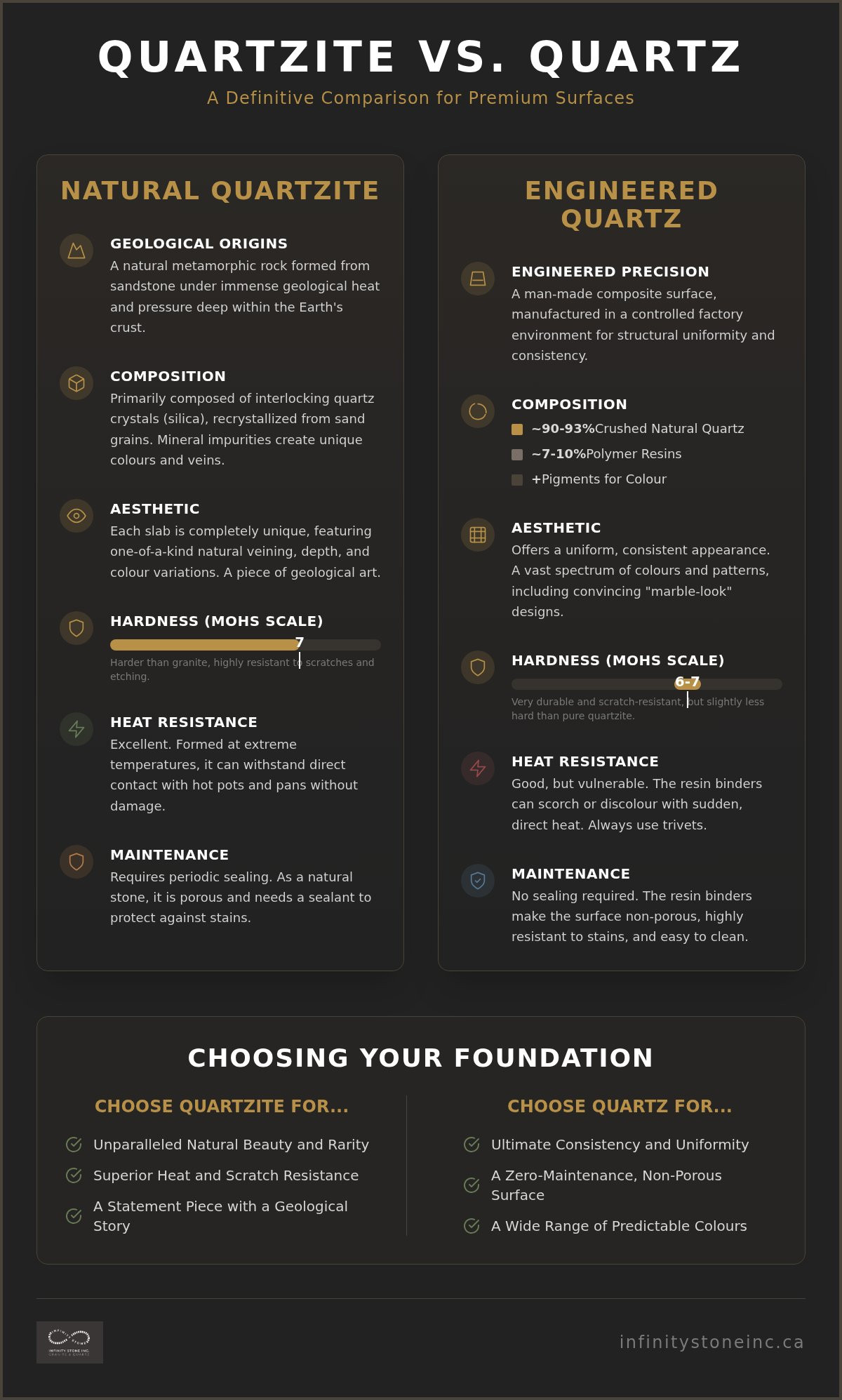
Quartzite exists as a testament to geological endurance. It begins its life as sandstone before undergoing a profound transformation deep within the earth's crust. Through intense heat and pressure, the individual sand grains recrystallize into a dense, interlocking structure of silica. This process, detailed in the Geological Origins of Quartzite, results in a material that ranks among the hardest available for residential surfaces. The striking veining and deep colour palettes aren't manufactured; they're the result of mineral impurities like iron oxide or mica trapped during the rock's formation. No two slabs are identical, offering a level of exclusivity that engineered products cannot replicate.
The Science Behind Engineered Quartz Slabs
Engineered quartz slabs represent a triumph of industrial precision. Unlike their natural counterparts, these surfaces are manufactured in a controlled environment to ensure structural uniformity. The typical composition includes:
- 90-93% Mineral Quartz: Crushed natural crystals that provide the slab's primary hardness.
- 7-10% Polymer Resins: Binding agents that fill every microscopic void, creating a non-porous finish.
- Pigments: Specialized additives that allow for a vast spectrum of colours and patterns.
This manufacturing process allows for the creation of "marble-look" quartz that mimics natural stone with high fidelity. Because the resin acts as a sealant, these slabs don't require the periodic maintenance associated with natural materials, making them a pragmatic choice for high-traffic culinary spaces.
Selecting a slab becomes an act of curation. While quartz provides a predictable, uniform aesthetic ideal for minimalist or large-scale applications, quartzite appeals to those who value geological rarity. In Mississauga's most prestigious homes, the debate of quartzite vs quartz slabs often hinges on whether the owner prefers the "perfect" consistency of an engineered product or the "perfectly imperfect" narrative of a natural stone. Both materials offer distinct advantages, but only one carries the weight of a million-year history.
Durability and Performance: The Practical Comparison
In a high-traffic Mississauga kitchen, surface performance isn't just a matter of aesthetics; it's a requirement for long-term value. When evaluating quartzite vs quartz slabs, homeowners must prioritize how these materials interact with daily culinary stressors. The common misconception that "engineered" equates to "indestructible" often leads to maintenance errors. While quartz offers a controlled, non-porous finish, it doesn't possess the same raw mineral hardness as its natural counterpart. For those seeking a material that survives the rigours of professional-grade appliances, the choice requires a nuanced understanding of physical properties.
The Mohs scale provides a clear metric for this comparison. Natural quartzite typically ranks at a 7, making it physically harder than most engineered quartz, which generally ranges between 6 and 7. This difference means quartzite is less likely to suffer from surface abrasions over time. Understanding the durability of quartzite slabs is essential for projects where the surface must remain pristine despite heavy use. By sourcing the raw material through a specialist, you ensure the specific block selected meets the highest standards of structural integrity.
Heat Resistance and Thermal Shock
Natural quartzite withstands high temperatures with ease, as its formation involves geological heat far exceeding anything a residential range can produce. Engineered quartz, however, contains roughly 7-10% polymer resins. These binders can scorch or discolour if you place a hot pan directly on the surface. Thermal shock occurs when a sudden, extreme temperature shift causes a material to expand or contract unevenly, resulting in structural cracks or permanent surface blemishes.
Scratch and Impact Resistance
Quartzite's dense crystalline structure provides exceptional resistance to abrasions. It's difficult to scratch with standard kitchen cutlery, though the stone's hardness can actually dull your knives. The resins in engineered quartz, while softer than the stone itself, provide a degree of impact absorption. This flexibility helps prevent the small chips that occasionally occur on the sharp edges of natural stone slabs. To maintain the elegant finish of any premium surface, we always suggest using protective barriers during food preparation.
You can experience the tactile differences of these premium surfaces by visiting our Mississauga slab gallery to find the right fit for your home. Seeing the scale and texture in person allows you to make a selection based on both performance data and personal preference.
Aesthetic Versatility: Curating Your Design Vision
Visual impact is the primary driver for luxury interior design. A premium slab serves as a foundational element, setting the tone for the entire architectural narrative of a home. The decision regarding quartzite vs quartz slabs often rests on whether a project requires the unique organic movement of natural stone or the sleek, curated uniformity of an engineered surface. Both materials provide distinct aesthetic advantages, but they appeal to different design philosophies.
The Unrepeatable Art of Natural Quartzite
Designers frequently turn to natural quartzite for projects that demand a signature look. Rare varieties like Taj Mahal, with its soft cream tones, or Sea Pearl, known for its subtle oceanic greys, offer a visual depth that engineered products struggle to replicate. The crystalline structure of these stones often possesses a slight translucency. This allows light to penetrate the surface and create a luminous effect that feels alive. Because the veining is a result of millions of years of geological activity, every slab is a unique piece of art. It's essential to view full-scale slabs in person at our Mississauga gallery; a small sample cannot convey the dramatic movement and sweeping patterns found in a complete piece of stone.
Consistency and Customization with Quartz
Engineered quartz is the preferred choice for large-scale projects where multiple identical surfaces are required. It allows for a modern, minimalist aesthetic that is difficult to achieve with natural materials. You can source slabs in pure, brilliant whites or industrial concrete greys that maintain perfect colour consistency across a vast kitchen island or a multi-room installation. For those exploring contemporary trends, our connoisseur's guide to quartz in Mississauga details how modern manufacturing produces complex patterns that rival the look of marble while maintaining the benefits of a man-made composite. This level of control makes quartz an ideal partner for the precision required in high-end cabinetry and custom millwork.
For a truly dramatic foyer or a primary suite feature wall, bookmatched slabs provide an unmatched sense of grandeur. By mirroring two slabs from the same block, you create a symmetrical pattern that showcases the stone as a living masterpiece. Whether you choose the organic soul of quartzite or the refined precision of quartz, the slab remains the essential anchor of high-end living. Each choice reflects a different facet of luxury, allowing homeowners to tailor their space to their specific aesthetic values.
Maintenance and Longevity: The Lifestyle Fit
Choosing between quartzite vs quartz slabs requires an honest assessment of your daily habits and long-term expectations. Luxury isn't just about the initial reveal; it's about how a surface ages within the context of a busy home. While both materials offer exceptional durability, their maintenance profiles differ significantly due to their molecular structures. Natural stone carries a legacy of porosity that requires mindful care, whereas engineered surfaces provide a static, consistent performance from day one. Understanding these nuances ensures your architectural anchor remains a source of pride rather than a maintenance burden.
Sealing Requirements for Natural Quartzite
Natural quartzite is a porous material by its very nature. To protect its crystalline beauty, you must apply a high-quality penetrative sealer to prevent liquids from migrating into the stone. This process isn't as daunting as many homeowners fear. You can easily perform a "water drop test" to check the status of your slab's protection. Simply place a few drops of water on the surface; if it beads, your sealer is intact. If the water absorbs and darkens the stone, it's time for a reapplication. These modern sealers create an invisible barrier against acid etching and deep-seated stains. For most Ontario households, this is a straightforward task performed only once every one to three years.
The Maintenance-Free Appeal of Engineered Quartz
Engineered quartz offers a maintenance-free appeal that resonates with pragmatists. Because the manufacturing process fills every microscopic void with resin binders, the slabs are entirely non-porous. You won't need to worry about lemon juice, vinegar, or wine causing immediate damage or permanent staining. However, this convenience comes with specific boundaries. The resin finish is sensitive to high-pH chemicals and abrasive scouring pads which can dull the surface over time. Using a soft cloth and a simple pH-neutral cleaner preserves the factory-applied lustre. Unlike natural stone, which may develop a subtle, characterful patina over decades, quartz remains visually identical to the day it was installed.
The decision ultimately hinges on whether you value the evolving soul of a natural material or the unchanging precision of an engineered one. Both paths lead to a high-end finish that defines a home's character. Explore our curated collection of premium slabs in Mississauga to see which maintenance profile best suits your specific lifestyle and design goals.
Sourcing Your Slabs: The Mississauga Selection Process
The procurement of a premium surface is a strategic phase in the luxury supply chain. Unlike mass-market retailers, a specialized supplier like Infinity Stone acts as a discerning curator of global inventory. We focus exclusively on the material supply. This ensures that the highest quality blocks are available for your chosen fabricator to transform. When comparing quartzite vs quartz slabs in a showroom environment, the difference in material presence becomes immediately apparent. Sourcing the raw material directly allows you to control the aesthetic foundation of your project before any tools touch the stone.
Why Material Selection Precedes Fabrication
Selecting your specific slab is the most critical step in the renovation timeline. You shouldn't leave this to a fabricator's discretion. Natural variations in quartzite mean that two slabs from the same quarry can possess entirely different veining intensities. By choosing the material first, you can coordinate the stone with cabinetry finishes and lighting temperatures. This sequence prevents the common error of trying to match a backsplash to a pre-installed kitchen that doesn't harmonize with the stone's undertones. For a deeper look at this professional workflow, consult our designer's guide for sourcing stone in Ontario. This collaborative approach between the homeowner, the designer, and the distributor ensures that the final selection aligns with the intended architectural narrative.
Viewing Slabs at our Mississauga Centre
Visiting our Mississauga gallery provides an experience that digital catalogues cannot replicate. We display handpicked, imported slabs under professional lighting designed to reveal the true depth of the mineral structures. This environment is essential for evaluating the subtle differences between quartzite vs quartz slabs, particularly when assessing the translucency of natural crystals versus the crisp patterns of engineered composites. You'll have the opportunity to walk through rows of large-format slabs, witnessing the scale of the veining in its entirety. Seeing the material at its full size is the only way to appreciate the movement and colour transitions that define a premium interior.
To maximize your visit, we recommend bringing floor plans, paint swatches, and cabinetry samples. Our inventory represents a curated selection of the world's finest geological finds and engineered innovations. We invite you to explore our Mississauga gallery to realize your design vision and secure the foundational elements for your high-end project. By selecting your material from a specialized source, you gain the peace of mind that your home will be anchored by a surface of peerless quality.
Securing the Foundational Elements of Your Luxury Interior
The decision between quartzite vs quartz slabs is ultimately a choice of design philosophy. You now understand that natural quartzite offers unrepeatable geological artistry and superior heat resistance; meanwhile, engineered quartz provides unmatched consistency and non-porous convenience. Both materials represent the pinnacle of premium surfaces when sourced with a focus on quality over quantity. It's a decision that defines the soul of your space, requiring a balance of aesthetic ambition and practical lifestyle requirements.
As a trusted partner for GTA designers and architects, Infinity Stone Inc. ensures your selection is the strongest foundational element of your renovation. Visiting a specialized gallery allows you to move beyond small samples and experience the true scale of these materials under professional conditions. We invite you to explore our handpicked inventory of premium slabs in Mississauga to see how these surfaces can transform your architectural vision into a reality. Your journey toward a refined interior begins with selecting the right raw material. We're ready to help you find the perfect anchor for your home.
Frequently Asked Questions
Is quartzite more expensive than quartz in the Ontario market?
Natural quartzite typically commands a higher price point in the Ontario market compared to engineered options. When evaluating quartzite vs quartz slabs, homeowners should recognize that the price of natural stone reflects geological rarity and complex quarrying processes. While entry-level quartzite may overlap with premium engineered slabs, exotic natural varieties represent a significant investment in home equity. Prices vary based on slab size, colour rarity, and the specific quarry of origin.
Can I use natural quartzite for an outdoor kitchen in the GTA climate?
Natural quartzite is an excellent choice for outdoor kitchens in the Greater Toronto Area because it resists UV degradation and extreme temperature fluctuations. Engineered quartz is not suitable for exterior use. The resins used in man-made slabs can yellow or crack when exposed to direct sunlight and Ontario's freeze-thaw cycles. Choosing a natural stone ensures your outdoor living space maintains its structural integrity and aesthetic appeal throughout the changing seasons.
Does engineered quartz stain as easily as natural stone?
Engineered quartz slabs are highly resistant to staining because they are non-porous and resin-bound. Natural stones like quartzite have a degree of porosity and require a high-quality penetrative sealer to prevent liquid absorption. If properly sealed, quartzite resists most common household spills effectively. However, for environments where wine or oil spills are frequent and might not be cleaned immediately, the engineered surface provides a more forgiving performance profile for the homeowner.
How can I tell if a slab is true quartzite or actually marble?
You can distinguish true quartzite from marble by performing a simple scratch test on a small corner of the material. Quartzite is significantly harder than marble and will easily scratch a glass tile or a steel blade. Additionally, marble reacts to acidic substances like lemon juice by etching, whereas pure quartzite remains unaffected. Our team in Mississauga can provide technical documentation to verify the geological classification and mineral composition of every slab in our inventory.
Do I need to hire a fabricator before I buy my slabs from Infinity Stone?
You don't need to have a fabricator under contract before visiting Infinity Stone Inc. to select your material. Many homeowners prefer to hand-select their specific slabs first to ensure the aesthetic aligns with their vision. Once you've secured your material, we can coordinate with your chosen professional for the collection of the slabs. Since we don't provide fabrication or installation services, we focus entirely on helping you source the perfect raw material.
Which material is better for a high-traffic kitchen with young children?
For a high-traffic kitchen with young children, the debate of quartzite vs quartz slabs often ends in favour of quartz. The non-porous surface withstands juice spills and heavy use without the immediate need for specialized care. If you prefer the look of natural stone, quartzite is a durable alternative that resists scratches from kitchen tools. However, the maintenance-free nature of quartz makes it the preferred choice for parents prioritizing efficiency and ease of cleaning.
Is quartzite harder than granite for countertop applications?
Quartzite is generally harder and denser than granite, ranking approximately 7 on the Mohs scale of mineral hardness. Granite typically falls between 6 and 6.5. This makes quartzite exceptionally resistant to the abrasions and surface wear common in culinary environments. While both materials are incredibly durable compared to marble or limestone, quartzite's higher silica content provides a superior level of physical protection against scratches and heavy impact in high-end applications.
What is the typical thickness of premium stone slabs available in Mississauga?
Premium stone slabs in the Mississauga market are typically available in two standard thicknesses: 2cm and 3cm. The 3cm thickness is often preferred for kitchen islands and countertops as it provides a substantial, luxury profile without the need for a laminated edge. The 2cm slabs are frequently used for vertical applications like backsplashes or fireplace surrounds where a lighter weight is more manageable. Both options offer the structural integrity required for high-end residential projects.


