

What if the stone you selected for its legendary hardness is actually the one most vulnerable to a simple splash of citrus? Selecting a premium surface for your Ontario home involves more than just aesthetic preference; it's an exercise in long-term risk management. You've likely felt the pressure of choosing between two titans of the natural world, perhaps even feeling the common anxiety regarding maintenance requirements in a high-traffic kitchen. It's easy to feel overwhelmed by the technical jargon or the fear of staining an expensive investment.
We understand that for a discerning homeowner, a kitchen island isn't just a workspace but a foundational element of high-end living. This article provides a definitive analysis of quartzite vs granite durability, moving beyond surface-level beauty to explore the technical trifecta of mineral hardness, chemical resilience, and structural density. You'll gain the confidence to select a slab that aligns with your specific lifestyle, alongside precise maintenance protocols to preserve its lustre. We'll compare the scratch resistance of these geological masterpieces and determine which material truly reigns supreme in the modern Canadian kitchen.
Key Takeaways
- Grasp the geological distinction between metamorphic quartzite and igneous granite to predict long-term performance and structural integrity in residential applications.
- Compare quartzite vs granite durability by examining technical benchmarks for scratch resistance and thermal stability against the demands of a modern Ontario kitchen.
- Identify how porosity and mineral density influence stain resistance, ensuring you choose a material that withstands daily use without losing its aesthetic appeal.
- Master the practical placement of these stones, from selecting high-impact quartzite for statement islands to utilizing granite’s chemical resilience in high-traffic bathrooms.
- Learn the importance of hand-selecting your specific slab at a professional Mississauga showroom to verify quality and veining before the material reaches your fabricator.
The Geological Foundation: Understanding Mineral Hardness
The foundation of any luxury interior begins deep within the Earth's crust, where elemental forces determine the lifespan of your kitchen surfaces. When evaluating quartzite vs granite durability, one must look beyond the polished surface to the mineral composition that dictates how a slab survives the daily rigours of an active Ontario home. Geology isn't merely academic; it is the blueprint for structural toughness. These stones possess distinct chemical identities that affect how they resist impact, abrasion, and the weight of architectural features.
Quartzite: The Result of Intense Heat and Pressure
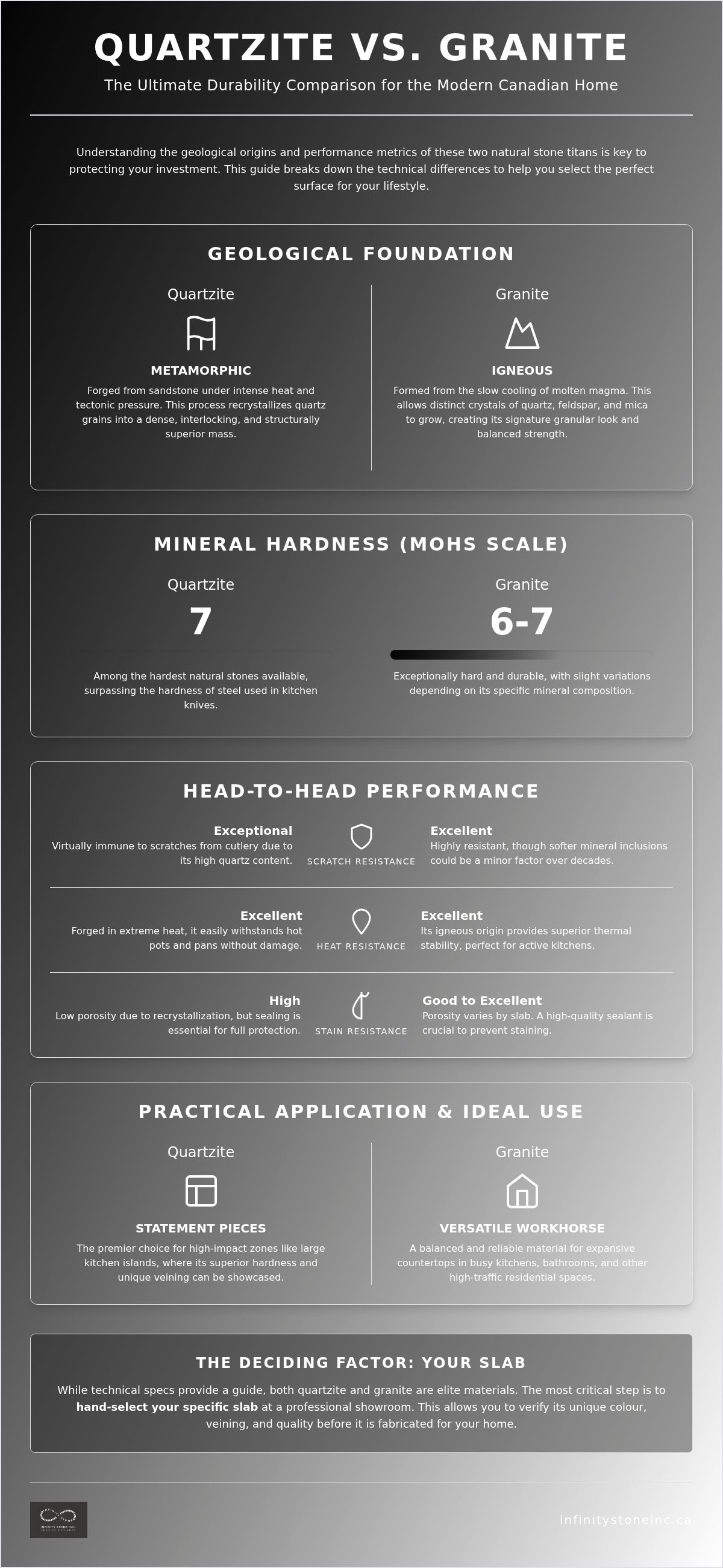
Metamorphism transforms humble sandstone into one of nature's most formidable materials through a process of intense heat and tectonic pressure. During the geological formation of quartzite, individual quartz grains recrystallize into a dense, interlocking mosaic. This recrystallization eliminates the tiny pores found in the original sandstone, creating a solid mass with exceptional structural integrity. This lack of internal voids provides a level of impact resistance that few other natural stones can match. Quartzite registers as a 7 on the Mohs scale, surpassing most common steels used in kitchen cutlery.
Granite: The Resilience of Volcanic Cooling
Granite takes a different path to the showroom. As an igneous rock, it forms from the slow cooling of molten magma beneath the surface, a process that allows for the growth of distinct mineral crystals. This granular structure gives granite its namesake and varied colour palette. The stone is primarily composed of quartz, feldspar, and mica, each contributing to its reliable, multi-purpose surface. The specific role of feldspar is vital, as it provides granite’s legendary chip resistance and structural flexibility. While it sits slightly lower on the hardness scale than quartzite, granite's mineral diversity makes it a steady partner for expansive countertops and high-use residential spaces.
Understanding these origins is essential for protecting your investment. Quartzite’s metamorphic bond means it functions as a singular, fused mass, making it the premier choice for statement kitchen islands where heavy cookware might strike an edge. Granite offers a balanced mineral profile; its quartz content provides hardness while the feldspar adds a level of resilience that prevents the stone from being overly brittle. By recognizing how quartzite vs granite durability is rooted in these ancient processes, you can better appreciate the curated excellence of each slab you encounter in a Mississauga showroom.
Head-to-Head Performance: Scratches, Heat, and Impact
Transitioning from geological theory to kitchen reality requires a look at how these materials survive the rigours of a high-traffic home. When assessing quartzite vs granite durability, performance is measured by the stone's ability to withstand common household stresses without compromising its architectural integrity. While both stones represent the pinnacle of natural surfaces, their individual responses to abrasion and thermal shock differ based on their unique mineral structures.
The Scratch Test: Knives vs. Natural Stone
Quartzite’s high quartz content makes it virtually immune to typical kitchen cutlery. Because quartz is harder than the stainless steel found in professional knives, the blade will often dull before it can leave a mark on the stone. Granite remains a gold standard for high-traffic prep zones, though its varied mineral composition means certain softer inclusions could theoretically show wear over decades of heavy labour. Despite this legendary hardness, we always advise against using the stone itself as a cutting board. The physical properties of quartzite ensure the surface remains pristine, but the density of the material will quickly ruin the edge of your finest blades.
Thermal Shock and Heat Exposure
One of the most significant advantages of natural stone slabs over engineered alternatives is their superior thermal stability. Unlike engineered quartz, which utilizes petroleum-based resins that can scorch or melt at high temperatures, both granite and quartzite are forged in the Earth's furnace. They handle heat with remarkable ease, making them ideal for placement near cooktops or as expansive hearths. Granite has a slight historical edge in handling localized heat, but both materials are largely unaffected by hot pots and pans. To protect your investment and the stone's professional sealant, using trivets remains a best practice in any Ontario kitchen to prevent the rare risk of thermal cracking in thinner slabs.
Impact resilience is another critical factor, particularly around the sink and outer edges where heavy pots might strike. Granite’s feldspar content provides a degree of flexibility that helps prevent brittle snapping, while quartzite’s density offers immense resistance to crushing forces. Over time, both stones maintain their polished lustre exceptionally well, though quartzite often retains its factory shine longer under abrasive cleaning conditions. Choosing the right material involves balancing these performance traits against your specific culinary habits. To truly appreciate the tactile differences in these surfaces, you can explore our handpicked inventory at our Mississauga showroom, where the quality of each individual slab is on full display.
Chemical Resilience and the Porosity Factor
A common misconception in the luxury stone market is that mineral hardness automatically equates to chemical invulnerability. While our previous analysis of quartzite vs granite durability established quartzite as the harder material on the Mohs scale, porosity introduces a different set of variables. Porosity refers to the microscopic voids within the stone that can absorb liquids; a hard stone can still be susceptible to deep-seated staining if its density isn't uniform. Granite typically possesses a highly consistent density, but certain quartzite varieties can be surprisingly thirsty, requiring a more rigorous approach to surface protection.
Mississauga homeowners must also be wary of "soft" quartzite. This industry term often refers to stones that contain calcite or other acid-sensitive minerals, despite being marketed as true quartzite. To verify the resilience of a specific slab before it leaves the showroom, we recommend the professional "Lemon Test." By placing an acidic substance like lemon juice on a sample piece for several minutes, you can observe if the surface etches or dulls. True quartzite should remain unaffected; if it etches, the material likely contains calcium carbonate and will require the same delicate care as marble.
Etching vs. Staining: A Critical Distinction
Understanding the difference between etching and staining is essential for long-term maintenance. Staining occurs when a pigment, such as red wine or coffee, is absorbed into the stone’s pores. Etching is a chemical reaction that physically eats away at the surface polish, leaving a dull, matte mark. Because of its mineral composition, granite is generally less reactive to household acids than some "soft" quartzite varieties. When sourcing premium stone slabs in Ontario, choosing high-density slabs is the most effective way to mitigate both risks in a high-traffic kitchen.
The Sealing Schedule for Luxury Surfaces
Modern high-performance sealers act as a critical barrier, filling the stone's pores to prevent liquid penetration without altering its natural beauty. While both materials require protection, the frequency of application varies. Granite typically requires an annual sealing treatment to maintain its resistance to oils and water-based stains. Many high-grade quartzites are naturally less porous and may only require sealing every two to three years, though lighter-coloured slabs often benefit from more frequent attention. For high-use kitchen islands, a proactive maintenance schedule ensures that your investment retains its factory lustre. Consistent care prevents the accumulation of residues and protects the stone's structural integrity against the daily demands of a busy household.
Practical Application: Choosing the Right Slab for the Space
Selecting the ideal material requires a strategic alignment of a stone’s geological profile with the functional demands of the environment. While the quartzite vs granite durability debate often focuses on laboratory benchmarks, the true test occurs within the specific context of an Ontario home. Different zones within a residence present unique challenges, from the chemical exposure of a master ensuite to the thermal stresses of an outdoor kitchen in the Greater Toronto Area.
- Kitchen Islands: Quartzite is the reigning champion of aesthetic durability. Its ability to provide the ethereal veining of marble with the hardness of quartz makes it the premier choice for high-visibility focal points that must withstand heavy daily use.
- High-Use Bathrooms: Granite’s low-maintenance chemical resistance is a significant asset here. It remains largely unaffected by the alkaline or acidic components found in luxury cosmetics, perfumes, and cleaning agents.
- Outdoor Kitchens: Ontario winters present a rigorous test for natural stone. Granite is exceptionally reliable for outdoor applications in our climate, as its mineral structure handles the freeze-thaw cycles of the GTA without the risk of delamination.
- Vertical Applications: For feature walls and fireplace surrounds, bookmatched slabs offer a seamless, mirror-image effect. The structural density of both stones ensures they remain stable when installed in expansive vertical planes.
The Designer’s Choice: Aesthetic vs. Utility
Modern design often necessitates a compromise between visual impact and practical longevity. By matching the marble-like veining of quartzite with its superior hardness, designers can achieve a high-end look without the fragility associated with softer stones. Conversely, the bold, speckled patterns of granite offer a timeless appeal that grounds a room in organic texture. For a deeper exploration of these visual nuances, consult our guide to Premium Quartzite Slabs in Ontario to understand how specific varieties perform in diverse lighting conditions.
Slab Thickness and Structural Support
Durability is also a function of physical dimensions. In the Ontario market, slabs are typically available in 2cm and 3cm thicknesses. While 2cm slabs are suitable for vertical cladding or lighter-duty areas, 3cm slabs are the standard for luxury kitchen countertops due to their increased impact resistance and edge profile options. Professional-grade supply is the first essential step toward a flawless finish; ensuring the material is free of internal fissures before it reaches the fabricator is vital for heavy stone installations in GTA renovations. To find the perfect foundation for your project, we invite you to view our handpicked slab inventory at our Mississauga showroom.
The Infinity Stone Advantage: Sourcing Excellence in Mississauga
The technical distinctions regarding quartzite vs granite durability are best understood when standing before a full-scale slab. Digital renderings and small samples often fail to capture the subtle mineral variations and structural nuances that define a premium natural surface. At Infinity Stone Inc., we serve as a discerning authority in the supply chain, ensuring that every piece in our Mississauga showroom meets the rigorous standards required for high-end Ontario residences. Curation is our primary focus; we act as the foundational link between global quarries and your refined interior spaces.
Curated Inventory for the Discerning GTA Market
Our global sourcing process identifies rare patterns and high-density formations that are specifically suited for the Canadian market. Viewing a full slab is essential for more than just aesthetic approval. It allows designers and homeowners to inspect the material for natural fissures and verify the consistency of its crystalline structure. This transparency is vital for ensuring long-term performance in high-traffic zones. To understand how we select our igneous offerings, explore The Connoisseur’s Guide to Sourcing Premium Granite Slabs in Mississauga, which details our criteria for structural integrity and visual depth.
A Partner to Your Fabricator and Contractor
Infinity Stone Inc. operates with a clear specialization; we are elite material distributors, not fabricators or installers. This focus allows us to dedicate our full attention to material quality and inventory breadth. We function as a professional partner to your chosen design community, providing the technical data and material specifications your fabricator needs for a precise installation. By securing your slab through a dedicated supplier, you ensure the material is handled with the expertise required to preserve its factory lustre. We work alongside GTA contractors to streamline the transition from our warehouse to your project site, maintaining a steady and purposeful project rhythm.
Realizing a luxury design vision requires a foundation of quality that only handpicked natural stone can provide. We invite Ontario designers, architects, and homeowners to visit our Mississauga showroom to experience the tactile beauty of our current collection. Whether you are seeking the metamorphic strength of quartzite or the volcanic resilience of granite, our curators are available to guide your selection. Visit us today to identify the perfect slab that will serve as the centrepiece of your next architectural masterpiece.
Securing Your Luxury Investment with Natural Stone
Choosing between these two premium materials requires a strategic balance of geological understanding and lifestyle assessment. While quartzite offers superior mineral hardness for high-impact kitchen islands, granite provides a reliable, low-maintenance solution for residential spaces exposed to frequent chemical contact. Understanding quartzite vs granite durability ensures that your selection isn't just an aesthetic triumph but a permanent architectural asset for your Ontario home. Every slab possesses a unique structural identity that dictates its performance against heat, scratches, and daily wear.
As a trusted supplier to GTA design professionals, Infinity Stone Inc. provides the dedicated expertise in natural stone durability necessary to guide your project from concept to installation. We invite you to explore our curated collection of premium slabs at our Mississauga showroom. Our handpicked global stone inventory allows you to witness the specific density and veining of each slab in person; this ensures your fabricator receives only the highest-grade material for your renovation. Your home deserves a foundation of curated excellence that lasts a lifetime. We look forward to helping you identify the stone that perfectly reflects your high standard of living.
Frequently Asked Questions
Is quartzite more durable than granite for a kitchen island?
Yes, quartzite is superior in terms of pure mineral hardness. It registers as a 7 on the Mohs scale, while granite typically sits between 6 and 6.5. This difference makes quartzite more resistant to scratches from heavy professional cookware. Choosing the right material for a high-traffic island depends on your specific quartzite vs granite durability requirements, specifically whether you prioritize scratch resistance or granite's slightly better chemical stability.
Does quartzite stain as easily as marble?
No, true quartzite is significantly less porous than marble and resists staining much more effectively. While marble is a soft carbonate stone that etches and absorbs liquids quickly, quartzite is a dense metamorphic rock. However, lighter-coloured quartzite slabs still require professional sealing to prevent the long-term absorption of oils or pigments. Its overall resistance makes it a more practical choice for the demanding environment of a luxury kitchen.
How often do I need to seal my granite or quartzite slabs in Ontario?
Most granite slabs require sealing once per year to maintain optimal protection against moisture and household oils. High-density quartzite may only need treatment every two to three years, though lighter varieties often benefit from annual care. Consistent maintenance is vital in Ontario homes to preserve the stone's factory lustre and prevent deep-seated staining. Always consult with your fabricator to determine the specific sealing requirements of your handpicked slab.
Can I put hot pans directly on a quartzite surface?
Yes, quartzite is exceptionally heat resistant and can withstand high temperatures without scorching or melting like resin-based engineered alternatives. It survives the heat test far better than synthetic quartz. While the stone itself is thermally stable, we recommend using trivets as a best practice. This precaution protects the professional sealant and prevents rare instances of thermal shock in thinner 2cm slabs during extreme temperature shifts in the kitchen.
Why is quartzite typically more expensive than granite?
Quartzite's higher price point reflects its rarity and the complexity of its extraction and processing. Because the stone is significantly harder than granite, it requires specialized diamond-tipped tools and more labour-intensive fabrication techniques to cut and polish. Additionally, the global demand for its marble-like aesthetics combined with superior quartzite vs granite durability drives its market value. It remains a premium investment for those seeking both elegance and structural toughness.
What happens if my natural stone slab chips?
Small chips, which typically occur around the sink or countertop edges, can often be repaired by a professional stone restorer using colour-matched epoxy resins. Once cured and polished, these repairs are virtually invisible to the untrained eye. While both stones are impact-resistant, granite's feldspar content provides a degree of flexibility that can help prevent brittle snapping. Maintaining a rounded edge profile during fabrication further reduces the risk of chipping in high-traffic areas.
Is there such a thing as soft quartzite, and is it durable?
"Soft quartzite" is an industry misnomer often used for stones that contain calcite, making them behave more like marble than true quartzite. While these slabs are beautiful, they are not as durable because they etch when exposed to acids like lemon juice or vinegar. True quartzite does not etch. Mississauga homeowners should perform a "Lemon Test" on a sample to verify the material's chemical resilience before committing to a specific slab purchase.
Can I use quartzite or granite for an outdoor kitchen in the GTA?
Granite is the superior choice for outdoor kitchens in the Greater Toronto Area due to its proven resilience against harsh Canadian winters. Its mineral structure handles the extreme freeze-thaw cycles of Ontario without the risk of delamination or cracking. While some quartzites perform well outdoors, granite remains the industry standard for exterior applications. It maintains its structural integrity and colour even when exposed to direct sunlight and the fluctuating temperatures of the GTA.


