

Granite has a reputation for heat resistance, but that isn’t a reason to set every hot pan directly on the counter. Protecting granite from heat damage means understanding that durable stone can still be affected by intense, concentrated heat or a sudden temperature change.
Conflicting advice is common. Granite generally tolerates heat well, yet a hot pot may affect a sealer, and an abrupt shift in temperature can stress the stone. A pale, dull or darkened patch isn’t automatically heat damage, either. Staining and other surface changes can look similar, so guessing at the cause may lead to the wrong fix.
This guide explains how heat can affect granite, which everyday habits help reduce avoidable exposure, and why a trivet is a sensible barrier for hot cookware. You’ll also learn how to distinguish possible heat-related changes from other issues, what to do if the surface looks different, and when to ask a qualified fabricator or stone-care professional to assess it.
Key Takeaways
- Granite can tolerate heat, but its composition, condition and installation can affect how it responds to exposure.
- Protecting granite from heat damage starts with using trivets or heat-resistant mats as the default barrier for hot cookware.
- A simple cooking routine should also account for appliances and sudden temperature changes near seams and edges.
- Care needs differ across granite, engineered quartz, quartzite and porcelain, so check guidance for the specific surface.
- If you notice discolouration, a crack or another surface change, stop exposing the area to heat, document it and seek a qualified assessment.
Protecting Granite from Heat Damage: What Homeowners Should Know
Granite can tolerate heat, but that doesn’t make every slab or countertop installation invulnerable. The practical aim of protecting granite from heat damage is to limit direct heat exposure and abrupt temperature changes, not to treat the surface as fragile. Natural stone varies in mineral composition and condition. The finish, supports, seams and nearby materials can also affect how a countertop responds.
Granite’s mineral structure helps explain its physical characteristics. For an overview of the properties of granite, including its composition and formation, see Wikipedia. A general description of the stone can’t guarantee identical performance across individual slabs or installations. Heat tolerance also doesn’t mean that a finish, sealer or surrounding component will respond in the same way as the stone itself.
Is granite heat-proof or only heat-resistant?
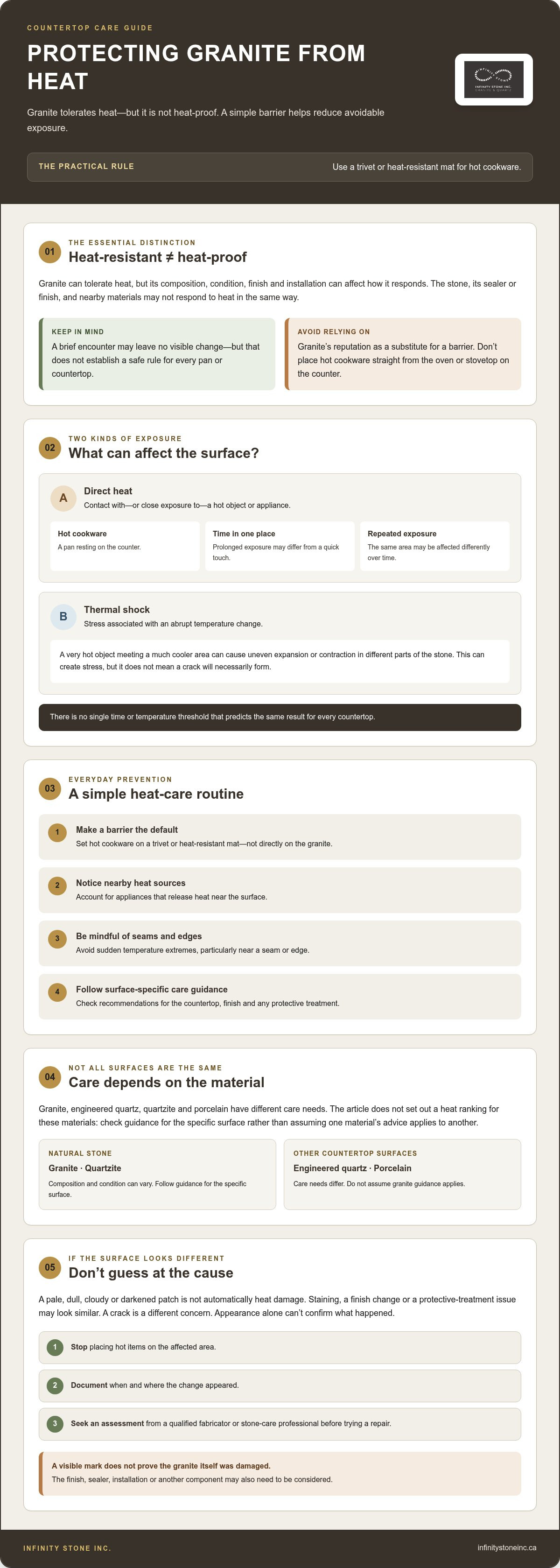
Think of granite as heat-resistant, not heat-proof. A brief encounter with a warm item may leave no visible change, but that doesn’t establish a safe rule for every pan, slab or surface condition. Don’t rely on the stone’s reputation as a substitute for a barrier. Use a trivet or heat-resistant mat between hot cookware and the counter.
What kinds of heat exposure should concern homeowners?
Brief contact differs from prolonged or repeated exposure. A hot item left in one place, or heat applied to the same area over time, may affect the surface differently from a quick touch. Protective treatments can also have different heat tolerances from granite. Follow care guidance for the specific countertop and treatment rather than assuming they behave alike.
Rapid temperature change is another consideration. Known as thermal shock, it can create stress when a very hot object meets a much cooler area. Risk may depend on the stone’s existing condition and where the exposure occurs, including its proximity to an edge or seam. Avoid sudden extremes, and don’t use a countertop as a resting place for hot cookware straight from the oven or stovetop.
A mark after heat exposure isn’t proof that the granite itself has been damaged. Discolouration, a cloudy area or a change in sheen could involve the finish or a protective treatment, while a crack raises a different concern. Appearance alone can’t confirm the cause. Stop placing hot items on the affected area, note when and where the change appeared, and ask a qualified fabricator or stone-care professional to assess it before trying a repair.
How Heat and Sudden Temperature Changes Can Affect Granite
Heat-related changes don’t have one universal cause. Direct exposure and rapid temperature shifts create different kinds of stress, and neither guarantees damage. The outcome can depend on the granite’s composition and existing condition, as well as the countertop’s finish, installation details, and the location and duration of exposure.
Direct heat versus thermal shock
Direct heat means contact with, or close exposure to, a hot object or appliance. A pan resting on the counter is one example; an appliance that releases heat near the surface is another. How long the heat stays in one place, and whether exposure happens repeatedly, may matter. There isn’t a single time or temperature threshold that predicts the same result for every countertop.
Thermal shock is stress associated with an abrupt temperature change. In simple terms, different parts of a stone surface can expand or contract unevenly as temperatures shift, creating stress within the material. Placing a very hot item on a cooler section of countertop can create a sudden change, but it doesn’t mean a crack will necessarily form. The Stone Collection discusses the risk of thermal shock and recommends using trivets as a precaution.
Why granite slabs and countertop details can respond differently
Granite is a natural stone, so its mineral composition and pattern vary from slab to slab. Colour or veining alone can’t tell you how a particular piece will respond to heat. A polished surface and a honed surface may also have different care considerations, while protective treatments and other surface products may respond differently from the stone beneath them. Check care information for the slab, finish and any treatment rather than relying on a general rule.
Condition and installation matter, too. An existing flaw, seam, edge or support material may affect how a change should be assessed. A visible mark near a seam, for example, shouldn’t be assumed to have the same cause as a change on an uninterrupted section of stone. Appearance alone can’t establish whether heat affected the granite, a surface treatment or another component.
For practical guidance on protecting granite from heat damage, consult the slab source, the fabricator who completed the countertop or the relevant product manufacturer. If the surface changes, have a qualified professional assess it instead of testing it with more heat or attempting a repair based on appearance. For a future project, reviewing granite slab options alongside care guidance can help inform material selection.
Granite and Other Countertop Materials: Comparing Heat-Care Needs
Choosing a countertop involves more than asking which surface handles heat best. Granite, engineered quartz, quartzite and porcelain differ in composition, finish and care instructions, so no single rule applies to every product. For all four, a trivet or heat-resistant mat is a sensible default for hot cookware. The comparison below focuses on practical habits, not a universal heat rating.
| Material | Material category | Practical heat-care habit |
|---|---|---|
| Granite | Natural stone | Use a trivet for hot pans, and follow care guidance for the slab’s finish and any protective treatment. |
| Engineered quartz | Manufactured surface made with quartz and other components | Use a trivet, and check the manufacturer’s instructions for cookware and appliance exposure. |
| Quartzite | Natural stone | Use a heat-resistant barrier and ask about care recommendations for the specific slab and finish. |
| Porcelain | Engineered ceramic material | Follow product-specific guidance, and use a trivet rather than assuming all porcelain surfaces share the same care requirements. |
Granite versus engineered quartz around hot cookware
Granite and engineered quartz aren’t interchangeable categories. Granite is natural stone; engineered quartz is manufactured from quartz and other components, which may include binders. That difference is one reason not to assume their surfaces respond identically to heat. The Natural Stone Institute’s technical data on granite provides material-specific context, but general information can’t replace guidance for a particular countertop. Use trivets for both materials, and consult the manufacturer or fabricator about the product’s finish and care requirements.
How quartzite and porcelain fit into a heat-care comparison
Quartzite is a natural stone, while porcelain is an engineered ceramic surface. Those categories offer useful context, but they don’t establish how a specific slab or product will respond to heat. Finish, fabrication and manufacturer instructions matter. Before choosing a surface, confirm the recommended care routine with the supplier or fabricator, especially if hot cookware is a frequent part of your kitchen routine.
Protecting granite from heat damage is one consideration among several, alongside appearance, maintenance and project needs. If you’re exploring natural stone alternatives, read this guide to premium quartzite slabs in Ontario. For any material, ask for product-specific care information before making a selection.
A Simple Routine for Protecting Granite from Heat Damage
A consistent kitchen routine is more reliable than judging whether a countertop looks sturdy enough for hot cookware. Make protection the default, and keep the care guidance for your specific slab where you can find it.
Everyday habits that reduce heat exposure
- Set out a barrier before cooking. Keep trivets or heat-resistant mats within reach, and place one on the counter before setting down a hot pan, baking dish or serving platter. Don’t rely on brief contact or granite’s natural durability as permission to place cookware directly on the surface.
- Check appliance guidance. For heat-producing countertop appliances, follow the manufacturer’s instructions for suitable surfaces, protective accessories and required clearances. Use only protection approved for the appliance, and check the instructions before assuming a mat or board is suitable.
- Choose a stable spot. Where practical, avoid setting hot items near seams, edges or areas with existing damage. A clear, designated landing area with a trivet helps prevent hurried placement on an unprotected section.
- Put the barrier back. Return trivets and mats to their usual place after use. A simple habit makes it easier for everyone in the household to follow the same routine.
Care instructions to confirm for your specific countertop
Keep a record of the granite slab details, finish and care instructions supplied by the material provider or fabricator. Ask which recommendations apply to your countertop, including guidance for appliances and hot cookware. If you’re unsure who supplied or completed the surface, a qualified fabricator or stone-care professional can help clarify its care requirements.
Also ask whether a sealer or other protective treatment is present, and what its care instructions cover. Don’t assume a sealer provides heat protection. Follow the applicable product guidance, and don’t treat a glossy, unworn appearance as proof that direct heat is safe.
If you’re planning a future kitchen and comparing materials, this guide to premium granite slabs in Mississauga offers a related starting point for selection. For granite slab options, explore granite slabs from Infinity Stone Inc., a Mississauga-based slab distributor serving Ontario. For fabrication and installation, consult a qualified provider and confirm care instructions for the finished countertop.
What to Do If You Suspect Heat Damage to Granite
A new mark after contact with heat can be unsettling, but appearance alone can’t confirm what changed. Discolouration, a dull or cloudy area, and a crack may have different causes and require different responses. Start by preventing further exposure, then gather clear information before seeking an assessment.
How to document a possible heat-related change
Stop placing hot cookware or appliances on the affected area. Avoid applying cleaners, sealers or repair products until you know what the surface needs. An unverified treatment could alter the appearance or complicate an assessment.
Make a concise record for the fabricator or stone-care professional:
- Note when you first noticed the change and whether it has spread or altered since.
- Record what was nearby and the type of heat exposure, such as a hot pan, serving dish or countertop appliance.
- Take clear photographs in consistent lighting, including one close view and one showing the location on the countertop.
- Gather any available slab, finish, installation and care details, including information about a sealer or other treatment.
These details can help a professional assess the situation, but they don’t establish a diagnosis. Don’t test the area with more heat or judge the cause by colour or texture alone.
When to consult a fabricator or explore replacement material
Contact the fabricator who completed the countertop, or a qualified stone-care professional, if you see a crack, a persistent surface change or a condition that appears to be worsening. Share your notes and photographs, and ask what assessment or repair options are appropriate. If the change is near a seam or edge, point that out when arranging an assessment. Leave decisions about repair methods to a qualified professional familiar with the surface.
For future care, ask the fabricator which guidance applies to your particular slab and finish. Protecting granite from heat damage is easier when the recommended routine is documented and easy to follow. If you’re considering a future project or a different surface, Infinity Stone Inc. supplies granite, quartz, quartzite, marble and porcelain slabs in Ontario. The company supplies slabs, not countertop repair, fabrication or installation services. Explore the stone slab sourcing guide as a resource for planning a material selection, and consult a qualified fabricator for project-specific advice.
Make Thoughtful Heat Care Part of Your Kitchen Routine
Granite is heat-resistant, but its response can vary with the slab, finish, condition and installation. Protecting granite from heat damage doesn’t require alarm: use trivets or heat-resistant mats as your everyday barrier, and avoid sudden temperature changes where possible.
If a mark or crack appears, don’t diagnose it by appearance alone. Stop exposing the area to heat, document what changed and ask a qualified fabricator or stone-care professional to assess the countertop. For future projects, compare material-specific care guidance alongside appearance and maintenance needs.
Infinity Stone Inc. is a Mississauga-based slab supplier serving Ontario, with granite, quartz, quartzite, marble and porcelain slab categories. Explore the available material options when planning your next project, and consult a qualified professional for fabrication, installation or damage assessment.
Explore Infinity Stone Inc.’s granite slabs and other premium materials when planning your next countertop project.
Frequently Asked Questions
Can you put a hot pan directly on granite?
It’s best to place a hot pan on a trivet or heat-resistant mat, not directly on granite. Granite is heat-resistant, but a pan’s heat may affect a protective treatment or, in some circumstances, stress the stone. Slab composition, condition and installation vary, so there isn’t a universal rule that makes direct contact safe. Making a barrier part of your cooking routine is a practical step in protecting granite from heat damage.
Is granite heat-proof or heat-resistant?
Granite is heat-resistant, not guaranteed heat-proof. Its natural mineral composition and condition can vary, and the finish, protective treatment and countertop installation may respond differently from the stone. Heat tolerance also doesn’t remove the possibility of stress from concentrated heat or a sudden temperature change. Use a trivet for hot cookware and follow guidance for your particular slab rather than relying on a general claim.
What happens if you put a hot pan on granite?
Nothing visible may happen, but that doesn’t guarantee every pan or countertop will respond the same way. Depending on the heat exposure and surface, a protective treatment could discolour or become cloudy; intense or concentrated heat may also stress the stone. A visible change isn’t proof of heat damage. Stop using the area for hot items and ask a qualified fabricator or stone-care professional to assess persistent marks or cracks.
Can thermal shock crack a granite countertop?
Yes, thermal shock can crack granite, although damage isn’t inevitable whenever temperatures change. Thermal shock describes stress associated with a rapid temperature shift, such as setting a very hot item on a much cooler surface. The stone’s condition and the location of exposure, including near an edge or seam, may affect the assessment. Use a heat-resistant barrier and ask a qualified professional to examine any new crack.
Should granite countertops be sealed to protect them from heat?
Don’t assume a sealer protects granite from heat. A sealer or other treatment may be intended for a different care purpose, and it can respond to heat differently from the stone itself. Ask your countertop fabricator whether a sealer is present and what its care instructions cover. Use trivets for hot cookware regardless, and follow product-specific guidance for maintaining the treatment rather than applying a new product without advice.
Are quartz countertops more sensitive to heat than granite?
There isn’t a universal comparison that makes every quartz countertop more or less heat-sensitive than every granite slab. Granite is natural stone; engineered quartz is a manufactured surface with a different composition. Product, finish and installation details matter, so check the manufacturer’s and fabricator’s recommendations for your specific counter. As a simple precaution, use trivets for both materials and don’t set hot cookware directly on either surface.
How can I tell whether a granite mark is heat damage?
You can’t reliably identify heat damage by appearance alone. A cloudy patch, discolouration, dull area or crack may have different causes, including changes to a surface treatment or other countertop issues. Stop placing hot items on the area, photograph it in consistent lighting, and record when it appeared and what exposure occurred. In Ontario, contact your project fabricator or a qualified stone-care professional for assessment. Infinity Stone supplies slabs, not repair or installation services.


