

What if the secret to a kitchen that survives Ontario's brutal winters and high-traffic dinner parties isn't natural stone, but a masterfully engineered alternative? When researching neolith vs porcelain slabs ontario, many homeowners feel overwhelmed by technical jargon and conflicting claims about durability. You're likely looking for a surface that offers the prestige of marble without the constant anxiety of edge chipping or staining. It's a common frustration to distinguish between sintered stone and premium porcelain when both materials appear so similar on the showroom floor.
This comparison provides the clarity you need to recognize the technical distinctions required for materials that thrive in our local climate and demanding residential environments. We will explore the precise engineering of Neolith, the versatility of large-format porcelain, and how each performs against the thermal expansion typical of the GTA. By the end, you'll know exactly which slab aligns with your architectural vision and where to source these elite surfaces in Mississauga.
Key Takeaways
- Distinguish between the molecular density of sintered stone and the high-heat durability of premium porcelain to ensure long-term structural integrity.
- Evaluate how neolith vs porcelain slabs ontario perform under local freeze-thaw cycles and the thermal shock common in high-traffic residential kitchens.
- Discover how to achieve the sophisticated aesthetic of rare marble using large-format surfaces that offer superior scratch resistance and minimal maintenance.
- Learn why a physical inspection at a Mississauga gallery is essential to verify pattern variation and texture for a seamless architectural finish.
- Identify the strategic advantages of partnering with an expert curator to source world-class materials tailored to the Ontario design market.
Understanding the Distinction: Neolith Sintered Stone vs. Porcelain Slabs
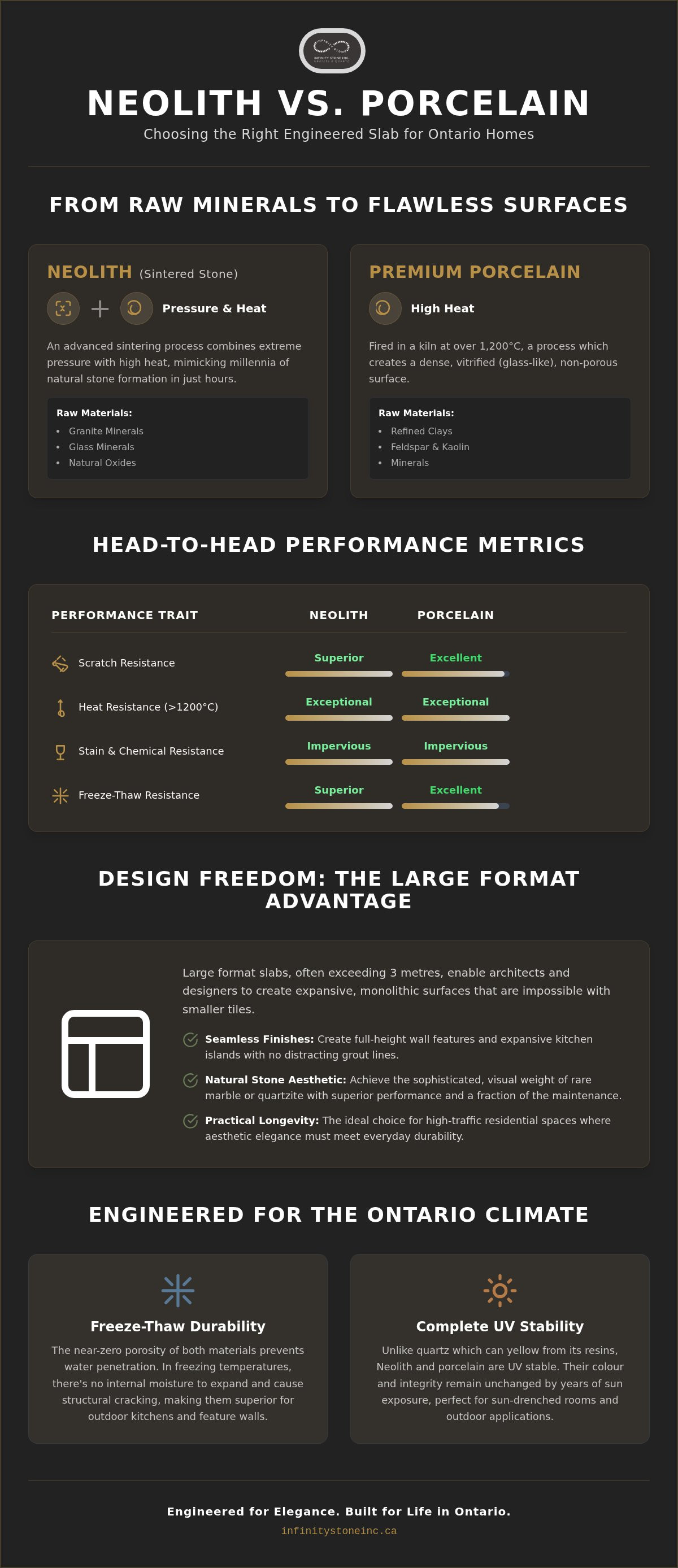
The debate surrounding neolith vs porcelain slabs ontario often stems from a lack of technical clarity. While both materials appear identical to the untrained eye, their internal composition and manufacturing pressures create distinct performance profiles. Porcelain slabs are fundamentally ceramic, composed of refined clays and minerals fired at temperatures exceeding 1,200 degrees Celsius. This high-heat firing creates a dense, glass-like structure that resists moisture absorption. Despite these technical nuances, the Ontario design community frequently uses these terms interchangeably. This semantic overlap can lead to confusion when specifying materials for high-traffic Mississauga kitchens or outdoor living spaces.
Selecting between neolith vs porcelain slabs ontario requires an understanding of how these formats behave during fabrication and long-term use. While porcelain is a centuries-old category, sintered stone is a relatively modern innovation designed to push the boundaries of durability. Both offer a sophisticated alternative to natural stone, but their molecular density differs due to the specific minerals used in the raw mixture.
What Defines Neolith as a Sintered Stone?
Neolith represents the pinnacle of "Sintered Stone" technology. Unlike traditional ceramics, Neolith utilizes a precise blend of granite minerals, glass minerals, and natural oxides. The critical difference lies in the sintering process. Raw materials undergo extreme pressure through a specialized vibration and vacuum system before entering the kiln. This intense compaction mimics the natural metamorphic process of stone over millennia but accelerates it into a few hours. This results in a surface with near-zero porosity. In the GTA, Neolith has become a category-defining brand. It's a favourite for those seeking a material that is virtually impervious to liquids, staining, and the rigorous demands of a busy household.
The Evolution of Large Format Porcelain Slabs
Modern manufacturing has pushed the boundaries of what's possible with clay-based materials. We've moved beyond standard tiles into expansive, large-format slabs that often exceed 3 metres in length. This evolution allows Mississauga architects to create seamless, full-height wall features and expansive kitchen islands without distracting grout lines. These slabs provide a continuous aesthetic that mimics rare marble or quartzite. Designers favour these surfaces because they offer the visual weight of natural stone with a fraction of the maintenance requirements. It's a logical choice for the sophisticated residential spaces found throughout Ontario, where aesthetic elegance must meet practical longevity.
Performance Metrics: Durability and Thermal Resistance in the Ontario Climate
The performance of neolith vs porcelain slabs ontario is best measured by how these materials withstand the physical and environmental rigours of the Greater Toronto Area. On the Mohs scale of mineral hardness, both materials typically score between 7 and 8. This makes them significantly more scratch-resistant than marble or granite. While porcelain is exceptionally hard, the sintering process used for Neolith creates a molecular bond that is virtually impervious to metal abrasions and heavy use.
Thermal resistance is another critical factor for discerning homeowners. These surfaces are forged in kilns at temperatures exceeding 1,200 degrees Celsius, meaning they don't scorch or crack under hot pans. Unlike quartz, which contains petroleum-based resins that can yellow or degrade under direct sunlight, both Neolith and premium porcelain are UV stable. This makes them the ideal choice for sun-drenched Mississauga solariums or expansive floor-to-ceiling window installations. Chemical resistance is equally impressive; acidic substances like lemon juice or red wine won't etch the surface, which remains a common failure point for natural stone.
Weathering the Ontario Winter: Outdoor Application Suitability
Ontario's freeze-thaw cycles provide a brutal test for any architectural material. The near-zero porosity of these surfaces ensures that moisture cannot penetrate the slab. When temperatures drop below freezing, there's no internal water to expand and cause structural cracking. This performance makes them superior choices for outdoor kitchens and patio feature walls in the GTA. While both materials perform well, the uniform density of Neolith offers a slight edge in uncovered Canadian environments where temperature swings are most extreme.
Impact Resistance and Edge Vulnerability
While these materials are incredibly hard, they possess high internal tension. This makes professional handling essential during the transport and fabrication phases. Edge chipping remains a common concern in high-traffic kitchens, particularly around under-mount sinks. Choosing the correct thickness is vital for long-term structural integrity. You can explore a variety of porcelain slabs at our gallery to compare these technical specifications in person. The thickness typically dictates the application:
- 6mm: Best suited for vertical wall cladding and furniture surfacing.
- 12mm: The industry standard for residential kitchen countertops and islands.
- 20mm: Provides maximum impact resistance for heavy-use commercial or premium residential surfaces.
Architectural Versatility: Aesthetic Options and Large Format Applications
The visual allure of these surfaces often dictates the final selection in premium Ontario builds. When comparing neolith vs porcelain slabs ontario, the tactile variety is a primary differentiator. Neolith offers sophisticated textures such as Silk for a velvet-like matte feel, Polished for high-gloss brilliance, and Riverwashed for a rugged, natural stone aesthetic. These finishes allow Mississauga designers to curate environments where the surface texture complements the lighting and architectural lines of the space.
Achieving the visual impact of rare marble remains a central goal for luxury interiors. These engineered slabs replicate the intricate veining of Calacatta or Statuario with remarkable precision. Unlike natural stone, these surfaces offer predictable patterns that enable perfect bookmatching. This technique creates a mirrored, symmetrical focal point that is highly coveted for expansive kitchen islands and feature walls. The sheer scale of these slabs minimizes visible seams, fostering a continuous, monolithic appearance that traditional tiling systems cannot replicate.
Surface Printing vs. Through-Body Colour
A technical gap often exists in the understanding of how patterns are applied. Many standard porcelain slabs rely on high-definition surface printing. While the top layer is indistinguishable from stone, a bevelled or mitred edge can reveal the "white edge" dilemma. This occurs when the internal clay body differs in colour from the printed surface. Neolith and elite porcelain manufacturers address this through "full-body" or through-body technology. By integrating minerals and pigments throughout the entire slab, the aesthetic remains consistent even when the material is cut or profiled. This is a vital consideration for projects requiring intricate edge detailing.
Large Format Slabs in Modern Ontario Design
The versatility of these materials is further enhanced by their varied thickness. In Mississauga luxury penthouses, 6mm slabs are the preferred choice for vertical applications like fireplace surrounds and bathroom wall cladding. Their lightweight nature simplifies installation while maintaining a high-end look. For horizontal surfaces such as kitchen islands and custom dining tables, 12mm and 20mm slabs provide the necessary structural mass and impact resistance. These large-format options allow for a seamless transition between different functional zones, creating the clean, expansive lines characteristic of modern Canadian design.
The Selection Process: Evaluating Quality for Residential and Commercial Projects
Selecting between neolith vs porcelain slabs ontario requires a meticulous physical audit that digital catalogues simply cannot provide. Digital renders often fail to convey the subtle depth of a "Riverwashed" texture or the precise clarity of a marble-veined print. A visit to a Mississauga gallery allows you to inspect the material under professional lighting, ensuring the slab meets your aesthetic expectations before it reaches the fabrication stage. This step is vital to confirm that the slab's visual weight aligns with the rest of your interior palette.
One of the most significant markers of quality is the frequency of pattern repeat. Lower-tier porcelain often utilizes a limited number of "faces," which can lead to an artificial, repetitive appearance in large-scale installations. Premium slabs offer high-definition prints with extensive variation, which is essential for maintaining the illusion of natural stone across an expansive kitchen island or feature wall. Technical precision is equally important; you must verify slab flatness and thickness consistency. Even a millimetre of deviation can compromise the seamless joinery required for mitred edges or flush-mount sinks. Sourcing from a distributor with direct global ties ensures that the inventory has been vetted for these rigorous industrial standards.
Cost vs. Value: Long-term ROI of Premium Surfaces
The initial investment in high-end engineered surfaces is often offset by their near-zero maintenance requirements. Unlike natural marble or granite, these slabs don't require periodic sealing or specialized pH-neutral cleaners. In the competitive GTA real estate market, a kitchen outfitted with Neolith or premium porcelain serves as a permanent value-add. It offers a lifespan that frequently outlasts the architectural tenure of the home itself, providing a durable surface that remains pristine under heavy use.
Working with Your Fabricator and Supplier
The transition from selection to installation is a critical phase. Once you've chosen your material at Infinity Stone Inc., we coordinate the handoff to your selected professional. It's vital to ensure your fabricator has specific experience with sintered stone and large-format materials, as these require specialized cutting speeds and water-cooled tools. For a deeper look at the procurement process, consult our guide on Sourcing Premium Stone Slabs in Ontario. To begin your selection process, we invite you to view our curated porcelain slab inventory at our Mississauga showroom.
Sourcing Exclusivity: Premium Porcelain and Sintered Slabs in Mississauga
Sourcing the right surface is the most critical decision in any high-end renovation. At Infinity Stone Inc., we bypass the mass-market approach to provide a curated selection of world-class materials. Our focus remains strictly on the distribution of premium natural and engineered stone. This specialization allows us to support the selection of luxury porcelain countertops in Ontario with a level of technical depth that general retailers cannot match. We act as a reliable partner for the design community, ensuring that every slab in our inventory meets a standard of excellence suitable for landmark residential projects.
Architects and builders in the GTA value our material-first focus. By prioritizing the slab's quality and aesthetic integrity before it reaches the fabricator, we ensure the foundation of the project is flawless. When weighing neolith vs porcelain slabs ontario, having access to a diverse, handpicked inventory is essential for finding the perfect match for specific architectural requirements. Our role is to provide the raw materials that define high-end living, sourced from the world's most innovative manufacturers.
The Designer’s Experience at Infinity Stone
Viewing a small sample is insufficient for luxury applications. Our Mississauga gallery showcases full-sized slabs, allowing designers to appreciate the true scale and flow of the veining. This perspective is vital for planning bookmatched features or large-format wall cladding. Our team provides expert guidance on matching material properties to your project's specific needs, whether you require the extreme heat resistance of sintered stone or the versatile elegance of large-format porcelain. We are committed to distributing only high-tier, reliable engineered surfaces that meet the rigorous standards of the Ontario design community.
Visiting Our Mississauga Showroom
Our central location serves Mississauga, Oakville, and the broader Greater Toronto Area. We offer a professional environment where homeowners and industry professionals can conduct detailed slab selections in a quiet, sophisticated atmosphere. Consultation services focus on technical suitability and aesthetic harmony, ensuring every selection is purposeful. We invite you to visit our gallery to experience the unique textures and refined colours of our inventory firsthand. Discover why we remain the preferred destination for those seeking the pinnacle of neolith vs porcelain slabs ontario for their next architectural masterpiece.
Refining Your Architectural Surface Selection
Selecting the ideal material for a high-end project requires balancing technical precision with your specific architectural intent. Whether you prioritize the extreme molecular density of sintered stone or the versatile scale of premium porcelain, both surfaces offer the durability needed to withstand Ontario's demanding climate. Successful integration depends on recognizing these nuances early in the design phase to ensure your surfaces remain pristine for decades. The decision between neolith vs porcelain slabs ontario is a significant step toward creating a space that reflects both elite craftsmanship and practical longevity.
As Ontario's premier distributor of handpicked stone and porcelain, we provide expert material guidance tailored to the sophisticated needs of designers and architects. Our Mississauga gallery serves the entire GTA, offering a curated environment where you can conduct a physical audit of full-sized slabs. It's the most reliable way to verify pattern clarity and texture before your project moves to the fabricator. We invite you to visit our Mississauga gallery to view our curated collection of premium slabs. Your journey toward a refined, enduring interior begins with the perfect material selection.
Frequently Asked Questions
Is Neolith more expensive than standard porcelain slabs in Ontario?
Neolith generally commands a higher price point than standard porcelain due to its proprietary sintering process and specialized mineral composition. While premium porcelain brands offer competitive pricing, Neolith positions itself as a luxury tier material. The final investment depends on the specific design and slab thickness. Homeowners comparing neolith vs porcelain slabs ontario should view both at a distributor to evaluate the aesthetic value relative to their specific project budget.
Can Neolith or porcelain slabs be used for outdoor kitchens in the GTA?
Both materials are exceptionally well-suited for outdoor kitchens in the Greater Toronto Area. Their near-zero porosity prevents water absorption, which is the primary cause of cracking during Ontario's freeze-thaw cycles. Unlike quartz or some natural stones, these slabs are UV stable and won't fade under direct sunlight. This ensures your outdoor surfaces remain pristine through both brutal winters and humid summers without the risk of structural degradation or surface yellowing.
Does Neolith chip more easily than natural granite or quartzite?
Neolith and porcelain are highly impact-resistant but possess different structural properties than natural stone. While they are harder than granite on the Mohs scale, their high internal tension makes the edges more vulnerable to blunt force impact. Professional fabrication and choosing a 12mm or 20mm thickness for high-traffic areas can mitigate this risk. In comparison, granite is more forgiving of edge impacts but lacks the superior scratch and stain resistance of engineered slabs.
What is the difference between sintered stone and porcelain?
The primary difference lies in the raw material mix and the pressure applied during manufacturing. Porcelain is a clay-based ceramic fired at high heat to achieve density. Sintered stone, such as Neolith, utilizes a complex blend of granite minerals, glass minerals, and natural oxides. These materials are subjected to extreme vacuum-vibration and pressure before firing. This process creates a molecular bond that results in a denser, more durable surface with lower porosity than traditional porcelain.
How do I clean and maintain a porcelain slab countertop?
Maintenance is remarkably simple because the surface is non-porous and chemically inert. You don't need specialized stone cleaners or pH-neutral soaps; warm water and a mild household detergent are usually sufficient for daily care. For stubborn residues, you can use more aggressive cleaning agents without fear of etching or dulling the finish. This ease of care is a significant advantage when evaluating neolith vs porcelain slabs ontario for busy residential kitchens and high-traffic commercial environments.
Are porcelain slabs suitable for fireplace surrounds?
Porcelain and sintered stone are ideal for fireplace surrounds due to their extreme thermal resistance. These materials are forged at temperatures exceeding 1,200 degrees Celsius, meaning they won't scorch, crack, or release VOCs when exposed to heat. Designers often select 6mm slabs for vertical cladding to create a seamless, monolithic look. This application provides the sophisticated aesthetic of a solid stone block without the structural weight or maintenance requirements associated with natural marble or quartzite.
Can I see the full slabs at your Mississauga showroom before buying?
We encourage all clients to view full-sized slabs at our Mississauga gallery before finalizing a selection. Digital samples often fail to capture the intricate veining, subtle textures, and true colour depth of premium materials. Seeing the entire slab allows architects and homeowners to plan for bookmatching and pattern flow across large surfaces. Our showroom provides a professional environment to conduct these audits, ensuring the material aligns perfectly with your overall architectural vision.
Do porcelain slabs require sealing like marble or granite?
Porcelain and sintered stone slabs never require sealing or resealing. Their manufacturing process creates a surface that is virtually impervious to liquids, oils, and acids. This permanent resistance to staining and bacterial growth is a primary reason why these engineered materials are preferred over natural stone for kitchens and bathrooms. You can enjoy the appearance of rare marble with the confidence that the surface will remain unstained through years of intensive daily use.


