

The most luminous slab in a Mississauga showroom isn't always the superior choice for a bespoke architectural project. While a mirror-like sheen captures immediate attention, the strategic decision between honed vs polished granite slabs defines how a luxury space breathes and ages. You likely recognize that a stone’s finish is the final brushstroke on a room's design, yet concerns regarding visible fingerprints on matte surfaces or staining on high-traffic areas often complicate the selection process.
This guide clarifies the aesthetic and functional distinctions between these two premium finishes to ensure your choice aligns with both your design vision and lifestyle requirements. You'll gain a professional perspective on light interaction, daily maintenance expectations, and the preservation of natural colour vibrancy. We provide the technical clarity necessary to select a foundational element that complements your high-end interior with quiet confidence and lasting durability.
Key Takeaways
- Contrast the high-gloss reflectivity of polished surfaces with the sophisticated, velvet texture of honed finishes to define your project's visual temperature.
- Evaluate how surface treatments impact porosity and maintenance, ensuring your stone choice withstands the demands of a high-traffic Ontario household.
- Discover the relationship between finish and colour vibrancy to select a slab that either highlights bold veining or offers a subtle, organic backdrop.
- Analyze the specific design applications for honed vs polished granite slabs to align your selection with modern minimalist or timeless traditional aesthetics.
- Recognize the importance of inspecting full-format slabs in person to accurately judge light interaction and texture before the fabrication stage.
The Fundamentals of Granite Surface Finishes
The transition from a rugged quarry block to a refined architectural masterpiece involves a precise sequence of abrasive refinement. The geological composition of Granite provides a resilient foundation, yet the final aesthetic character is dictated by mechanical finishing. This transformation isn't merely surface-level; it alters the stone's density, light reflectivity, and tactile response. When professionals evaluate honed vs polished granite slabs, they're assessing how these mechanical stages influence the stone's integration into high-end Mississauga residences.
Surface finishes serve as the final brushstroke in stone preparation. A raw slab undergoes multiple stages of grinding to achieve specific textural goals. This process affects more than just appearance. It dictates how the stone interacts with moisture, heat, and daily contact. By manipulating the grit of the diamond abrasives, technicians can either reveal a mirror-like clarity or a soft, diffused elegance. This technical duality allows designers to tailor the material to the specific atmospheric requirements of a luxury space.
Understanding the Polishing Process
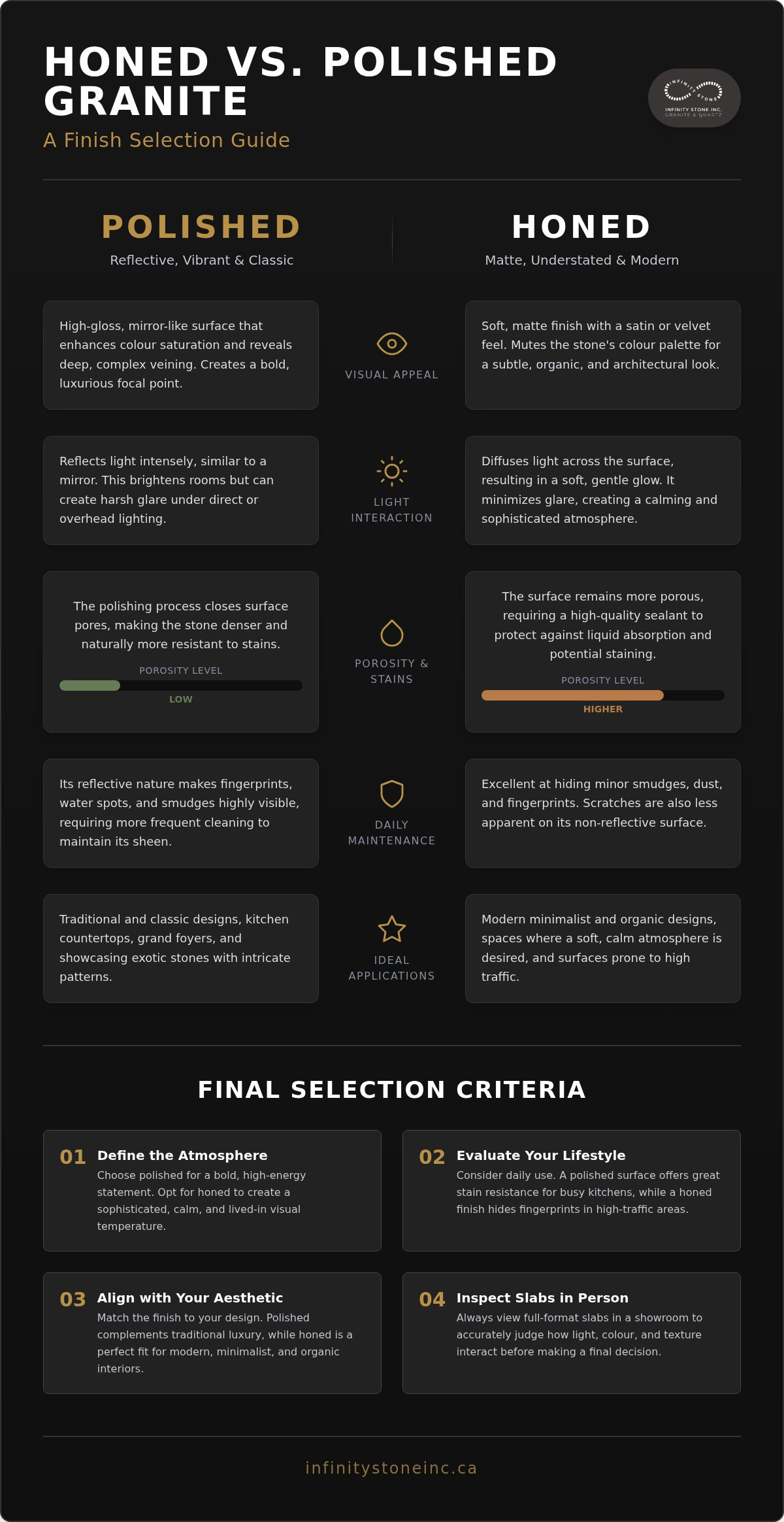
A polished finish represents the peak of stone refinement. Technicians use a sequence of diamond-faced pads with increasingly fine grit to buff the surface to a high-gloss sheen. This mechanical friction generates heat, which, combined with the finest abrasives, creates a mirror-like reflectivity. Beyond the visual appeal, this process naturally 'seals' the stone by closing microscopic surface pores. The result is a high-density, prestigious surface that has defined traditional luxury for decades. It's the standard for those seeking to showcase the deep, complex patterns inherent in premium granite.
What Defines a Honed Finish?
A honed finish offers an understated alternative for the modern connoisseur. Unlike the high-gloss buffing of its polished counterpart, the honing process stops at a lower abrasive grit. This creates a smooth, matte surface with a distinct satin or velvet feel. Designers often select this finish for its ability to soften a room's atmosphere. It avoids the harsh glare of overhead lighting, making it a staple in organic modern and minimalist designs where texture takes precedence over shine. While it feels warmer to the touch, it lacks the natural pore-closure of a polished slab, necessitating professional consideration during the selection phase.
The choice between honed vs polished granite slabs fundamentally changes the stone's physical interaction with its environment. Polished slabs offer a cool, glass-like touch, while honed surfaces provide a warmer, more tactile experience. This density shift is critical for builders and architects. A polished surface is often more resistant to liquid absorption due to its compressed surface structure. Conversely, a honed finish remains more porous, requiring a different approach to long-term care. These technical nuances ensure that the material is not just beautiful, but functionally appropriate for its intended architectural application.
Aesthetic Impact: How Finish Alters the Stone’s Personality
The visual identity of a natural stone slab is not a fixed attribute. It shifts dramatically based on how its surface is treated. When evaluating honed vs polished granite slabs, you're deciding how the stone's inherent geological artistry will communicate with the rest of your interior. A polished finish serves as a high-definition lens, saturating the deep blacks or vibrant minerals and making the crystalline structures appear three-dimensional. This creates a bold focal point that commands attention, often serving as the primary centrepiece of a kitchen or grand foyer.
In contrast, a honed finish offers a muted, organic expression. It pulls back the intensity of the stone's palette, resulting in a look that feels grounded and architectural. This understated elegance is increasingly popular in Mississauga's luxury market, where designers often seek a "lived-in" sophisticated atmosphere. According to the Natural Stone Institute’s Dimension Stone Design Manual, the perceived colour and depth of a stone are directly influenced by the light refraction index of its finish. This means the same slab can look like two entirely different materials depending on whether it's buffed to a shine or left with a matte texture.
Colour Vibrancy and Depth
Polished surfaces are the preferred choice for exotic granites with complex veining or rare mineral inclusions. The high-gloss finish acts as a magnifying glass, revealing hidden details and providing a sense of depth that a matte finish cannot replicate. If your design requires the stone to pop against neutral cabinetry, a polish is essential. A honed finish, however, provides a soft, charcoal-like appearance to even the darkest stones. This is ideal for projects where the goal is a subtle, tactile backdrop rather than a high-contrast statement.
Light Interaction and Glare
In Ontario, where natural light levels fluctuate significantly during long winters, the way a slab interacts with illumination is a critical functional consideration. Polished granite slabs can help bounce limited sunlight deeper into a room, which is a strategic advantage for smaller Mississauga kitchen spaces. However, under high-intensity LED pot lights, this reflectivity can create distracting hot spots and glare. Honed surfaces solve this by diffusing light evenly across the plane. This creates a soft, matte glow that remains consistent and inviting, regardless of the time of day or the intensity of the light source.
The relationship between pattern and finish is also vital. High-movement granites with dramatic "new age" veining often require a polish to define the sharp edges of their patterns. More uniform slabs, on the other hand, gain a sophisticated character when honed, as the matte surface emphasizes the stone's physical presence. To truly appreciate how light and finish interact, viewing full-format slabs in person is the only way to ensure your selection complements your project's specific lighting profile.
Performance and Durability: A Practical Comparison
Aesthetics often drive the initial selection, but long-term satisfaction depends on a slab's functional resilience. In high-traffic Ontario households, the physical interaction between the stone's surface and daily environmental stressors is paramount. The debate of honed vs polished granite slabs extends into the kitchen's utility, where porosity and tactile maintenance dictate the frequency of professional care. While granite is inherently durable, the mechanical finish significantly alters its resistance to the realities of a busy culinary space.
The density of the surface finish dictates how the stone responds to spills and abrasions. Polished surfaces undergo intense mechanical friction that effectively closes the microscopic pores of the stone. This compression makes polished granite naturally more resistant to liquid penetration and acid etching. Conversely, a honed finish stops short of this pore-closure, leaving the stone's structure more accessible to moisture. This physical state requires a more disciplined approach to sealing and daily maintenance to prevent permanent discolouration.
Stain Resistance and Porosity
A polished slab provides a robust barrier against moisture ingress, making it the superior choice for high-spill zones. The high-gloss finish allows liquids to bead on the surface, granting more time for cleanup before absorption occurs. According to MSI Surfaces' guide to granite finishes, honed stone possesses an increased surface area that has a higher affinity for organic oils and pigments. For culinary environments, this means honed slabs require specialized high-grade impregnating sealers and more frequent re-application to maintain their integrity against deep-seated stains.
Scratch Concealment and Daily Wear
While polished stone is denser, its mirror-like surface is unforgiving under direct light. Over time, minor abrasions from heavy cookware or abrasive cleaners can manifest as "spiderweb" scratches that dull the high-gloss sheen. A honed finish excels at disguising these superficial etches and minor scratches; the matte texture absorbs light, making physical wear less perceptible to the naked eye. However, dark honed granites present a unique maintenance challenge. They are highly susceptible to visible oils from fingerprints and water spots. These smudges appear as dark patches on the matte surface, requiring consistent wiping with pH-neutral cleaners to preserve the stone's uniform appearance.
Long-term durability is a strategic balance of density and visual forgiveness. A polished slab offers a sophisticated barrier against liquids but requires careful handling to avoid surface dulling. A honed slab provides a resilient aesthetic that hides physical impacts but demands vigilance against lipid transfers from skin contact. For Mississauga designers, the choice often hinges on whether the client prioritizes liquid resistance or the concealment of mechanical wear. Both finishes provide decades of service if the maintenance protocol matches the stone's specific physical profile.
Selection Criteria for Luxury Ontario Interiors
The Greater Toronto Area luxury market is witnessing a distinct shift in aesthetic preferences. While traditional uniform patterns were once the standard, modern Mississauga interiors now favour "new age granite" characterized by dramatic veining and high-movement artistry. Choosing between honed vs polished granite slabs requires a holistic view of the room's architectural elements, specifically how the stone's texture interacts with cabinetry finishes and flooring materials. A mismatched finish can disrupt the visual harmony of a bespoke space, whereas a strategic selection elevates the entire design narrative.
Polished slabs remain the definitive choice for traditional and transitional designs. Their high-gloss surface complements ornate millwork and rich wood tones, providing a sense of established prestige. Conversely, honed finishes are the cornerstone of "organic modern" aesthetics. This finish pairs exceptionally well with matte black hardware, white oak flooring, and other natural textures that prioritize tactile warmth over sheer brilliance. When selecting your material, consider the gloss level of your surrounding surfaces; a matte cabinet often benefits from the contrast of a polished countertop, while high-gloss cabinetry finds balance with a honed stone surface.
Kitchen Island Applications
The kitchen island serves as the primary architectural centrepiece of the home. For slabs featuring exotic, sweeping veins, a polished finish is often the superior choice to highlight the stone's geological complexity. This is particularly true for bookmatched installations where mirror-image patterns require the clarity of a high-gloss surface to align perfectly. However, for islands intended as high-use prep stations, a honed finish offers a practical advantage by disguising the minor etches that occur during culinary activity. Creating contrast by using a polished island against honed perimeter counters is a sophisticated way to define functional zones within a large open-concept layout.
Bathroom and Low-Traffic Elegance
In private sanctuaries like primary ensuites, the goal is often a spa-like tranquility. Honed granite provides a soft, velvet-like appearance that feels intimate and calming. From a safety perspective, honed surfaces offer better slip resistance in wet areas compared to their polished counterparts, making them a prudent choice for flooring or shower benches. For vertical applications, such as fireplace surrounds or feature walls, polished slabs function as natural art. The reflectivity adds a layer of glamour to a living room, catching the flicker of a flame or the glow of curated accent lighting to create a dynamic visual experience.
To ensure your selection aligns with your specific design goals, you should view our handpicked granite slabs in person. Seeing the scale of the movement and the true texture of the finish is the only way to guarantee the stone will perform as intended within your Ontario project.
Sourcing Premium Granite Slabs in Mississauga
Sourcing the foundation for a luxury interior requires a move beyond digital catalogues and small hand samples. In the Mississauga market, the distributor serves as the vital link between global quarries and local architectural applications. Selecting between honed vs polished granite slabs is a decision best finalized in a controlled, professional environment where the full scale of the material is visible. Infinity Stone Inc. maintains a handpicked inventory of imported stone, allowing designers to inspect the specific nuances of each finish before the material reaches the fabrication stage.
Professional slab inspection involves more than a cursory glance. It requires an evaluation of surface consistency under professional lighting. For polished slabs, you must look for "haze" or uneven buffing that can occur in lower-quality batches. For honed surfaces, the inspection focuses on the uniformity of the matte texture and the absence of accidental burnish marks. This level of scrutiny ensures that the slab you select is the exact piece that will define your space for years. It's about verifying the stone's integrity before it leaves the warehouse.
The Importance of Viewing Full Slabs
Small samples are often misleading; they fail to capture the rhythmic movement of a high-movement granite or the subtle light diffusion of a large-format honed surface. When inspecting a full slab, you can identify how natural fissures interact with the finish. A polished surface might highlight a crystalline vein as a shimmering feature, while a honed finish might soften it into a subtle textural detail. For large-scale projects requiring multiple slabs, viewing the full inventory ensures colour consistency across the entire sequence, preventing jarring transitions in the final installation.
Selecting for Long-Term Value
Premium granite remains a significant contributor to the resale value of high-end Ontario homes. The choice of finish can influence market appeal; polished stone offers traditional grandeur, while honed finishes cater to contemporary tastes. Consulting with experts at a stone slab supplier in Mississauga provides the technical assurance that your material meets the highest industry standards. Finalizing your vision requires a seamless transition from sourcing premium stone slabs to the hands of a skilled fabricator. This collaborative approach ensures that the nuanced beauty of your chosen finish is preserved throughout the cutting and edge-profiling process.
Finalizing Your Material Selection with Confidence
The strategic decision between honed vs polished granite slabs involves balancing visual brilliance with long-term functional resilience. You've discovered how a polished finish saturates stone colour and seals pores naturally, whereas a honed surface offers a soft, tactile elegance that diffuses light across a room. Both finishes serve as foundational elements for high-end living, provided the selection aligns with your project's specific lighting, texture, and maintenance requirements. Understanding these distinctions ensures your stone remains a lasting centrepiece rather than a maintenance burden.
Infinity Stone Inc. provides the expert guidance and handpicked global stone inventory necessary to move from abstract design concepts to concrete reality. Our dedicated Mississauga distribution centre serves as a professional partner for designers and architects seeking curated excellence and technical reliability. Explore our curated collection of premium granite slabs at our Mississauga showroom to experience these textures in person. We look forward to helping you select the perfect slab that reflects your unique aesthetic standards and architectural vision.
Frequently Asked Questions
Is honed granite more expensive than polished granite?
A honed finish typically commands a higher price point than standard polished options, often adding an upcharge of $10 to $25 per square foot. This additional cost reflects the extra labour required to achieve a uniform matte texture through specialized abrasive pads. While polished finishes remain a luxury staple, the curated aesthetic of a professionally honed slab is categorized as a premium architectural upgrade in the Ontario market.
Does honed granite stain more easily than polished granite?
Honed granite is more susceptible to staining because the mechanical process stops before the stone's microscopic pores are naturally closed by high-speed buffing. This increased porosity means the material absorbs liquids and oils more rapidly than its polished counterpart. To mitigate this risk, owners must apply a high-grade impregnating sealer more frequently to maintain a robust barrier against culinary pigments and acids.
Can I change the finish of my granite slab after it has been installed?
It's possible to change the finish of an installed slab, but the process is technically demanding and often cost-prohibitive. On-site refinishing involves significant dust, specialized equipment, and a high risk of uneven results compared to factory-finished slabs. We recommend finalizing your choice between honed vs polished granite slabs at the distribution centre level to ensure the highest quality surface integrity before the stone is fitted.
Which granite finish is best for hiding fingerprints and water spots?
Honed and leathered finishes are superior for concealing water spots and minor etches, though dark honed granites present a unique challenge with skin oils. While the matte surface diffuses light to hide mineral deposits, fingerprints can appear as dark patches on non-reflective, dark stones. For high-traffic islands, a lighter honed stone or a textured leathered finish provides the best balance for maintaining a pristine appearance with minimal daily wiping.
Do honed granite slabs require a special type of sealer?
Honed granite slabs require a high-performance impregnating sealer specifically designed for porous natural stone. Because the surface is more "open" than a polished slab, the sealer must penetrate deeper to provide adequate protection. Professionals often recommend a more rigorous sealing schedule, potentially every six to twelve months, depending on the stone's density and the intensity of daily kitchen activity in your home.
Is a polished finish too slippery for use in a luxury bathroom?
A polished finish is significantly more slippery when wet, making it a potential hazard in luxury ensuites or shower enclosures. The mirror-like surface lacks the mechanical friction provided by a matte or textured finish. Designers often specify honed granite for bathroom floors and wet benches to enhance slip resistance without compromising the sophisticated aesthetic of the natural material in moisture-prone environments.
How do I clean a honed granite slab without leaving streaks?
Cleaning a honed surface without streaks requires a pH-neutral stone cleaner and a clean microfibre cloth. You should avoid dish soaps or cleaners containing waxes, as these leave a residue that creates a cloudy appearance on matte stone. Using a dedicated stone spray and drying the surface thoroughly in a circular motion prevents the accumulation of oils that cause visible streaking under kitchen lighting.
Which finish is more popular for modern kitchen designs in 2026?
Honed finishes have become the preferred choice for modern "organic modern" and minimalist kitchen designs in 2026. While polished granite remains a timeless option for traditional projects, the shift toward natural, low-glare textures has increased the demand for matte surfaces. This trend reflects a broader architectural preference for materials that prioritize tactile warmth and a sophisticated, understated presence over high-gloss reflectivity.


