

Designing an exterior living space in Ontario is fundamentally an exercise in geological survival rather than pure aesthetics. When evaluating granite vs quartzite for outdoor use, architects and discerning property owners quickly discover that visual prestige means little if a slab cannot endure brutal sub-zero freeze-thaw cycles and direct summer sun.
You already understand the anxiety that comes with exterior material selection. Between the legitimate fear of thermal shock cracking, persistent grease stains beside the grill, and the unfortunate discolouration that occurs when resin-heavy engineered quartz is mistakenly placed outdoors, exterior surfaces face relentless stress.
Discover whether authentic granite or high-density crystalline quartzite delivers superior resilience, UV stability, and cold-weather endurance for demanding Canadian climates. The following analysis examines the exact mineralogical performance of each stone, giving you complete clarity to specify the ideal natural slab for your outdoor kitchen.
Key Takeaways
- Understand the geological distinctions between granite vs quartzite for outdoor use to prevent freeze-thaw fractures, surface spalling, and sub-zero delamination.
- Compare UV stability and solar heat absorption rates to keep outdoor preparation zones cool and completely immune to summer fading.
- Identify which natural mineral composition offers maximum scratch defense and superior resistance to hot cookware and barbecue grease.
- Master the architectural criteria for maintaining uninterrupted visual continuity between interior luxury living areas and exterior stone terraces.
- Discover the strategic advantage of hand-selecting full-scale raw slabs directly from dedicated wholesale distributor inventory across Ontario.
Evaluating Natural Stone Slabs for Demanding Canadian Outdoor Environments
Specifying materials for an exterior terrace or culinary station in Southern Ontario requires strict attention to environmental physics. Natural elements test horizontal surfaces without mercy. Summer installations face ambient heat waves and intense solar radiation, while winter brings relentless sub-zero temperatures, slush, and biting winds. Selecting surfaces strictly for visual drama without verifying structural density leads directly to early failure. When architects contrast granite vs quartzite for outdoor use, the primary objective centres on eliminating vulnerable moisture pathways before the first frost arrives.
Engineered quartz surfaces perform exceptionally well indoors, but they quickly deteriorate under exterior conditions. The synthetic polymer resins used to bind crushed quartz cannot withstand sustained ultraviolet rays. Sun exposure triggers chemical breakdown, resulting in yellowing, chalky hazing, and warped seams. Authentic natural stones circumvent these vulnerabilities entirely. Igneous and metamorphic formations possess an inorganic purity that synthetic surfaces cannot match, ensuring your exterior counter remains stable across every season.
The Reality of Canadian Freeze-Thaw Weather Cycles
Water expands by roughly nine percent upon freezing. When atmospheric moisture, melted snow, or driving rain penetrates microscopic fissures within a stone slab, sub-zero temperatures transform that liquid into internal hydraulic pressure. Over repeated freeze-thaw cycles, this expansion causes spalling, micro-fissuring, and catastrophic structural cleavage. Slabs engineered with high bulk density and exceptionally low water absorption rates effectively prevent moisture ingress. By blocking water from settling within the capillary pores of the stone, these surfaces survive deep Ontario freezes without loss of structural integrity.
Why Natural Metamorphic and Igneous Stones Excel Outdoors
The superior resilience of exterior natural stone stems directly from its subterranean genesis. The documented geological properties of granite reveal an interlocking crystalline matrix developed under extreme cooling pressures, creating exceptional density. Metamorphic quartzites undergo profound tectonic recrystallisation, fusing sandstone grains into tightly packed quartz networks.
- Inorganic Mineral Structures: Natural igneous and metamorphic compositions do not fade, bleach, or blister under prolonged summer ultraviolet exposure.
- High Thermal Stability: Having formed under subterranean heat, these slabs easily accommodate hot barbecue cast iron and extreme seasonal temperature swings.
- Superior Weathering Resistance: High internal density stops external contaminants, protecting the material through decades of outdoor entertaining.
These mineralogical characteristics place high-density natural stone at the top of the specification list. In the technical debate of granite vs quartzite for outdoor use, both stones present proven structural profiles that easily surpass soft marbles, limestones, and synthetic alternatives.
Geological Resilience: Mineral Composition, Mohs Hardness, and Structural Density
Geological origin dictates how raw stone behaves under real-world culinary and environmental duress. Understanding these subterranean origins clarifies how each material handles blade contact, sizzling cookware, and severe weather. While soft sedimentary options like limestone degrade quickly when exposed to moisture and acid, both granite and quartzite offer supreme crystalline strength. When evaluating granite vs quartzite for outdoor use, examining their mineral makeup reveals distinct physical advantages.
Granite: The Benchmark of Igneous Density
Granite forms deep within the continental crust through the slow cooling of molten magma. This process creates an interlocking matrix of quartz, feldspar, and trace ambient minerals. Scoring between 6 and 7 on the Mohs hardness scale, granite readily repels abrasions from steel chef knives and cast-iron cookware. The high concentration of feldspar lends granite its distinctive speckled aesthetic while maintaining exceptionally low fluid absorption across the slab.
Quartzite: Metamorphic Purity and Crystalline Toughness
Quartzite begins as pure quartz sandstone before tectonic subduction subjects it to staggering heat and directional pressure. This metamorphic recrystallisation fuses granular quartz into an unbroken mosaic of pure silicon dioxide. Official technical data on quartzite confirms this transformation yields a hardness rating of 7 to 8 on the Mohs scale, easily surpassing granite. Crucially, true quartzite contains zero calcite. Unlike marble, acidic culinary spills such as citrus juice, marinades, or red wine cannot chemically etch its polished crystalline surface.
Critical Distinction: Natural Quartzite vs Engineered Quartz
A pervasive misconception in exterior architecture involves confusing metamorphic quartzite with factory-produced engineered quartz. Engineered quartz combines crushed mineral aggregates with up to ten percent petroleum-based polymer resins. When exposed to outdoor sunlight, these artificial resins break down, turn yellow, and warp. Natural metamorphic stone contains zero synthetics. Discerning builders reviewing our curated quartzite slabs gain access to pure, inorganic mineral structures that remain entirely unaffected by UV rays.
Deciding between granite vs quartzite for outdoor use ultimately reveals two high-performance materials forged by subterranean physics rather than synthetic binders. Designers seeking authentic structural integrity can inspect these geological formations firsthand by exploring wholesale inventory at Infinity Stone Inc. alongside their chosen fabricator.
Granite vs Quartzite for Outdoor Use: Performance, Weathering, and UV Stability
Subjecting natural surfaces to real-world exterior conditions exposes sharp functional contrasts between material classes. High-volume grilling zones require surfaces capable of handling boiling fats, sudden flare-ups, and intense sunlight without cracking or staining. In the direct evaluation of granite vs quartzite for outdoor use, operational performance hinges on solar reflectivity, liquid permeability, and seasonal thermal expansion.
Resistance to UV Exposure, Heat, and Direct Flame
Both stone categories effortlessly withstand direct contact with hot cookware, smoking smoker lids, and searing cast iron. The definitive differentiator during summer entertaining is solar absorption. Dark granites absorb significant thermal energy under unbroken sunlight, becoming uncomfortably hot to the touch during peak afternoon hours. In contrast, pale crystalline quartzites reflect solar rays efficiently. Their lighter mineral matrix maintains a noticeably cooler prep surface, providing a more comfortable prep area during July heatwaves.
Stain Resistance, Porosity, and Chemical Reactivity
Outdoor cooking involves heavy grease splatter, acidic marinades, and concentrated seasonings. Mineral density directly dictates how each slab responds to these culinary compounds:
- Granite Absorption Profiles: As documented in field studies on the geological properties of granite, the stone features varying capillary porosity depending on its specific quarry origin. Regular application of a solvent-based impregnating sealer every 6 to 12 months prevents barbecue fats from settling into the micro-pores.
- Quartzite Density Advantages: Dense crystalline quartzites offer exceptional barrier strength against fluid penetration. Certain cross-cut selections feature microscopic capillaries along their natural bedding planes, making meticulous edge-sealing vital.
- Acid Immunity: Neither stone reacts with citrus juices, vinegar reductions, or alcohol, completely avoiding the dull etching patches typical of exterior marble.
Winter Durability and Thermal Expansion Behaviour
Sub-zero winter survival depends entirely on structural accommodation. Both stones expand and contract predictably through the annual temperature range without internal delamination. Successful installations rely on proper architectural preparation. Designers must ensure adequate cantilever bracing beneath expansive bar overhangs and incorporate calibrated expansion joints where stone surfaces interface with rigid barbecue framing. Explore our comprehensive inventory guide to granite slabs to review the structural tolerances of specific high-density quarries.
A rigorous comparison of granite vs quartzite for outdoor use confirms that both stones offer the structural stamina needed for exterior projects, provided that solar orientation and fabricator sealing routines guide your final material choice.
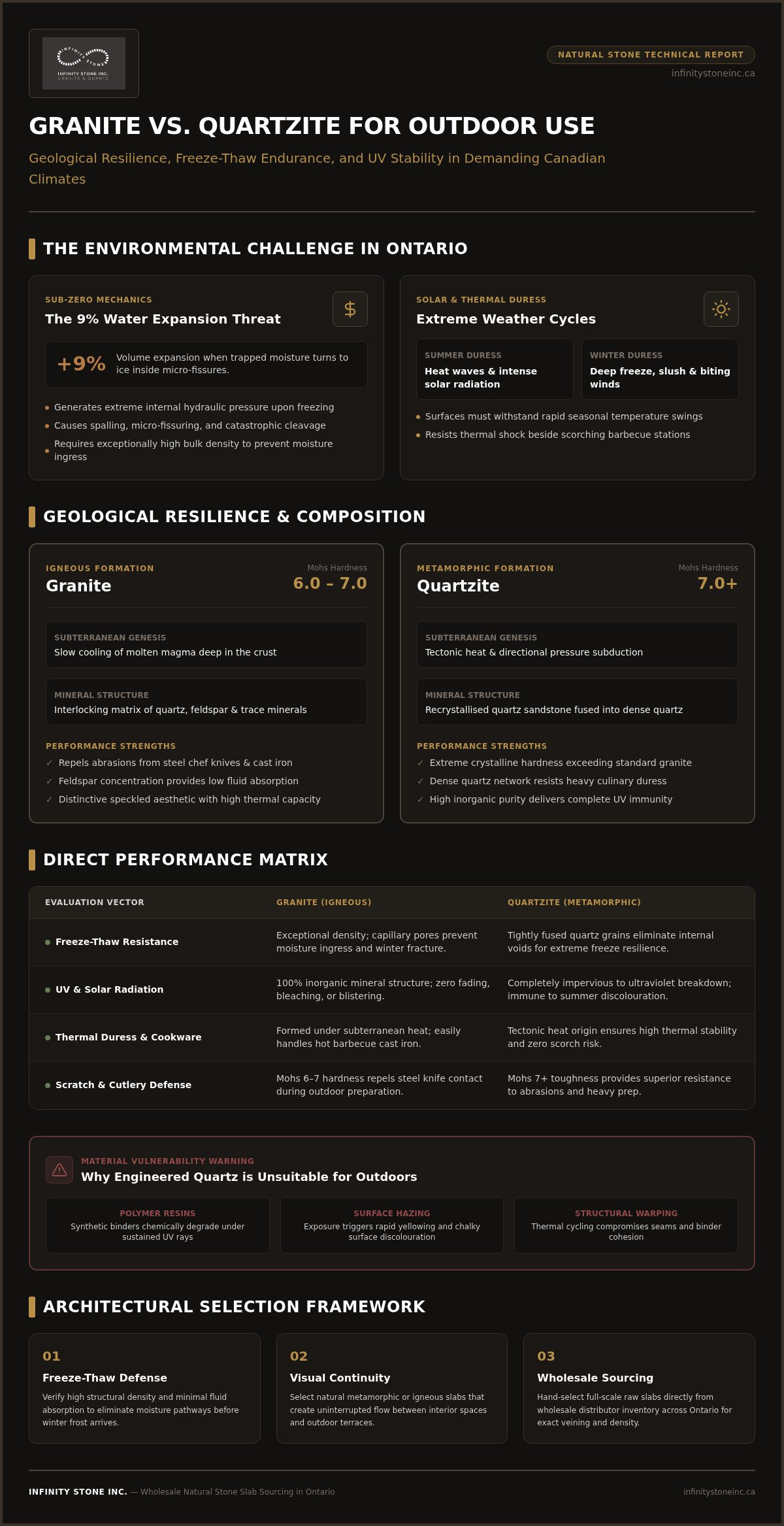
Architectural Selection Framework: Choosing the Right Slab for Your Outdoor Kitchen
Specifying horizontal surfaces for luxury exterior living spaces requires a deliberate balance between functional performance and architectural harmony. Countertops should not exist as isolated components. They must integrate seamlessly with building facades, hardscaping elements, and interior sightlines. When weighing granite vs quartzite for outdoor use, establishing clear architectural criteria early prevents costly specification errors and elevates overall property value.
Connecting interior living areas with exterior terraces demands visual continuity. Bringing material palettes through full-height glass partitions creates an expansive living footprint. Achieving this cohesion involves evaluating stone aesthetics alongside functional culinary demands. Substructure framing must also be verified, as masonry bases or marine-grade aluminium cabinetry dictate allowable dead loads and unsupported cantilever depths for dining ledges. For homeowners coordinating countertop fabrication with appliance specifications, The Pinnacle Patio offers in-depth planning advice on pairing stone counters with built-in grills and modular island layouts.
Visual Harmonisation: Modern Veining vs Classic Granular Depth
Aesthetic preferences often determine the initial direction of a project. Distinct geological formations yield dramatically different design expressions:
- Quartzite Dynamics: Featuring sweeping, marble-like ribbons and translucent quartz crystals, quartzite complements contemporary architectural facades. It delivers the striking visual movement of Italian calacatta marble without chemical etching vulnerabilities.
- Granite Stability: Granite provides complex, flecked dimensional depth. This granular uniformity pairs effortlessly with rustic exterior masonry, natural flagstone patios, and transitional timber framing.
Architects and designers can explore a vast collection of imported stone slabs to evaluate these distinct movement patterns in full-scale dimensions.
Surface Finishes: Polished, Honed, or Leathered for Exterior Spaces
Surface texture drastically alters exterior functionality. While a polished finish accentuates vibrant mineral colours, direct midday sun often creates blinding surface glare on wide-open pool decks. Honed finishes provide a smooth, low-reflection matte face well suited to covered pavilions, though the open pore structure requires vigilant sealing against cooking oils. Leathered textures present the premier exterior finish. The gentle undulating relief disperses harsh sunlight, masks atmospheric dust, sheds water efficiently, and delivers secure tactile grip around outdoor preparation stations.
Selecting between granite vs quartzite for outdoor use requires matching surface textures and geological profiles to your specific spatial orientation. To inspect raw material options in person, contact the team at Infinity Stone Inc. and arrange a showroom consultation alongside your chosen stone fabricator.
Sourcing Premium Outdoor Slabs: The Wholesale Distributor Advantage in Ontario
Procuring stone for a luxury exterior project requires a supply chain built on material transparency. While mass-market retailers often restrict client selection to small hand samples, premium outdoor living design demands complete visual oversight. Sourcing directly through a dedicated natural stone distributor grants homeowners, architects, and designers unmediated access to complete imported inventory bundles. By focusing strictly on wholesale slab curation, specialized distributors uphold rigorous quality standards that protect projects from compromised structural material.
Every raw geological block extracted from overseas quarries exhibits singular character. Evaluating full bundles side by side allows trade professionals to inspect broad crystal patterns, verify colour saturation, and assess natural fissures before cutting begins. In the practical choice between granite vs quartzite for outdoor use, inspecting raw slabs in person ensures that the specific density and texture match your exact architectural vision.
The Value of Inspecting Full-Scale Slabs in Mississauga
A palm-sized physical swatch cannot capture the sweeping diagonal movement of crystalline quartzite or the rich depth of exotic granite. Viewing full-format slabs within an expansive gallery eliminates guesswork. The Infinity Stone Inc. warehouse showroom in Mississauga maintains a curated environment where natural light highlights genuine mineral tones and crystalline translucency. Property owners can walk through complete bundles, ensuring the raw stone surfaces selected for their exterior patio harmonise perfectly with planned landscaping, masonry, and architectural elevations.
Navigating Procurement with Your Independent Fabricator
The distinction between material supply and finished processing remains central to bespoke construction. Dedicated wholesale distributors supply premium raw slabs, while your chosen fabrication specialist handles edge detailing, bridge-saw cutting, and site fitting:
- Collaborative Selection: Homeowners can tour the Mississauga showroom alongside their chosen fabricator to inspect slab integrity, grain orientation, and natural inclusions together.
- Specialised Craftsmanship: Independent stone fabricators provide focused expertise tailored to your specific outdoor kitchen footprint, ensuring sink cutouts and barbecue drop-ins receive clean execution.
- Seamless Logistics: Direct distributor coordination streamlines slab holding, transport logistics, and workshop delivery across the Greater Toronto Area and broader Southern Ontario.
Touring extensive inventory gives trade professionals decisive control over their final build. Choosing between granite vs quartzite for outdoor use becomes intuitive once you experience the physical presence of premium natural stone firsthand. Globally, premier natural stone suppliers and fabricators such as Futar highlight the importance of evaluating full slabs and specialised craftsmanship to guarantee enduring exterior performance.
Specifying Geological Excellence for Your Exterior Living Space
Successfully designing an exterior culinary retreat in Ontario relies on specifying materials that withstand sub-zero freeze-thaw cycles without sacrificing aesthetic prestige. Resolving the choice between granite vs quartzite for outdoor use ultimately balances your functional requirements with architectural vision. Metamorphic quartzite provides luminous veining and superior solar reflection, while igneous granite delivers proven density against heavy barbecue oils and direct heat. Both natural formations completely surpass fragile, resin-bound engineered alternatives.
Achieving extraordinary exterior results starts with transparent material sourcing. As a specialized natural stone distributor located in Mississauga, Infinity Stone Inc. imports handpicked exotic quartzite and granite bundles from premier quarries worldwide. Our expansive indoor gallery invites homeowners, designers, and custom builders to inspect full-format slabs firsthand alongside their chosen fabricators. Ready to anchor your outdoor terrace with enduring geological strength? Explore our premium natural stone slabs at Infinity Stone Inc. and realize your exterior architectural vision.
Frequently Asked Questions
Can quartzite withstand Ontario freeze-thaw winter conditions without cracking?
Yes, authentic metamorphic quartzite easily withstands Ontario freeze-thaw cycles because of its fused crystalline density and minimal moisture absorption. Without open capillary pathways for water to penetrate, freezing moisture cannot create internal hydraulic pressure that leads to cracking. Working alongside an independent fabricator ensures the underlying cabinetry provides level perimeter support, eliminating structural stress fractures as the ground shifts slightly between seasons.
Will granite or quartzite fade or discolour when exposed to direct summer sunlight?
Neither genuine granite nor authentic quartzite will fade or discolour under intense summer sunlight. Both materials consist entirely of inorganic minerals that are inherently UV-stable. Unlike resin-based engineered composites, these subterranean stones retain their original pigment saturation, crystallization, and natural veining indefinitely, even under Southern Ontario's harshest midday ultraviolet exposure.
Is engineered quartz safe to install in an uncovered outdoor kitchen?
No, engineered quartz is unsuitable for uncovered exterior kitchens. Engineered quartz slabs incorporate polyester resins and chemical binders that rapidly deteriorate when subjected to ultraviolet radiation. Unprotected sun exposure triggers polymer breakdown, leading to surface yellowing, hazy patches, and warping. Outdoor installations require pure, resin-free natural slabs such as quartzite or granite to ensure lasting structural integrity.
Which finish is best for outdoor natural stone: polished, honed, or leathered?
A leathered finish is the optimal choice for outdoor natural stone surfaces. While polished finishes produce intense daytime glare under the sun and honed surfaces can show grease spots more easily, leathered stone provides subtle texture that diffuses harsh light. Its undulating profile naturally hides dust, sheds precipitation efficiently, and delivers superior slip resistance around outdoor food preparation spaces and patio wet bars.
How frequently do outdoor granite and quartzite countertops require sealing?
Exterior granite and quartzite surfaces generally require sealing every six to twelve months in Ontario. Severe winter freezes, driving rain, and intense summer sun accelerate sealer breakdown faster than indoor environments. Applying a premium penetrating solvent-based sealer in late autumn helps winterize the stone, preventing barbecue marinade absorption and blocking moisture ingress before temperatures plunge below freezing. Consult your chosen fabricator for specific application protocols.
Can hot grilling tools and cookware be placed directly onto exterior stone surfaces?
Yes, both materials provide exceptional heat resistance that easily tolerates hot pans and grilling tools. Having formed under immense subterranean temperatures, both stone types won't scorch, melt, or blister. In the ongoing debate over granite vs quartzite for outdoor use, both stones tolerate boiling pots and cast-iron skillets straight from the barbecue, though using trivets remains good practice to prevent rapid localized thermal shifts.
How do I choose between quartzite and granite for an outdoor barbecue island?
Choose based on your sun exposure and architectural preference. Deciding between granite vs quartzite for outdoor use often comes down to lighting and aesthetics. Quartzite reflects afternoon heat, staying cooler in direct sunlight while delivering elegant marble-like veining for modern designs. Granite offers dense, speckled visual texture and superior oil resistance. Visiting a dedicated Mississauga slab distributor lets you compare full bundles in person alongside your trade team.


