

What if getting buy-in from spouse on countertop choice starts before you compare a single slab? One of you may favour a quiet, consistent colour, while the other is drawn to expressive veining or a bolder style. When the options seem endless, it’s easy for a design discussion to feel like a contest. Instead, start by agreeing on what matters most to both of you.
This guide offers a practical way to set shared priorities, narrow the material and style options, and compare realistic choices without either partner feeling overruled. You’ll learn how to weigh appearance alongside everyday needs, assess actual slabs together, and make a decision you can both explain and feel confident about. Infinity Stone Inc., a Mississauga-based supplier of quartzite, quartz, granite, marble, and porcelain slabs, can be one resource as you compare materials. Fabrication and installation are arranged separately, so clarify those next steps before finalizing your selection.
Key Takeaways
- Begin with a calm conversation about what matters to each of you, rather than treating different tastes as a disagreement about who has better style.
- Use shared priorities and clear boundaries to make getting buy-in from spouse on countertop choice a fair, focused decision.
- Compare suitable materials and slabs using the same criteria, including appearance, care requirements, intended use, and project fit.
- Follow a shortlist-and-review process, and agree on a browsing window to avoid endless comparisons.
- View actual slabs together before deciding, and confirm who will arrange fabrication and installation separately.
Why Countertop Choices Can Create Tension: How to Start Together
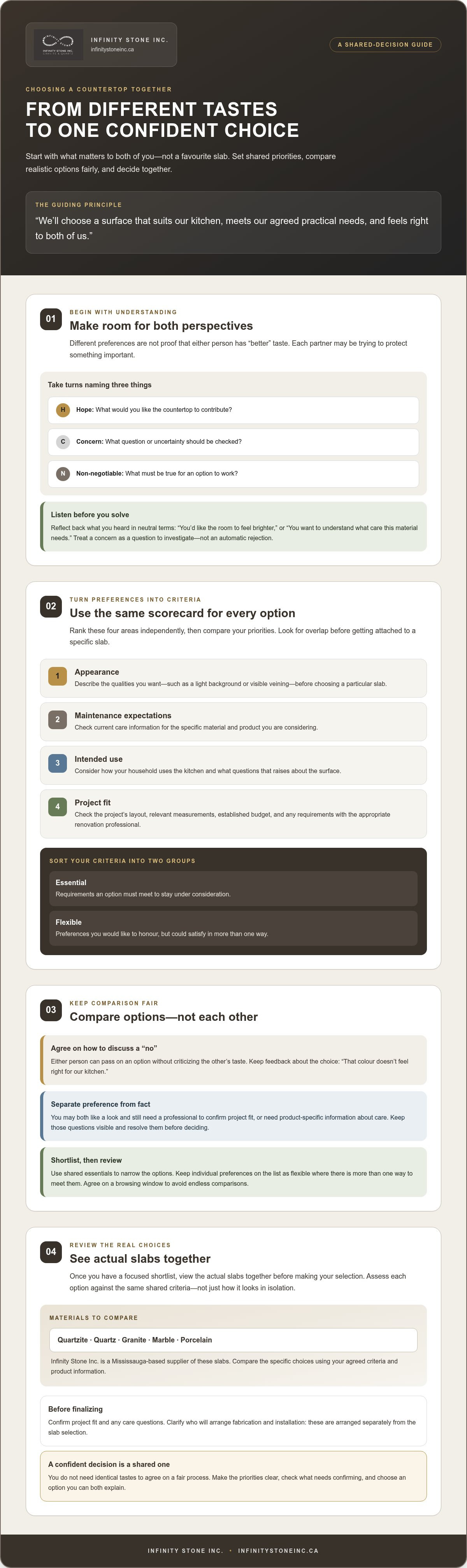
A countertop is a prominent design feature and a surface you use throughout the day. One partner may picture a bright, understated kitchen, while the other is thinking about daily routines, care, or how a surface will look beside the existing cabinets. Those priorities can point to different options without either person having “better” taste. Often, each person is trying to protect something important to them.
That’s why getting buy-in from spouse on countertop choice works best as a shared decision, not a pitch for one person’s favourite slab. A neutral overview of collaborative decision-making can help frame the goal: consider both perspectives, make assumptions visible, and agree on a way forward.
What each partner may be prioritizing
Before browsing more options, take turns describing what you hope the countertop will contribute. One person might want a calm, light look that suits the room; the other might be focused on how the surface fits everyday routines. Listen without immediately proposing a compromise. Then reflect back what you heard in neutral terms: “You’d like the room to feel brighter,” or “You want to understand what care this material needs.”
Each partner can write down a main hope, a concern, and a non-negotiable. Treat a concern as a question to investigate, not an automatic reason to reject every option. For example, if upkeep is a worry, check the current information for the specific product rather than assuming all materials behave the same way.
How to make the conversation feel fair
Choose a calm time to talk, not the middle of a stressful appointment or a rushed decision. Agree that either person can say no to an option without criticizing the other’s taste. “That colour doesn’t feel right for our kitchen” keeps the discussion about the choice. “You always pick impractical things” turns it into a personal dispute.
Separate preferences from facts that need checking. You might both like a particular look and still need a professional to confirm whether a slab suits the project or what care it requires. Keep a short list of those questions and resolve them before deciding.
Finish by writing down one shared decision principle, such as: “We’ll choose a surface that suits our kitchen, meets our agreed practical needs, and feels right to both of us.” Use it as a reference when new colours, patterns, or materials compete for attention. You don’t need to agree on every preference right away. First agree on how you’ll make the choice fairly.
Turn Different Countertop Preferences into Shared Priorities
Once you’ve heard what matters to each of you, turn those preferences into criteria you can use to assess options. “I want a dramatic look” can sit alongside “I want a surface that suits our everyday routine.” The goal isn’t to dismiss either preference. It’s to identify what’s essential, what’s flexible, and what needs more information before you compare slabs.
Agreed criteria make comparisons more focused and keep the decision grounded in your shared needs.
Create a short countertop decision scorecard
Each partner can independently rank four areas: appearance, maintenance expectations, intended use, and project fit. For appearance, describe the qualities you want, such as a light background or visible veining, instead of choosing a specific slab immediately. For intended use, consider how your household uses the kitchen and what questions that raises about the surface. Then compare your rankings and mark the priorities you share.
Use the overlap to create your first shortlist. An option should meet your agreed essential requirements before either partner spends time weighing smaller details. Keep individual preferences on the list too, but mark them as flexible if there are several ways to meet them.
Agree on boundaries before discussing materials
Write down project constraints that may affect your choices, including the planned layout, relevant measurements, the renovation budget you’ve established, and any requirements from the people handling the project. Confirm practical constraints with the appropriate renovation professional rather than relying on assumptions. For questions about care or performance, check information for the specific material and slab under consideration.
Separate boundaries into two groups:
- Essential: Requirements an option must meet to stay under consideration.
- Flexible: Preferences you’d like to honour but could satisfy in more than one way.
This distinction helps prevent one person’s strong preference from being mistaken for a shared requirement. It also makes compromise more precise. If you both want a bright kitchen but differ on pattern, for example, look at several slabs in the agreed colour direction instead of debating one early favourite.
For couples focused on getting buy-in from spouse on countertop choice, the scorecard gives you a fair reference when tastes diverge. Revisit it before adding options to the shortlist, and note unresolved questions for the relevant renovation professional. Once your criteria are clear, you can compare materials and actual slabs with a shared understanding of what each option needs to deliver. If you’re beginning to explore natural and engineered surfaces, Infinity Stone’s countertop slabs are one potential source to consider. Fabrication and installation are arranged separately.
Compare Countertop Materials and Slabs Without Turning It into a Contest
With shared priorities in place, compare options using the same questions rather than debating whose favourite looks better. A simple comparison sheet can keep the discussion balanced. For every option, note its appearance, care requirements, intended use, and confirmed project fit. If a detail hasn’t been verified, write it down as a question instead of treating an assumption as fact.
Consider quartzite, quartz, granite, marble, and porcelain if they meet your agreed criteria. Quartzite, granite, and marble are natural stones; quartz and porcelain are engineered materials. Each category offers different colour and pattern options, but the material name alone can’t tell you whether a particular slab suits your home or preferences.
A material category describes the type of surface; an individual slab determines the specific colour and pattern you’ll see.
Use samples and slab viewing to discuss appearance
Where practical, compare samples or actual slabs under lighting similar to the intended room. Look at the background colour, veining, pattern movement, and how the surface relates to your cabinetry. Natural patterns vary, so a small sample may not show the full visual effect of a particular slab. If you’re considering natural stone, viewing the actual slab together can help you assess its character before deciding.
Start by naming what each person likes about an option. One partner might appreciate its subtle pattern, while the other likes how its colour works with the cabinets. Then discuss concerns without dismissing the other person’s taste. This keeps the conversation about the surface and the room, not about who has better judgement.
Separate visual preference from performance questions
A surface can appeal to both of you visually while raising different practical questions. Check care and suitability claims against the manufacturer’s current product information or guidance from a qualified fabricator. Ask how the specific material and product relate to your intended daily use, and confirm project requirements with the relevant renovation professional.
Use the same prompts for every option:
- Appearance: What do we like about its colour, veining, and overall movement?
- Care: What routine care does the product documentation recommend?
- Intended use: What should we confirm about how we use the kitchen?
- Project fit: Have the relevant project requirements been checked?
A broad material name doesn’t prove that every product in that category has identical characteristics. When getting buy-in from spouse on countertop choice, keep visual preferences and performance questions in separate columns. That way, you can compare the look while seeking reliable answers about care and suitability before either partner commits.
Use a Step-by-Step Process to Reach a Countertop Decision
A clear sequence keeps the discussion moving without forcing a decision before both partners are ready. Agree on a browsing window in advance, then use it to review a focused set of options. If you reach the end without a confident choice, pause and arrange another look rather than extending the search indefinitely.
- Step 1: Revisit your priorities. Read through the requirements and flexible preferences you agreed on. Confirm they still reflect what matters to both of you.
- Step 2: Build a shortlist. Remove options that don’t meet essential project requirements, then keep a manageable group for closer consideration.
- Step 3: Compare together. Review each shortlisted slab against the same criteria. Give both partners room to explain what works and what gives them pause.
- Step 4: Confirm the details. Check the specific slab, product information, project fit, and any outstanding questions with the appropriate professionals.
- Step 5: Decide together. Choose an option only when both of you can explain how it meets your shared criteria. If neither feels ready, take time to reflect and schedule a second viewing.
What to do when you remain divided
Pinpoint the feature causing the disagreement. Is it the background colour, the amount of veining, or uncertainty about a practical requirement? Keep the points you agree on and look for alternatives that preserve those shared priorities while changing the disputed detail. A design professional or fabricator can clarify technical questions, but shouldn’t be asked to take sides.
Confirm the choice before moving forward
Before settling on a slab, review the actual selection and relevant product details together. Check that it fits the project requirements, then confirm fabrication and installation arrangements with the professionals responsible for that work. Each partner should be able to describe why the choice works, rather than agreeing simply to avoid another discussion.
This process makes getting buy-in from spouse on countertop choice a series of manageable decisions instead of one high-pressure moment. If you’re ready to compare slabs against your shortlist, explore countertop slab options from Infinity Stone Inc., a Mississauga supplier of quartzite, quartz, granite, marble, and porcelain slabs. Fabrication and installation are arranged separately.
Make Your Shared Countertop Choice Real with the Right Slab
A confident selection follows a clear sequence: agree on shared priorities, narrow the field to a focused shortlist, then choose a slab both partners approve. You don’t need identical tastes. You do need to understand why the chosen option works for your home and how it meets the criteria you set together.
Use your scorecard to decide which material categories deserve a closer look. Quartzite, quartz, granite, marble, and porcelain each offer options to assess for appearance, care expectations, intended use, and project fit. If one category seems promising, consult reliable product information and the professionals involved before drawing conclusions about a specific product.
Explore slab categories that match your shared priorities
Keep the comparison focused. If you both value a particular colour direction, look for slabs that fit it, then discuss differences in pattern, veining, or movement. Viewing actual slabs together can help you evaluate the specific surface rather than relying only on a small sample or broad material label. If quartzite or quartz is on your shortlist, the relevant countertop guides can offer another starting point for your research.
Infinity Stone Inc. supplies natural and engineered slabs in Mississauga, Ontario, including quartzite, quartz, granite, marble, and porcelain. Explore Infinity Stone’s natural and engineered slab selection together, and use your agreed criteria to guide what you review.
Plan the handoff from selection to finished countertop
Choosing the slab is one part of the project. Homeowners arrange countertop fabrication and on-site installation separately, so confirm who will handle each stage before moving ahead. Ask the slab supplier and the fabricator you select what project information they require. Clarify how the slab choice and fabrication details will be confirmed with the professionals involved.
Before finalizing the selection, make sure both of you can explain why it meets your shared priorities and what happens next. That final check helps turn getting buy-in from spouse on countertop choice into a decision you can move forward with together, from the chosen slab to the separately arranged project work.
Choose a Slab You’ll Both Feel Good About
A lasting decision doesn’t require identical taste. Start with shared priorities, use them to narrow the options, and compare specific slabs against the needs you’ve agreed on. When you separate appearance preferences from questions about care and project fit, getting buy-in from spouse on countertop choice becomes a more balanced process.
Take time to review the actual slab together before settling on a selection. Then confirm product details and project requirements with the appropriate professionals. Countertop fabrication and on-site installation need to be arranged separately from purchasing the slab.
For homeowners in Mississauga and across Ontario, Infinity Stone Inc. supplies natural and engineered stone slabs in quartzite, quartz, granite, marble, and porcelain. Explore Infinity Stone’s natural and engineered slab selection together and see which categories fit your shared criteria.
With a thoughtful process and a shortlist you both support, you can move ahead with greater confidence and look forward to a countertop that feels right for your home.
Frequently Asked Questions
How do I talk to my spouse about a countertop choice without arguing?
Start with a calm conversation about needs rather than favourite slabs. Take turns describing what you hope for, what concerns you, and what you consider essential. Reflect your spouse’s priorities back before responding, and agree that either of you can reject an option without criticizing the other’s taste. This can make getting buy-in from spouse on countertop choice feel like a shared decision, not a debate to win.
What if my spouse and I have completely different countertop styles?
Look for the priorities behind each style preference. One person may want a quiet, light surface, while the other likes strong pattern or contrast. Agree on shared requirements first, then identify which visual details are flexible. You might keep a preferred colour direction while comparing different levels of veining, for example. A focused shortlist can reveal options that respect both perspectives without requiring either person to abandon every preference.
How can couples choose a countertop together?
Make the choice in stages: list your priorities, rank them separately, compare what you have in common, then shortlist options that meet your essential requirements. Assess each option using the same criteria, including appearance, care information, intended use, and project fit. Before deciding, review the specific slab and confirm outstanding questions with the relevant professionals. If either partner is unsure, pause and arrange another review rather than rushing.
Should we choose a countertop based on appearance or durability?
Consider appearance and practical suitability together rather than treating one as the only deciding factor. Discuss the look you both want, how the kitchen is used, and what care routine you’re comfortable with. Then check current product documentation and ask a qualified fabricator about questions related to suitability and performance. Don’t assume every product within a material category has identical characteristics. Choose an option that meets your shared criteria based on confirmed information.
Can looking at the actual slab help us agree on a countertop?
Yes. Seeing a specific slab can help you compare its colour and pattern more clearly than relying on a small sample or general material description. Look at it together and discuss what each of you likes before raising concerns. Infinity Stone Inc. is a Mississauga-based supplier of natural and engineered slabs in Ontario, including quartzite, quartz, granite, marble, and porcelain. Ask the supplier about the slab-selection process and what details are available to review.
What should we compare when choosing a countertop material?
Compare appearance, care requirements, intended use, and confirmed project fit. For appearance, note colour, veining, and pattern movement. For care and suitability, check information for the specific product rather than relying on broad claims about a material. Ask the professionals involved in your renovation to clarify project requirements. Record unknowns as questions to resolve so an assumption doesn’t become a reason to rule out an option prematurely.
What happens if we still cannot agree on a countertop?
Take a pause, then name the exact feature behind the disagreement. Is it the colour, pattern, care expectation, or an unanswered project question? Keep the priorities you share and look for alternatives that adjust the disputed detail. If you need technical clarification, ask a design professional or fabricator for information, not a verdict on whose preference is better. A second look at the shortlist can help you decide with more confidence.


