
The greenest countertop may be the one you never have to replace. For homeowners comparing eco-friendly countertop materials canada can offer, durability matters alongside recycled content, low emissions and responsible sourcing. A slab’s environmental footprint depends on more than its label: manufacturing, transport, maintenance and end-of-life options all play a part.
It’s understandable to question sustainability claims in the stone industry, especially when a material must also deliver a refined, luxurious finish. And imported slabs can raise concerns about transportation emissions. The most eco-conscious choice isn’t always the one marketed as “green”; it’s the one whose verified qualities and long service life align with your priorities.
This 2026 Canadian buying guide compares quartzite, granite, marble, quartz and porcelain for durability, aesthetics and environmental considerations. You’ll learn what to ask about recycled content and VOC emissions, how to weigh transport against longevity, and why sourcing through a local Mississauga distributor can reduce regional transport legs. The goal is a sophisticated surface that supports better indoor air quality and lasting design.
Key Takeaways
- Assess a countertop across its full lifecycle, including sourcing, manufacturing, transport, upkeep and end-of-life options, rather than relying on a “green” label alone.
- Compare quartzite, granite and marble with quartz and porcelain to find the balance of natural character, performance and environmental considerations that suits your home.
- Use this guide to compare eco-friendly countertop materials canada homeowners can consider, and identify the sustainability claims worth verifying before choosing a slab.
- Ask suppliers about recycled content, VOC emissions and sourcing details so your selection reflects both indoor air quality and environmental priorities.
- Explore how handpicked slabs and local Ontario distribution can support a durable choice while reducing regional transport legs.
Defining Sustainable Luxury: What Makes a Countertop Eco-Friendly in Canada?
An eco-friendly countertop is not defined by recycled content alone. Its environmental profile depends on the full lifecycle: raw material extraction, processing, transportation, expected service life, maintenance and end-of-life options. A useful assessment compares these stages rather than relying on a broad “green” label. The Countertop overview provides a helpful introduction to the range of surfaces used in kitchens and other spaces.
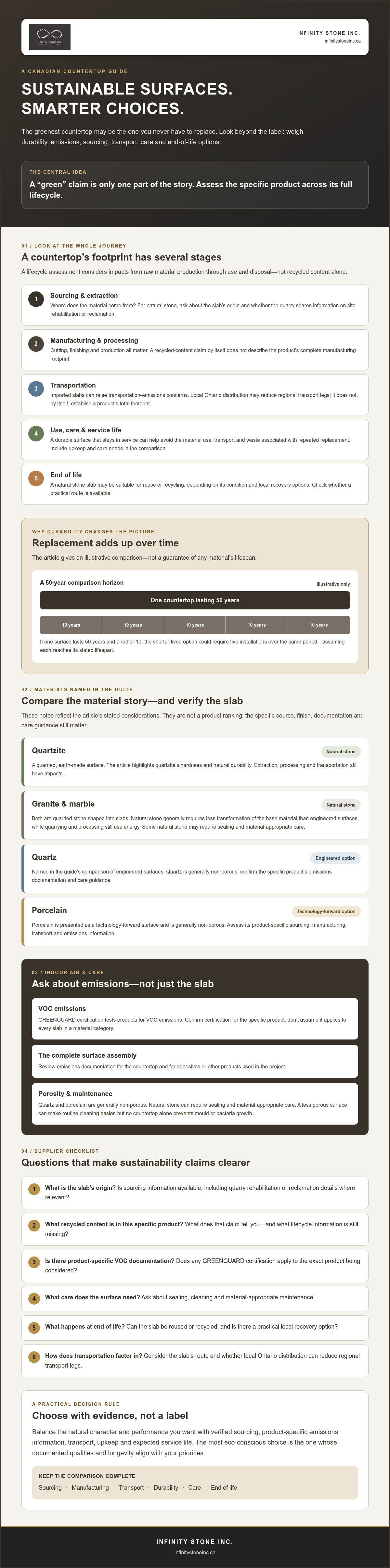
Durability is easy to overlook in sustainable design. A surface that resists everyday wear and remains desirable for decades can help avoid the material use, transport and waste associated with repeated replacement. If one countertop lasts 50 years and another lasts 10, the shorter-lived option could require five installations over the same period, assuming each reaches its stated lifespan. That comparison is illustrative, not a guarantee of any material’s service life.
For Canadians weighing eco-friendly countertop materials canada has to offer, consider the whole picture. Quartzite and granite are original earth-made materials, while porcelain offers a technology-forward option. Natural stone extraction and imported transport have environmental impacts, so permanence alone doesn’t tell the complete story. Ask for product-specific sourcing and lifecycle information where available.
The Lifecycle Assessment of Premium Stone Slabs
A lifecycle assessment, or LCA, examines impacts from quarrying or raw material production through processing, shipping, use and disposal. Stone processing involves cutting and finishing, and transport can add to its footprint. At end of life, a natural stone slab may be suitable for reuse or recycling, depending on its condition and local recovery options. Check whether a supplier or local waste program can identify a practical route.
This is a more complete standard than a simple recycled-content claim. A countertop with recycled inputs may still have a substantial manufacturing or transportation footprint, while a durable slab may reduce replacement waste over time. Compare evidence for the specific material and product, not just the category name.
Indoor Air Quality and GREENGUARD Certification
Outgassing is the release of compounds into indoor air from a material or the products used with it. In tightly sealed Canadian homes, ventilation may be limited, so low-emission choices can support indoor air quality. GREENGUARD certification tests products for VOC emissions, but certification should be confirmed for the specific product rather than assumed for every slab in a material category.
Surface porosity also matters, but it isn’t a substitute for good cleaning. Porcelain and quartz are generally non-porous; natural stone can require sealing and material-appropriate care. A less porous surface can make routine cleaning easier, but no countertop should be described as preventing mould or bacteria growth on its own. Review care guidance and emissions documentation for the complete surface assembly, including adhesives or other products used in the project.
The Timeless Sustainability of Natural Stone: Quartzite, Granite, and Marble
Quartzite, granite and marble are the original earth-made surfaces: quarried stone shaped into slabs rather than manufactured from a blend of ingredients. Their environmental value lies partly in this direct material story and partly in their potential to stay in service for decades. Natural stone still carries impacts from extraction, cutting and transportation, so durability is an advantage to weigh alongside responsible sourcing, not a claim that every slab is automatically sustainable.
Compared with engineered surfaces, natural stone generally requires less transformation of the base material, though quarrying and processing still use energy. Ask suppliers about the origin of a slab and whether the quarry provides information on site rehabilitation or reclamation. Practices vary, so don’t assume that modern standards apply uniformly. For broader project context, the Canada Green Building Council explains LEED certification; a stone selection alone doesn’t guarantee credits.
Quartzite: The Pinnacle of Natural Durability
Quartzite’s hardness makes it a compelling option for busy kitchens where a surface faces regular use. Its durability can help reduce the risk of premature replacement, while its natural veining offers a distinctive, enduring aesthetic. Heat and scratch resistance depend on the specific slab and how it’s used, so confirm care guidance rather than expecting a surface to remain untouched. Explore quartzite slabs as a long-lasting natural stone choice.
As a natural material, quartzite is not made by binding stone particles together with synthetic resin. Individual slabs may have repairs or treatments, however, so ask what has been applied to the slab you’re considering. That detail helps you assess its composition and maintenance needs with greater confidence.
Responsible Sourcing of Granite and Marble
Granite offers another durable, earth-made surface, while marble brings distinctive veining and a classic presence that can outlast short-lived design trends. Marble is more susceptible to etching and staining than some alternatives, making realistic care expectations essential to its longevity. Its appeal isn’t only decorative: choosing a design you’ll want to keep can help avoid renovations driven solely by changing fashions. See marble slabs for enduring design inspiration.
Slab selection also matters. Infinity Stone Inc. handpicks inventory for high density and durability, a selection approach that can help reduce defects and avoidable material waste during later fabrication by local fabricators. For Ontario homeowners comparing eco-friendly countertop materials canada offers, exploring carefully selected natural stone slabs is a practical next step.
Engineered Excellence: Assessing Quartz and Porcelain Slabs
Engineered surfaces offer a different sustainability profile from natural stone. Their performance and environmental impact depend on the materials and manufacturing behind each slab. Quartz surfaces combine mineral content with binders, and some manufacturers incorporate recycled materials. Porcelain is made from abundant natural ingredients and can be recyclable, but the energy used in production and transport still belongs in any lifecycle comparison. Look beyond the material category to product-specific documentation.
Porcelain Slabs: The Eco-Forward Choice
Large-format porcelain is a technology-forward option for contemporary kitchens and architectural interiors. It is typically made from clay, feldspar and quartz, then kiln-fired to create a dense, durable surface. Its composition and long service life can make it attractive for projects seeking material efficiency, while some manufacturers also incorporate recycled content. Recyclability and recycled-content claims vary by product, so confirm them with the manufacturer.
Porcelain is valued for resistance to UV exposure, which can make it suitable for designs that connect indoor and outdoor spaces. Check the technical information for the specific slab and intended application rather than assuming every product performs identically. For a closer look at material characteristics, see this guide to porcelain countertops.
Quartz Slabs and Modern Manufacturing
Quartz is not a uniform sustainability choice. These engineered slabs combine quartz mineral with binders, and their recycled content and emissions profile can differ by manufacturer and product. Some manufacturers report using recycled glass or other recovered materials, but a claim about one product shouldn’t be applied to every quartz slab. Ask for the exact product’s recycled-content and VOC documentation, and confirm whether any certification applies to that specific selection.
In 2026, terms such as “bio-resin” and “low-silica” may appear in conversations about evolving manufacturing. Treat them as claims to verify, not guarantees shared by all quartz surfaces. Request current technical documentation, including what the resin contains and how the product’s emissions are assessed. Quartz’s non-porous surface generally doesn’t require periodic sealing, which can reduce reliance on chemical sealants during routine care.
For eco-friendly countertop materials canada shoppers, compare durability and maintenance alongside recycled content. Infinity Stone Inc. specializes in large-format porcelain and distributes quartz slabs to local Ontario fabricators, reducing secondary transport legs within the region. Its Mississauga inventory provides a local point of comparison, while the slabs themselves are imported. Explore this overview of quartz slab suppliers in Mississauga and request product-specific evidence before weighing environmental claims.
A Comparison Framework for the Eco-Conscious Canadian Homeowner
Choose a countertop by weighing four factors together: expected service life, manufacturing and transport, maintenance, and end-of-life options. A locally distributed slab can reduce regional transport legs, but “local” doesn’t necessarily mean locally quarried. Compare the slab’s origin with its durability: a longer-lasting surface may avoid replacement even if it has travelled farther. For eco-friendly countertop materials canada homeowners are considering, product-specific details matter more than a simple green ranking.
The comparison below is a starting point, not a universal scorecard. Quarry practices, manufacturing, slab characteristics, care instructions and local reuse options all affect the result.
| Material | Durability and care | Sustainability considerations |
|---|---|---|
| Quartzite | Durable natural stone; care and sealing needs vary by slab. | Long service life can reduce replacement waste; consider quarrying and transport impacts. |
| Granite | Durable natural stone; follow slab-specific care guidance. | Earth-made material with potential for reuse; sourcing and shipping affect its footprint. |
| Quartz | Generally non-porous and doesn’t typically need sealing. | Recycled content varies by product; include manufacturing and binder information in your assessment. |
| Porcelain | Generally non-porous; check the manufacturer’s care instructions. | Made from abundant natural materials, with some products incorporating recycled content; assess production energy and transport. |
Maintenance and Chemical Impact
Care requirements aren’t identical across a material category. Some natural stone may need sealing, but the frequency depends on the specific slab and product guidance. Porcelain and quartz generally don’t require periodic sealing, though both still need routine cleaning. Start with soap and water if the manufacturer recommends it, and avoid harsh or abrasive cleaners unless the care instructions permit them. Simpler care can reduce reliance on specialized cleaning products and help protect the finish.
Recyclability and End-of-Life Considerations
A sound stone slab may find a second use as smaller tiles, a utility surface or a landscaping feature, depending on its condition, dimensions and local reuse options. Porcelain may also be recyclable, but recovery routes vary. Composite materials can be harder to separate into their component materials, so check local programs rather than assuming they’ll be diverted from landfill.
Materials that age gracefully can remain useful even as design preferences shift. Before choosing, ask what happens if the surface is removed: can it be reused, recycled or responsibly managed locally? For a closer look at available slab materials, explore quartzite, granite, quartz and porcelain slabs.
Sourcing Sustainable Slabs: The Infinity Stone Inc. Selection in Mississauga
A sustainable slab decision depends on more than material type. The specific slab’s quality, origin, expected service life and route to your project all matter. Infinity Stone Inc. is a Mississauga-based distributor serving Ontario with imported quartzite, quartz, granite, marble and porcelain slabs. Its local distribution point can reduce secondary transport legs to Ontario fabricators, although the slabs themselves are imported. That distinction helps homeowners and designers make a more informed sourcing comparison.
Handpicked Quality for Long-Term Value
Infinity Stone Inc. handpicks its inventory, selecting for high density and durability. A sound, carefully selected slab can support long-term use and help limit avoidable material waste. Slab quality alone can’t guarantee fewer breaks during fabrication: handling, design, fabrication methods and the characteristics of the individual slab also matter. Share your project requirements with your chosen fabricator, who can assess the material and plan its use. Read more about sourcing stone slabs in Ontario.
Viewing a slab in person, where viewing arrangements are available, helps you assess its colour, veining, pattern movement and any visible variation before making a selection. Those details can inform layout discussions with your fabricator and help align the chosen material with your design intent. Contact the supplier to confirm current inventory and whether in-person viewing is available before planning a visit.
Supporting the Local Design Ecosystem
A Mississauga distribution hub connects imported slabs with Ontario projects and local fabricators. Wholesale distribution can reduce additional regional transport legs compared with moving material through more distant distribution points. It doesn’t remove the emissions associated with quarrying, manufacturing or international shipping, so consider the full journey alongside expected service life.
For homeowners and designers comparing eco-friendly countertop materials canada can provide, the next step is to compare individual slabs, not just broad material categories. Ask your fabricator to review dimensions, intended use and layout so the selected material can be assessed for the project before fabrication. This helps connect design priorities with practical material planning without assuming every slab has the same qualities.
Explore Infinity Stone Inc.’s current selection of quartzite, quartz, granite, marble and porcelain slabs, then share your preferred options with your chosen fabricator. Confirm current inventory and viewing arrangements directly with the Mississauga distributor.
Choose a Surface Designed to Last
The strongest sustainability choice is one that balances a refined appearance with long service life, thoughtful maintenance and a clear understanding of sourcing. Quartzite and granite offer the permanence of natural stone; quartz and porcelain bring engineered performance, with recycled content and emissions varying by product. Compare the specific slab and its lifecycle details rather than relying on a material label alone.
For homeowners and designers assessing eco-friendly countertop materials canada offers, Infinity Stone Inc.’s handpicked imported inventory includes quartzite, granite, marble, quartz and porcelain slabs. Its Mississauga distribution hub serves Ontario and supplies local fabricators, helping reduce secondary regional transport legs. Designers and architects can also consider slab characteristics alongside project requirements when making a selection.
See colour, veining and pattern variation for yourself, then discuss your preferred material with your chosen fabricator. Browse premium, handpicked stone slabs at our Mississauga showroom and take the next step towards a distinctive surface made to serve your home for years to come.
Frequently Asked Questions
Which countertop material is considered the most eco-friendly in Canada?
There isn’t one countertop material that’s most eco-friendly for every Canadian home. The answer depends on its full lifecycle, including extraction or manufacturing, transport, expected lifespan, maintenance and end-of-life options. A durable natural stone slab may avoid replacement waste, while porcelain may offer recyclability and, in some products, recycled content. Compare product-specific environmental information and choose a surface that suits your household and is likely to remain in use.
Is natural stone more sustainable than engineered quartz?
Natural stone isn’t automatically more sustainable than engineered quartz. Quartzite and granite are earth-made materials, but quarrying, processing and transportation contribute to their environmental impact. Engineered quartz may contain recycled material, though its binders and manufacturing process also matter. For Ontario projects, compare the origin, product-specific recycled-content information, emissions documentation and expected service life of the actual slabs. A broad material label alone can’t establish which option has the lower lifecycle impact.
Do eco-friendly countertops require more maintenance?
Not necessarily; maintenance depends on the particular material and its care instructions. Some natural stone may need periodic sealing, while quartz and porcelain are generally non-porous and don’t typically require sealing. All surfaces need appropriate cleaning. Check the slab manufacturer’s guidance before choosing products, and use mild cleaning methods, such as soap and water, if recommended. This can help limit reliance on specialized chemicals while protecting the surface’s appearance and useful life.
What is the carbon footprint of importing stone slabs to Ontario?
There’s no single carbon-footprint figure for imported slabs arriving in Ontario. The impact depends on factors such as the quarry or manufacturing location, distance travelled, transport mode, shipment details and regional delivery. Ask for origin and transportation information if it’s available, then consider the slab’s expected lifespan as part of the comparison. A Mississauga distribution hub can reduce secondary transport legs to Ontario fabricators, but it doesn’t eliminate emissions from international shipping.
Can stone countertops be recycled at the end of their life?
Stone slabs may be reused or repurposed if their condition, dimensions and local options allow. For example, an intact section could potentially become a smaller surface, tile or landscaping feature. These outcomes aren’t guaranteed, and recycling or reuse availability varies by community and project. Before choosing a slab, ask your fabricator about offcuts and check local reuse or waste programs. Planning for a second use can keep a durable material in service longer.
Are there specific certifications I should look for in sustainable stone?
Look for documentation that addresses the environmental concern you want to verify, and confirm it applies to the specific product. GREENGUARD certification assesses VOC emissions, which is relevant to indoor air quality. Cradle to Cradle evaluates product lifecycle considerations, while LEED is a building certification system where eligible material attributes may contribute to project credits. Don’t assume a stone category or supplier is certified; request current product-level evidence and confirm applicable requirements with your project team.
Is porcelain more eco-friendly than granite?
Not in every case. Porcelain is made from natural materials and may be recyclable, while some manufacturers incorporate recycled content. Granite is a natural, durable material that may remain in use for a long time or be reused. Each also has impacts from production, extraction and transportation. Compare the specific slab’s sourcing, manufacturing information, expected service life and end-of-life options, rather than treating either porcelain or granite as an automatic environmental winner.
How does the durability of a material affect its environmental impact?
A durable countertop can reduce the need for replacement, which may avoid future material production, transport and renovation waste. Its benefit depends on lasting performance in the home and on how it’s maintained; durability doesn’t erase impacts from extraction or manufacturing. Compare realistic care requirements and product information, not just hardness claims. For Ontario homeowners choosing eco-friendly countertop materials canada can offer, a surface that suits daily use and enduring design preferences may support a longer service life.


