

The most expensive quartz slab in the showroom isn't always the highest performing. While many designers select a surface based on a pocket-sized sample, the reality of a full-scale installation often reveals unexpected pattern repetitions or technical inconsistencies. Understanding how to choose the right quartz slab requires a move beyond simple colour matching into the realm of material science and architectural intent.
You likely feel the pressure to get this high-stakes investment right, especially when faced with conflicting brand claims, varying resin ratios, and the fear of a pattern looking different once installed in your kitchen or bath. This guide provides the clarity needed to master the selection process, ensuring your chosen surface balances sophisticated aesthetic rhythm with industrial-grade durability. We will examine the critical technical markers, from 3 cm thickness standards to full-body veining, and explore the 2026 shift toward warmer neutrals like creamy ivory and greige. By the end of this analysis, you'll have the confidence to select a material that serves as a foundational element for your luxury interior project in the GTA.
Key Takeaways
- Understand the critical 90-93% natural quartz composition and how specific resin ratios dictate long-term resistance to UV discolouration and thermal shock.
- Learn to evaluate aesthetic rhythm by analyzing full-slab veining patterns to ensure a natural, non-repetitive flow that mimics the organic beauty of natural stone.
- Master how to choose the right quartz slab by selecting appropriate architectural thicknesses, such as 3cm for classic durability or 2cm for modern vertical cladding.
- Conduct a professional showroom audit in Mississauga to identify technical imperfections like resin pools or surface pits that remain invisible in small 2x2 hand samples.
- Recognize the importance of sourcing from specialized distributors who curate high-tier inventory specifically for the luxury standards of the Ontario market.
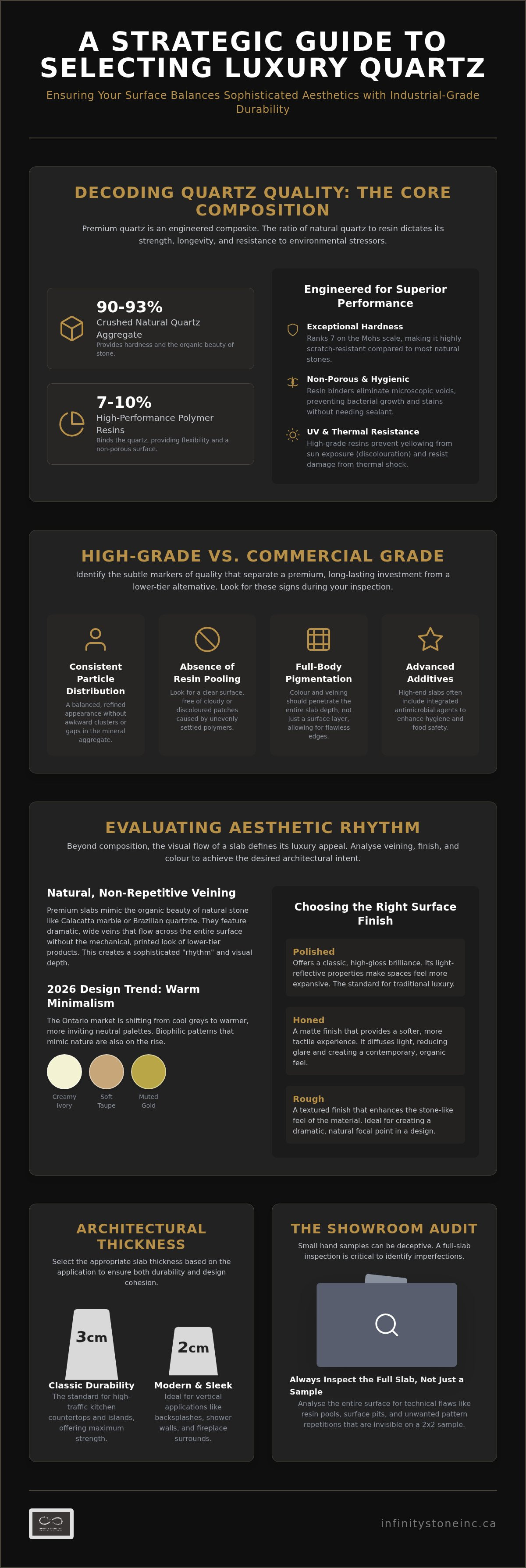
Decoding Quartz Quality: Composition and Resin Ratios
Premium quartz slabs isn't merely aesthetic surfaces; they are highly engineered composites. A top-tier slab typically consists of 90% to 93% crushed natural quartz aggregate bound together by 7% to 10% high-performance polymer resins. This specific Engineered Stone Composition ensures the material retains the hardness of stone while gaining the flexibility and stain resistance of modern polymers. When researching how to choose the right quartz slab, you must look beyond the surface pattern to the chemical integrity of the material itself.
Resin quality determines how a slab reacts to environmental stressors. High-grade resins offer superior resistance to UV discolouration and thermal shock, whereas inferior polymers may yellow or crack over time. The manufacturing process is equally critical. Industry leaders utilize Bretonstone technology, a high-pressure vacuum vibration method that eliminates air pockets and creates a dense, uniform structure. Lower-tier manufacturers often skip these rigorous steps, resulting in slabs that are more prone to chipping and internal structural failure.
The Science of Engineered Durability
The primary advantage of premium quartz lies in its non-porous surface. Unlike natural marble or granite, engineered quartz doesn't require sealing because the resin fills every microscopic void. This prevents bacterial growth and makes the surface exceptionally hygienic for high-traffic kitchen applications. On the Mohs hardness scale, premium quartz typically ranks at a 7, making it significantly more scratch-resistant than most natural stones. High-end slabs also incorporate advanced pigments that ensure colour consistency through the entire thickness, allowing for beautiful mitered edges and visible profiles.
Recognizing High-Grade vs. Commercial Grade
Distinguishing between professional-grade materials and commercial "builder-grade" options is essential when learning how to choose the right quartz slab. Commercial slabs often exhibit technical flaws that compromise both aesthetics and longevity. Look for the following markers of quality during your inspection:
- Consistent Particle Size: Refined slabs feature a balanced distribution of minerals without awkward clusters or gaps.
- Absence of Resin Pooling: Lower-tier slabs often show cloudy patches where the polymer has settled unevenly.
- Antimicrobial Additives: High-end slabs frequently include integrated agents to enhance food safety.
- Full-Body Pigmentation: The colour and veining should penetrate the entire slab, not just the surface layer.
While wholesale price points may seem attractive, they frequently reflect higher filler content or lower-quality resins. These shortcuts compromise the long-term investment of your Ontario home, leading to surfaces that lose their lustre or sustain permanent damage from standard household heat. Choosing a curated slab from a specialized distributor ensures the technical grade matches the visual sophistication of your design.
Evaluating Aesthetic Rhythm: Veining, Colour, and Finish
The visual success of a luxury kitchen or bath depends on the "rhythm" of the surface. When you are learning how to choose the right quartz slab, you must analyze how the pattern moves across a full 120-inch span. Premium engineering now allows for dramatic, wide-vein Calacatta styles that avoid the mechanical repetition found in lower-tier products. These high-end slabs utilize multi-tonal base colours to create depth, ensuring the surface looks like a natural geological formation rather than a printed image.
Surface finish further refines the aesthetic. A polished finish offers classic brilliance and light-reflective properties that can make a smaller Ontario kitchen feel more expansive. However, many contemporary projects now utilize honed or rough finishes. These matte textures provide a softer, more tactile experience that diffuses light, making them ideal for spaces with heavy natural glare or for those seeking a more organic, stone-like feel underfoot or on countertops.
2026 Design Trends for Ontario Luxury Interiors
The GTA market is transitioning toward "warm minimalist" palettes. This shift replaces cool greys with creamy ivories, soft taupes, and muted golds. We are also seeing a rise in biophilic patterns that mimic the intricate, flowing veining of rare Brazilian quartzite. Designers often recommend incorporating stone slabs with bold, contrasting pigments to anchor feature islands and create a focal point within open-concept layouts. To truly appreciate these nuances, you should examine full-scale quartz slabs in a professional showroom setting.
Lighting and Colour Metamerism
Ontario's geographic location means natural light changes drastically throughout the day and by room orientation. Northern exposure provides a consistent but cool light that can pull out blue or green undertones in a slab. Southern exposure is warmer and more intense, potentially over-emphasizing yellow hues. LED colour temperature also plays a critical role. A slab that looks perfect under 3000K (warm white) showroom lights may appear entirely different under 4000K (cool white) task lighting. Always evaluate your selected material under both natural and artificial light sources to ensure the undertones remain consistent with your existing cabinetry and flooring.
Technical Specifications: Thickness and Slab Dimensions
Technical specifications dictate the structural success of your installation. While aesthetic rhythm is vital, dimensions determine the physical limits of your design. Most professional distributors offer two standard thicknesses: 2 cm (3/4 inch) and 3 cm (1 1/4 inches). Understanding the functional differences between these profiles is a core part of learning how to choose the right quartz slab for specific architectural applications. 2 cm slabs are the preferred choice for vertical cladding, shower surrounds, and modern, minimalist countertop profiles that prioritize a sleek, thin appearance. Conversely, 3 cm slabs represent the pinnacle of classic luxury, offering superior structural integrity for expansive kitchen islands and high-traffic surfaces.
Slab dimensions directly influence the visual continuity of your project. Standard slabs typically measure 120 inches by 55 to 56 inches. However, the growing demand for oversized kitchen islands in Mississauga has led to the rise of "Jumbo" slabs. These larger formats, often 126 inches by 63 inches, allow for seamless installations on islands that would otherwise require a joint. By prioritizing slab size during the selection process, you ensure a sophisticated finish that maintains the integrity of the pattern across the entire room.
Choosing the Right Thickness for Your Project
Weight considerations are paramount when selecting 3 cm materials. A standard 3 cm slab is significantly heavier than its 2 cm counterpart, requiring reinforced cabinetry and, in some heritage Ontario homes, an assessment of floor joist capacity. However, the additional mass allows for more intricate decorative edge profiles, such as a deep Ogee or a full Bullnose, which are difficult to achieve on thinner materials. While 2 cm slabs may have a lower material cost, they often require mitered edges to appear thicker, which can increase fabrication complexity and labour costs. Balancing material volume with these fabrication requirements is essential for a high-performance result.
Maximizing Yield and Minimizing Seams
Calculating your yield involves more than just square footage; you must account for pattern direction and waste from sink or cooktop cutouts. When you evaluate how to choose the right quartz slab, consider how the veining will transition at the seams. While engineered quartz is inherently consistent, some high-end manufacturers now offer book-matched pairs. These mirrored slabs are essential for creating symmetrical feature walls or continuous veining across a waterfall edge. Ensuring you have enough material from the same production batch is the only way to guarantee that the base colour and aggregate size remain perfectly uniform across multiple surfaces in your home.
The Showroom Audit: Inspecting Slabs in Person
Selecting a surface based on a 2x2-inch hand sample is a common mistake that often leads to disappointment. These small tiles cannot convey the sweeping movement of a large-scale vein or the subtle shifts in base colour across a 120-inch slab. When you're mastering how to choose the right quartz slab, the showroom audit is your most powerful tool. This phase allows you to verify dye-lot consistency, which is vital if your project requires multiple slabs. Even within engineered stone production, slight variances in mineral batches can occur. Tag your specific slabs.
Conduct a forensic inspection of the material. While premium manufacturing is precise, rare imperfections like resin pools (cloudy clusters of polymer) or surface pits can occasionally appear. These aren't just aesthetic flaws; they can indicate uneven material density. Understanding how to choose the right quartz slab involves identifying these markers before the material reaches your fabricator. Your distributor acts as a curator, ensuring only high-tier materials are available for selection, but your final approval provides the ultimate confidence in your investment.
What to Bring to Your Selection Appointment
Preparation ensures your choice harmonizes with your existing interior palette. Bring physical samples of your cabinetry finishes, flooring, and paint swatches to place directly against the slab. A high-powered flashlight is an essential tool for this appointment; use it to cast light across the surface at an angle. This technique reveals "ghosting" or micro-scratches that remain invisible under standard warehouse lighting. Check for resin pools. Finally, have your floor plan ready to visualize where seams will fall in relation to the slab's pattern movement.
Evaluating the "Hand" and Texture
Tactile quality is as important as visual appeal. Run your hand across the slab to detect micro-fissures or uneven polishing that could affect the final installation. If you're considering a matte or leathered finish, test for fingerprint resistance and ease of cleaning. Consulting with an expert quartz slab supplier in Mississauga will provide specific insights into how different brands perform under daily use. To secure the perfect material for your next project, view our curated slab inventory in person at our showroom.
Sourcing for Longevity: Why Distributor Selection Matters
The final pillar in mastering how to choose the right quartz slab is selecting a distributor that understands the technical and aesthetic demands of the luxury market. Big-box retailers typically prioritize high-volume, commodity-grade materials that may lack the refined veining or resin integrity found in premium collections. In contrast, a boutique distributor focuses on curated excellence. This distinction ensures your investment is protected by high-tier manufacturing standards and manufacturer-backed warranties that cover structural defects and UV stability. The logistical journey from global quarry to a Mississauga warehouse requires professional handling to prevent micro-fissures that can compromise a slab during the fabrication process.
Infinity Stone Inc. curates its inventory specifically for the Ontario market, bridging the gap between international innovation and local design sensibilities. By focusing strictly on material supply, a specialized distributor maintains a neutral, expert perspective on brand performance. This "Material First" approach allows homeowners and designers to prioritize the foundational element of the room before committing to specific fabrication details. When you understand how to choose the right quartz slab, you recognize that the source is just as important as the stone itself.
The Importance of Regional Expertise
Mississauga has established itself as the central hub for premium stone distribution in the GTA. Accessing a local showroom allows for a streamlined relationship between the supplier, your chosen fabricator, and your design team. This proximity is essential for coordinating the physical movement of slabs and ensuring that the material you tagged in person is exactly what arrives at the shop. Regional experts also understand the specific environmental factors in Ontario, such as the impact of seasonal light shifts on slab undertones, which we explored in previous sections.
Finalizing Your Selection
Once you have identified the ideal material, the "Hold" process becomes your primary safeguard. This ensures your specific slabs, with their unique veining and dye-lot numbers, are secured for your project while you finalize your cabinetry and layout. Before signing off, review the technical data sheets for your specific brand. These documents provide essential data on heat resistance, chemical sensitivity, and resin ratios. This technical transparency is the hallmark of a high-end distributor. To realize your design vision and experience the tactile quality of our curated inventory, visit the Infinity Stone showroom in Mississauga to finalize your selection.
Elevating Your Architectural Vision with Premium Quartz
Selecting the ideal surface for a luxury Ontario home requires a meticulous balance of technical auditing and aesthetic rhythm. You've learned that composition, specifically the 90-93% natural quartz ratio, dictates the slab’s long-term resistance to UV discolouration. We've explored how 3 cm architectural-grade materials provide the structural integrity needed for expansive Mississauga kitchen islands. Understanding how to choose the right quartz slab transforms a standard renovation into a high-end architectural statement.
As direct importers of world-class stone with specialized GTA distribution since 2017, we provide the foundational elements for sophisticated living. A forensic showroom inspection remains the only way to verify dye-lot consistency and surface perfection. Our curated inventory satisfies the rigorous technical requirements of architects while meeting the aesthetic sensibilities of top decorators. Secure your material early.
Explore our curated collection of premium quartz slabs at our Mississauga showroom to realize your design vision. Your journey toward a durable, low-maintenance, and visually stunning interior starts with a single, well-informed selection.
Frequently Asked Questions
Is there a difference in quality between different quartz brands?
Quality varies significantly based on manufacturing technology and resin-to-quartz ratios. Premium slabs utilize high-pressure vacuum vibration to eliminate internal porosity. Lower-tier commercial grades often contain higher filler content and inferior resins. These shortcuts result in surfaces more prone to chipping and thermal shock. Researching the brand’s technical specifications is a critical step in learning how to choose the right quartz slab for a long-term residential investment.
Can I use quartz for an outdoor kitchen in the Ontario climate?
Standard quartz slabs aren't suitable for outdoor applications in the Ontario climate. The polymer resins used in engineered stone are sensitive to UV radiation, which causes yellowing and surface degradation over time. Additionally, Ontario's extreme temperature fluctuations can lead to cracking. For outdoor kitchens in the GTA, we recommend exploring porcelain slabs or specific natural stones that possess higher resistance to direct sunlight and freeze-thaw cycles.
How do I know if a quartz slab is 2cm or 3cm thick?
You can distinguish thickness by measuring the edge profile of the material. A 2 cm slab measures approximately 3/4 of an inch, while a 3 cm slab is roughly 1 1/4 inches thick. While 2 cm is ideal for vertical applications like backsplashes, 3 cm is the standard for high-end kitchen islands due to its superior structural strength. Professional showrooms in Mississauga always display slabs vertically so you can easily inspect these technical dimensions.
Will quartz slabs stain if I spill red wine or coffee?
Quartz is exceptionally resistant to staining because it's non-porous. Spills from red wine, coffee, or oils won't penetrate the surface if wiped away promptly. However, permanent markers or high-pH chemicals can cause surface discolouration if left to sit. To maintain the pristine appearance of your slab, avoid abrasive cleaners and use a simple solution of mild soap and water for daily maintenance in your kitchen or bathroom.
What is the best finish for a high-traffic kitchen island?
Polished finishes remain the most practical choice for high-traffic kitchen islands. This smooth surface provides maximum stain resistance and is the easiest to sanitize. While honed and matte finishes are trending for 2026, they require more frequent cleaning to manage fingerprints and water spots. If you prefer a tactile, organic feel, consider a leathered finish which offers a sophisticated texture while hiding micro-scratches better than traditional high-gloss options.
Do I need to seal my quartz slab after it is installed?
You don't need to seal quartz slabs after installation. The engineering process integrates polymer resins into the quartz aggregate, creating a permanent, non-porous barrier. Applying a stone sealer to quartz is actually counterproductive; the liquid cannot penetrate the surface and will merely sit on top, creating a cloudy, unattractive film. This maintenance-free characteristic is a primary reason homeowners prioritize quartz for busy residential spaces throughout Ontario.
How do I coordinate my quartz slab with my backsplash tile?
Coordination requires matching the undertones of both materials under consistent lighting. Bring your physical backsplash tiles to the showroom to view them against the full-scale quartz slab. If your slab features dramatic Calacatta veining, choose a subtle, monochromatic tile to avoid visual clutter. Conversely, a "salt and pepper" quartz pattern pairs beautifully with a bold, geometric backsplash tile. This synergy is essential when deciding how to choose the right quartz slab.
Can I see the exact slab I am buying before it is cut?
Seeing the exact slab before it's cut is a mandatory step for any luxury project. Hand samples are too small to represent the full movement of the veining or the unique distribution of the aggregate. At our Mississauga warehouse, we encourage clients to view and tag their specific slabs in person. This ensures there are no surprises regarding pattern repetition or dye-lot consistency once the material arrives at your home for installation.


